⚡ Wire Gauge Calculator for 120V Circuits
Find the correct AWG wire size for any 120V circuit — enter amperage, run length & conductor material for NEC-compliant results
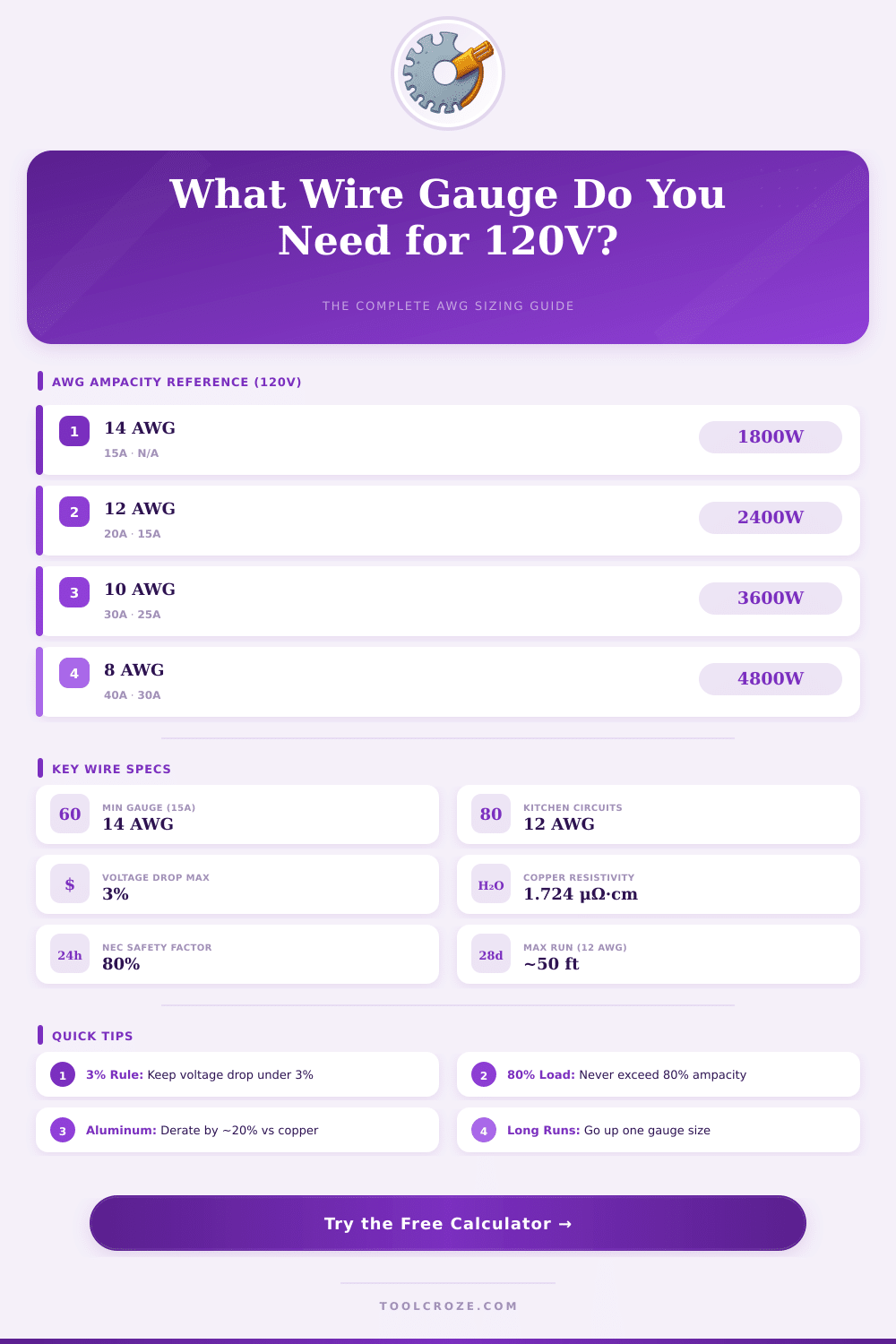
| AWG / kcmil | Cu 60°C (A) | Cu 75°C (A) | Cu 90°C (A) | Al 75°C (A) | Dia. (in) | Ω/1000ft |
|---|---|---|---|---|---|---|
| 14 AWG | 15 | 20 | 25 | — | 0.064 | 2.525 |
| 12 AWG | 20 | 25 | 30 | 20 | 0.081 | 1.588 |
| 10 AWG | 30 | 35 | 40 | 30 | 0.102 | 0.999 |
| 8 AWG | 40 | 50 | 55 | 40 | 0.128 | 0.628 |
| 6 AWG | 55 | 65 | 75 | 50 | 0.162 | 0.395 |
| 4 AWG | 70 | 85 | 95 | 65 | 0.204 | 0.248 |
| 3 AWG | 85 | 100 | 110 | 75 | 0.229 | 0.197 |
| 2 AWG | 95 | 115 | 130 | 90 | 0.258 | 0.156 |
| 1 AWG | 110 | 130 | 150 | 100 | 0.289 | 0.124 |
| 1/0 AWG | 125 | 150 | 170 | 120 | 0.325 | 0.098 |
| AWG | 10A / 25ft | 15A / 25ft | 20A / 50ft | 20A / 100ft | 30A / 50ft | Max Run (20A, 3%) |
|---|---|---|---|---|---|---|
| 14 AWG | 1.26V (1.1%) | 1.89V (1.6%) | 5.04V (4.2%) | 10.1V (8.4%) | — | ~29 ft |
| 12 AWG | 0.79V (0.7%) | 1.19V (1.0%) | 3.18V (2.6%) | 6.35V (5.3%) | 4.76V (4.0%) | ~46 ft |
| 10 AWG | 0.50V (0.4%) | 0.75V (0.6%) | 2.00V (1.7%) | 3.99V (3.3%) | 3.00V (2.5%) | ~73 ft |
| 8 AWG | 0.31V (0.3%) | 0.47V (0.4%) | 1.26V (1.0%) | 2.51V (2.1%) | 1.88V (1.6%) | ~116 ft |
| 6 AWG | 0.20V (0.2%) | 0.29V (0.2%) | 0.79V (0.7%) | 1.58V (1.3%) | 1.18V (1.0%) | ~185 ft |
| Wire Type | Temp Rating | Voltage | Common AWG | Typical Use | Wet Location? |
|---|---|---|---|---|---|
| NM-B (Romex) | 60°C | 600V | 14, 12, 10 | Dry indoor residential | No |
| UF-B | 60°C | 600V | 14, 12, 10 | Underground, outdoor | Yes |
| THHN | 90°C dry | 600V | 14–4/0 | Conduit, dry locations | No |
| THWN-2 | 75°C wet/90°C dry | 600V | 14–4/0 | Conduit, wet locations | Yes |
| XHHW-2 | 90°C wet/dry | 600V | 14–2000kcmil | Conduit, service entrance | Yes |
| MC Cable | 75°C | 600V | 14–1 | Commercial, exposed runs | No |
| SER (AL) | 75°C | 600V | 4–2/0 AL | Service entrance cable | No |
| Application | Typical Load | Min AWG (Cu) | Breaker Size | Max Outlets | Notes |
|---|---|---|---|---|---|
| General Lighting | 8–12A | 14 AWG | 15A | 12 | NEC 210.11(A) |
| General Outlet | 12–16A | 12 AWG | 20A | 10 | Standard branch |
| Kitchen Counter | 15–20A | 12 AWG | 20A | 2 ded. circuits | NEC 210.52(B) |
| Bathroom | 15–20A | 12 AWG | 20A | 1 ded. circuit | GFCI required |
| Refrigerator | 6–8A | 12 AWG | 20A | Dedicated | NEC 210.52(B)(1) |
| Microwave | 10–15A | 12 AWG | 20A | Dedicated | 1500W typical |
| Dishwasher | 8–12A | 12 AWG | 20A | Dedicated | GFCI required |
| Garage Workshop | 15–30A | 10 AWG | 30A | Varies | GFCI at outlets |
| Space Heater | 12–15A | 12 AWG | 20A | Dedicated preferred | 1500W = 12.5A |
| EV Level 1 | 12–16A | 12 AWG | 20A | Dedicated | GFCI recommended |
The wire gauge is simply the size of the wire. The number of the wire gauge shows the diameter of it, and everything depends on that, whether it can bear enough electrical flow without dangerous overheating. It does not matter whether you deal with copper or aluminium the wire gauge relates to the cross area of that lead.
Here is everything that commonly confuses folks: the system works backwards. When the wire gauge number is lower, the wire itself is thicker. Like this, 18 wire gauge wire is broader than 20 wire gauge; so the 20 wire gauge is the smaller one.
What Wire Gauge Means and How to Measure It
It seems unlikely, and probably because of that many folks mix it up the first time they meet it.
In North America one uses the American system of wire gauge ratings (AWG) to measure wires. It exists from around 1857 and follows the standard ASTM B 258. Rather than simple direct measure in inches or millimeters, AWG assigns to every size its own number.
Interesting about it is the logarithmic base, there really is math behind those steps. The diameter of wire almost doubles every six wire gauge steps, which helps to recall relations between various sizes when one counts them quiclky.
Even so AWG is not the only wire gauge system. The United Kingdom used the Standard Wire Gauge (SWG), that some countries still apply. There is also the metric method, that simply measures the cross area by means of square millimeters.
Various industries even created there own wire gauge ratings based on what they work with.
When you really need to find the wire gauge of wire, you have some options. There are physical tools for measuring, like disks. Usually round or sometimes oval…
With slots around the edge. Every slot has a stamped number, and you simply fit the wire until it fits in one of them. Some of those tools cover different metals, like copper, brass or aluminium.
Maybe you find two-part aluminium tools that cover different ranges. Otherwise one can use calipers to measure the diameter yourself. For instance, 8 AWG wire has around 0.1285 inches, while 10 AWG is about 0.1019 inches.
The real way to produce wire is also quite wonderful. One draws the metal through a plate, that shrinks it a bit more every time… Basically cold pressure, that one repeats many times.
Most AWG wire gauge ratings that you will see deal with copper wires. The resistance of copper at room temperature (20 degrees Celsius) varies a bit based on purity and making method. The smaller the wire, the higher the wire gauge number grows and the more the electrical resistance.
Standard USB cable, for sample, stores 28 AWG copper or steel wires for energy and data. Wires in coverings usually have letter codes stamped on them, THHN, XHHW, THW (that show the material), wire gauge and voltage limit based onthe National Electrical Code.