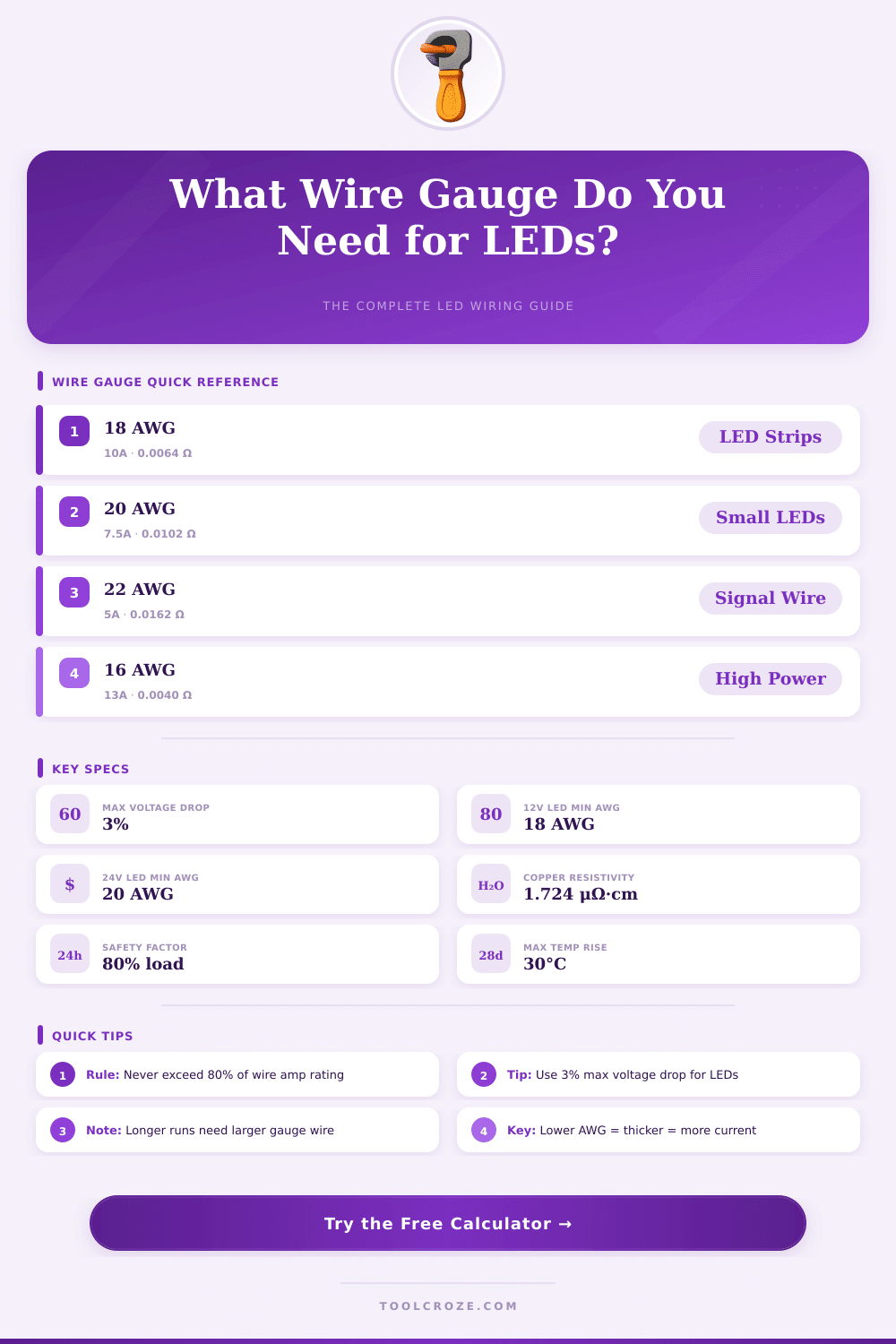
💡 LED Wire Gauge Calculator
Find the correct wire size for LED strips, fixtures, and lighting systems — enter your voltage, current, and run length for instant results.
| AWG | Diameter (mm) | Area (mm²) | Resistance (Ω/100ft) | Max Amps (Free Air) | Typical LED Use |
|---|---|---|---|---|---|
| 10 AWG | 2.588 | 5.26 | 0.100 | 30A | Main power feed, large systems |
| 12 AWG | 2.053 | 3.31 | 0.159 | 20A | High-power commercial LED |
| 14 AWG | 1.628 | 2.08 | 0.253 | 15A | Long runs 24V high power |
| 16 AWG | 1.291 | 1.31 | 0.402 | 13A | Medium LED strips, 24V systems |
| 18 AWG | 1.024 | 0.823 | 0.639 | 10A | Standard 12V/24V LED strips |
| 20 AWG | 0.812 | 0.518 | 1.015 | 7.5A | Short 12V strips, RGB data |
| 22 AWG | 0.644 | 0.324 | 1.614 | 5A | Low-power accent lighting |
| 24 AWG | 0.511 | 0.205 | 2.567 | 3.5A | Signal wires, very short runs |
| 26 AWG | 0.405 | 0.129 | 4.081 | 2.2A | Data/signal only |
| 28 AWG | 0.321 | 0.0810 | 6.490 | 0.83A | Micro LED, signal |
| AWG | 10 ft (3 m) | 20 ft (6 m) | 30 ft (9 m) | 50 ft (15 m) | Pass/Fail @ 3% |
|---|---|---|---|---|---|
| 12 AWG | 0.16V (1.3%) | 0.32V (2.7%) | 0.48V (4.0%) | 0.80V (6.7%) | ✔ ≤20ft |
| 14 AWG | 0.25V (2.1%) | 0.51V (4.2%) | 0.76V (6.3%) | 1.27V (10.6%) | ✔ ≤15ft |
| 16 AWG | 0.40V (3.3%) | 0.80V (6.7%) | 1.21V (10.0%) | 2.01V (16.8%) | ✔ ≤8ft |
| 18 AWG | 0.64V (5.3%) | 1.28V (10.6%) | 1.92V (16.0%) | 3.19V (26.6%) | ⚠ ≤5ft |
| 20 AWG | 1.02V (8.4%) | 2.03V (16.9%) | 3.05V (25.4%) | — | ❌ Too small |
| Metric (mm²) | AWG Equivalent | Max Amps | Resistance (Ω/100m) | Common Application |
|---|---|---|---|---|
| 6.0 mm² | ≈10 AWG | 32A | 0.315 | Main DC feed |
| 4.0 mm² | ≈12 AWG | 25A | 0.473 | High-power LED |
| 2.5 mm² | ≈14 AWG | 18A | 0.750 | Commercial strips |
| 1.5 mm² | ≈16 AWG | 13A | 1.24 | Standard LED runs |
| 1.0 mm² | ≈18 AWG | 10A | 1.83 | 12V/24V LED strips |
| 0.75 mm² | ≈20 AWG | 7A | 2.44 | Short LED runs |
| 0.5 mm² | ≈20-22 AWG | 5A | 3.66 | Low power accent |
| 0.35 mm² | ≈22 AWG | 3A | 5.24 | Signal & data |
| Project Type | Voltage | Typical Current | Recommended AWG | Notes |
|---|---|---|---|---|
| Under-cabinet strips | 12V | 2–5A | 18 AWG | Up to 10ft run |
| Bedroom accent strip | 12V | 1–3A | 20 AWG | Up to 8ft run |
| Landscape path lights | 12V | 5–10A | 14–16 AWG | 20–50ft typical |
| Commercial LED sign | 24V | 10–20A | 12 AWG | Long runs common |
| Automotive interior | 12V | 2–8A | 18 AWG | Short runs |
| Grow light setup | 24V | 5–15A | 14–16 AWG | Check derating |
| RGB LED controller | 12–24V | 3–6A/ch | 18 AWG per ch | Each color channel |
| High bay warehouse | 48V | 5–15A | 12–14 AWG | Long feeder runs |
Choosing the right size for LED wire seems easy, until you genuinely start to involve yourself with it. The American system of wire sizes, AWG for short, shows the sizes of wires, and here is the spot: a low number of AWG means thicker wire. That thicker wire is able to bear bigger power that flows through it.
Well does this choice genuinely matter, because it separates good and well working use of that, that will cause problems later.
How to Choose the Right Wire Size for LED Lights
Two things affect the decision about size: how many amps your LEDs consume and how far long the wire must extend. The longer the distances from the power source to the LED strips the bigger must be the size to make up for the voltage drop. This voltage drop should not pass 3 percent between the power source and the place, where the LEDs sit.
Worth noting, that both the positive and the ground wire experience this drop likewise, because both bear the same electricity.
For the most common home LED setups with short distances and small power needs, LED wire of 20 to 22 AWG well bears low-power tasks, if it does not pass ten feet. If you consume under two or three amps and the way is shorter than ten feet, then 18 to 20 AWG should work without problems. During setup of LED general lighting or similar low-voltage devices, commonly one uses insulated 18-2 or 16-2 cable, according to the needs of the wire way.
Here it becomes interesting. Smaller diameter of wire causes bigger resistance, what limits the skill to bare electricity over any distance. The advantage?
Almost never wrong to use thicker wire than strictly needed. If there is doubt about the real load, then choosing thicker wire always is the safer choice.
For wire ways that consume around ten amps, 16 AWG reaches the ideal minimum. At a load of only five amps, 18 AWG works for the task. Some wires of LED strips and their connections already use 18 or 20 AWG, so simply matching the size with that of the pigtail of the device is good for ways under twenty feet.
Two-conductor LED wire of 18 AWG well works for connecting single-color 24V LED light to the power.
When the ways become longer, you need more careful planning. If you extend 50 feet of 16 AWG, then maybe you only can use even strips, before the voltage drop becomes the main trouble. For 10-amp DC load in 12 volts with total wire length of five metres, something around 12 AWG usually keeps the situation under control.
Copper LED wire of 12 AWG keeps the voltage drop under three percent, while 14 AWG reaches right the limit, more near 3.5 to 4 percent loss. Spreading the power each metre or so along long strips helps to escape the dimming, that you would notice at the far end.
LED lighting consumes much less electricity compared to old bulbs. If you lay LED lighting on a normal 15-amp circuit with 14 AWG wire, then overload becomes almost impossible. The choice ofwire always must depend on the current demands of your total loads.