🔧 Hydraulic Cylinder Bore Size Calculator
Calculate bore diameter, rod size, flow rate, and cylinder force for any hydraulic application
| Bore (in) | Bore (mm) | Extend Force (lbf) | Extend Force (kN) | Rod Side Area (in²) | Std Rod Size (in) |
|---|---|---|---|---|---|
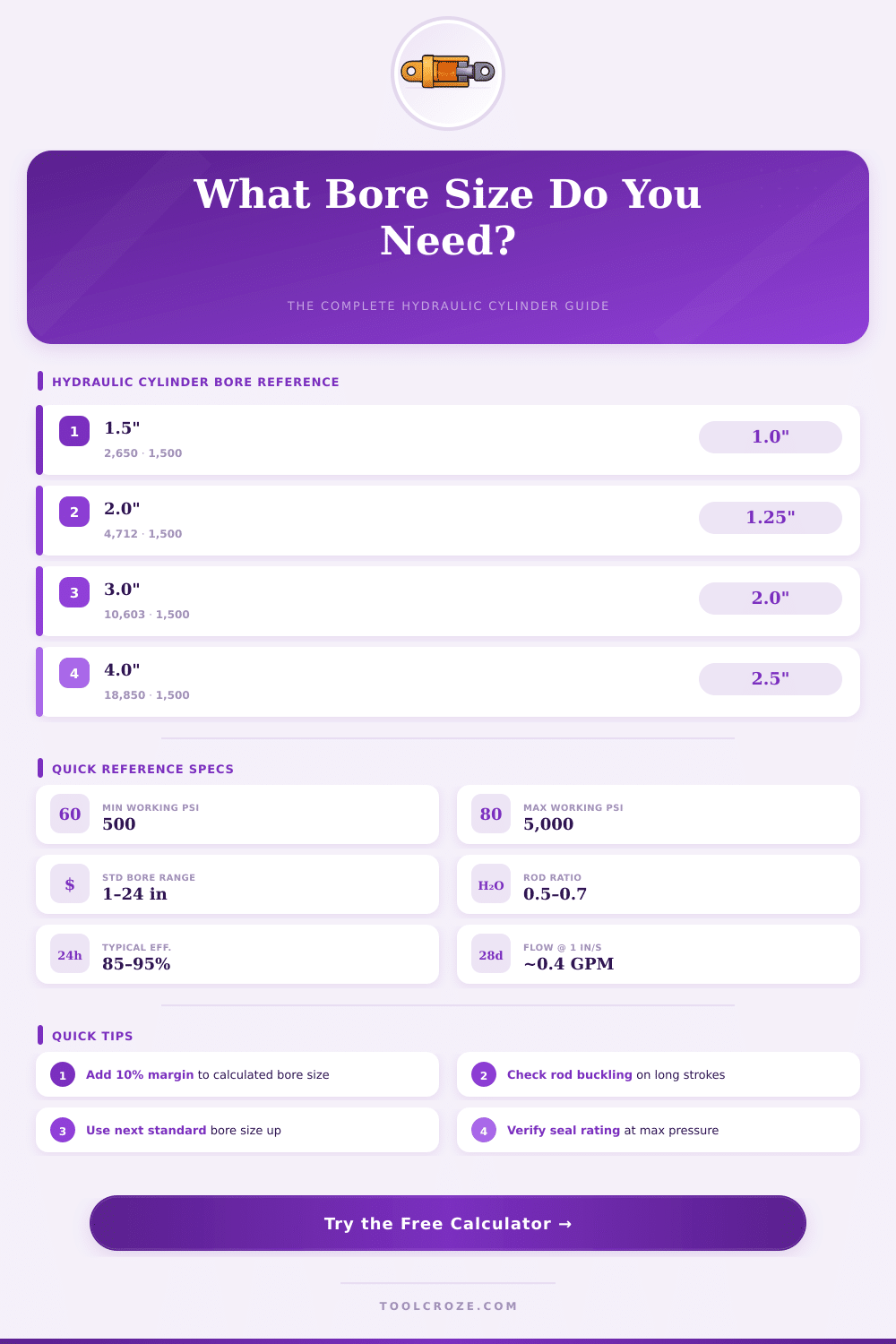
| 1.5 | 38.1 | 3,534 | 15.7 | 1.37 | 1.0 |
| 2.0 | 50.8 | 6,283 | 27.9 | 2.95 | 1.25 |
| 2.5 | 63.5 | 9,817 | 43.7 | 5.00 | 1.5 |
| 3.0 | 76.2 | 14,137 | 62.9 | 7.95 | 2.0 |
| 3.5 | 88.9 | 19,242 | 85.6 | 11.28 | 2.25 |
| 4.0 | 101.6 | 25,133 | 111.8 | 15.34 | 2.5 |
| 5.0 | 127.0 | 39,270 | 174.7 | 24.36 | 3.0 |
| 6.0 | 152.4 | 56,549 | 251.5 | 37.70 | 4.0 |
| 8.0 | 203.2 | 100,531 | 447.2 | 69.82 | 5.0 |
| Cylinder Speed | Flow Rate (GPM) | Flow Rate (L/min) | Pressure Drop | Velocity (ft/min) |
|---|---|---|---|---|
| 0.5 in/sec | 0.92 | 3.48 | Low | 2.5 |
| 1.0 in/sec | 1.84 | 6.97 | Low | 5.0 |
| 2.0 in/sec | 3.68 | 13.93 | Moderate | 10.0 |
| 3.0 in/sec | 5.52 | 20.90 | Moderate | 15.0 |
| 4.0 in/sec | 7.36 | 27.86 | High | 20.0 |
| 6.0 in/sec | 11.05 | 41.8 | Very High | 30.0 |
| Fluid Type | Viscosity (cSt @ 40°C) | Operating Range | Max Pressure | Efficiency Factor | Notes |
|---|---|---|---|---|---|
| Mineral Oil ISO 46 | 46 | -20 to 90°C | 6,000 PSI | 0.96 | Most common |
| Synthetic ISO 32 | 32 | -40 to 120°C | 6,000 PSI | 0.97 | High temp use |
| Water-Glycol | 35–50 | -20 to 60°C | 3,000 PSI | 0.90 | Fire resistant |
| Biodegradable Ester | 46 | -20 to 90°C | 5,000 PSI | 0.95 | Eco-friendly |
| Phosphate Ester | 40 | -20 to 100°C | 3,500 PSI | 0.92 | Fire resistant, aggressive |
| Application | Typical Bore | Pressure Range | Stroke | Design Factor |
|---|---|---|---|---|
| Log Splitter (10T) | 4.0" | 2,000 PSI | 24" | 1.15 |
| Dump Trailer | 4.0–6.0" | 2,500 PSI | 30–48" | 1.20 |
| Shop Press 20T | 3.5" | 3,000 PSI | 12" | 1.10 |
| Excavator Bucket | 3.0–5.0" | 3,500 PSI | 24–48" | 1.25 |
| Tractor Loader | 3.0–4.0" | 2,500 PSI | 20–36" | 1.15 |
| Gate / Door | 1.5–2.0" | 1,200 PSI | 12–24" | 1.10 |
| Industrial Press | 6.0–12.0" | 3,000 PSI | 12–24" | 1.30 |
| Steering Cylinder | 2.0–3.0" | 2,000 PSI | 8–16" | 1.20 |
The internal diameter of the barrel in a hydraulic cylinder forms mainly its bore. That same size fits the plunger, that seats inside. In the hydraulic field one calls it simply “bore”.
It is really important to get this size right especially during refill of old or outer rolls. The bore, together with rod diameter, stroke length and close level, help to find a good replacement or even better model.
How to Measure and Choose the Right Bore for a Hydraulic Cylinder
Various sizes and kinds of hydraulic cylinders are available. So it matters to measure them well before buying a new part. The good fact is, that the rating of a hydraulic cylinder is not hard.
You just need a tape measure and caliper for that.
Two main methods exist for measuring the bore. When the hydraulic cylinder already is taken apart, you just measure the internal diameter of the barrel or that of the plunger itself. For assembled or installed cylinders, one measures the outer diameter and removes the thickness of the two tube walls.
Micrometers are useful for measurign the thickness of the tube wall, that later goes off the outer diameter. Designs of the maker also can check the bore, comparing your values with the original specs.
Here is practical advice. Usually the bore is half inches smaller than the outer diameter. At cylinders of 3 inches upward, the bores grow in half inch steps.
Commonly one uses round values as 2, 2.5, 3, 3.5 or 4 inches for standard bores. They range from 25 to 125 mm. Some cylinders four heavy tasks reach even 200 mm, what matches around 7.87 inches, because big devices like presses or steel machines require that.
The bore determines directly, how much force the hydraulic cylinder can push. The push force relates to the pressed surface of the plunger, that comes from the bore diameter. Hydraulic systems work at much higher pressures than air systems, so these cylinders can stay small, but always give more push.
On the other hand, growing the bore will slow the motion of the hydraulic cylinder, when theavailable energy is limited.
Picking the right hydraulic cylinder does not limit to force. Rod stress and skill to bear column load also matter. The stroke length of the rod ranges from parts of an inch to several feet.
If one uses too small a hydraulic cylinder, that holds the max weight only in full reach, a bad failure will happen. Better to choose a big bore and rod for safe carrying of the whole load. After calculation of the minimal bore according to the right formula, one rounds it to the next standard size.
Then it is possible to choose the ideal rod size also.