🔧 Hydraulic Cylinder Area Calculator
Calculate bore area, rod area, annular area, extend & retract force, flow rate, and cycle time
Mineral Oil
Viscosity (cSt)
Pressure (psi)
Typical System
Mechanical
Efficiency
Constant
(in³/rev→gpm)
System Max
(psi)
System Max
(psi)
gpm to in³/min
Factor
Conversion
Factor
| Bore Dia (in) | Bore Dia (mm) | Bore Area (in²) | Bore Area (cm²) | Force @1500 psi (lbf) | Force @2000 psi (lbf) | Force @3000 psi (lbf) |
|---|---|---|---|---|---|---|
| 1.0" | 25.4 mm | 0.785 | 5.07 | 1,178 | 1,571 | 2,356 |
| 1.5" | 38.1 mm | 1.767 | 11.40 | 2,651 | 3,534 | 5,301 |
| 2.0" | 50.8 mm | 3.142 | 20.27 | 4,712 | 6,283 | 9,425 |
| 2.5" | 63.5 mm | 4.909 | 31.67 | 7,363 | 9,817 | 14,726 |
| 3.0" | 76.2 mm | 7.069 | 45.60 | 10,603 | 14,137 | 21,206 |
| 3.5" | 88.9 mm | 9.621 | 62.07 | 14,432 | 19,242 | 28,863 |
| 4.0" | 101.6 mm | 12.566 | 81.07 | 18,850 | 25,133 | 37,699 |
| 5.0" | 127.0 mm | 19.635 | 126.68 | 29,452 | 39,270 | 58,905 |
| 6.0" | 152.4 mm | 28.274 | 182.41 | 42,412 | 56,549 | 84,823 |
| Bore (in) | Rod (in) | Rod Area (in²) | Annular Area (in²) | Area Ratio (Ext/Ret) | Retract Force @2000 psi | Typical Application |
|---|---|---|---|---|---|---|
| 2.0" | 1.0" | 0.785 | 2.356 | 1.33:1 | 4,712 lbf | General purpose |
| 2.5" | 1.25" | 1.227 | 3.682 | 1.33:1 | 7,364 lbf | Medium duty press |
| 3.0" | 1.5" | 1.767 | 5.301 | 1.33:1 | 10,603 lbf | Log splitter |
| 3.0" | 2.0" | 3.142 | 3.927 | 1.80:1 | 7,854 lbf | Tie-rod cylinder |
| 4.0" | 2.0" | 3.142 | 9.425 | 1.33:1 | 18,850 lbf | Dump hoist |
| 5.0" | 2.5" | 4.909 | 14.726 | 1.33:1 | 29,452 lbf | Heavy equipment |
| 6.0" | 3.0" | 7.069 | 21.206 | 1.33:1 | 42,412 lbf | Industrial press |
| Bore (in) | Flow 2 gpm | Flow 5 gpm | Flow 10 gpm | Flow 20 gpm | Extend Vel @5gpm | Notes |
|---|---|---|---|---|---|---|
| 1.5" | 6.5 in/s | 16.3 in/s | 32.7 in/s | 65.3 in/s | 16.3 in/s | Small bore, fast |
| 2.0" | 3.7 in/s | 9.2 in/s | 18.4 in/s | 36.7 in/s | 9.2 in/s | General purpose |
| 2.5" | 2.3 in/s | 5.9 in/s | 11.8 in/s | 23.5 in/s | 5.9 in/s | Medium duty |
| 3.0" | 1.6 in/s | 4.1 in/s | 8.2 in/s | 16.3 in/s | 4.1 in/s | Log splitter range |
| 4.0" | 0.9 in/s | 2.3 in/s | 4.6 in/s | 9.2 in/s | 2.3 in/s | Slow, high force |
| 5.0" | 0.6 in/s | 1.5 in/s | 2.9 in/s | 5.9 in/s | 1.5 in/s | Heavy duty |
| 6.0" | 0.4 in/s | 1.0 in/s | 2.1 in/s | 4.1 in/s | 1.0 in/s | Very large bore |
| Application | Typical Bore | Typical Pressure | Stroke Range | Required Force | Flow Rate |
|---|---|---|---|---|---|
| Hydraulic Jack (2T) | 1.5" / 38mm | 1500 psi | 4"–8" | 4,400 lbf | 1–2 gpm |
| Shop Press (10T) | 2.0" / 51mm | 2000 psi | 6"–12" | 20,000 lbf | 2–5 gpm |
| Log Splitter (20T) | 4.0" / 102mm | 2000 psi | 18"–24" | 40,000 lbf | 5–10 gpm |
| Dump Truck Hoist | 5.0" / 127mm | 2500 psi | 36"–60" | 60,000+ lbf | 15–25 gpm |
| Excavator Arm | 3.5"–5" | 3000–5000 psi | 24"–48" | Variable | 20–40 gpm |
| Forklift Tilt | 2.5" / 63mm | 2000 psi | 6"–10" | 10,000 lbf | 4–8 gpm |
| Agricultural Plow | 3.0" / 76mm | 2000 psi | 8"–14" | 20,000 lbf | 5–12 gpm |
| Crane Boom | 5"–6" | 3000–5000 psi | 24"–72" | 80,000+ lbf | 20–50 gpm |
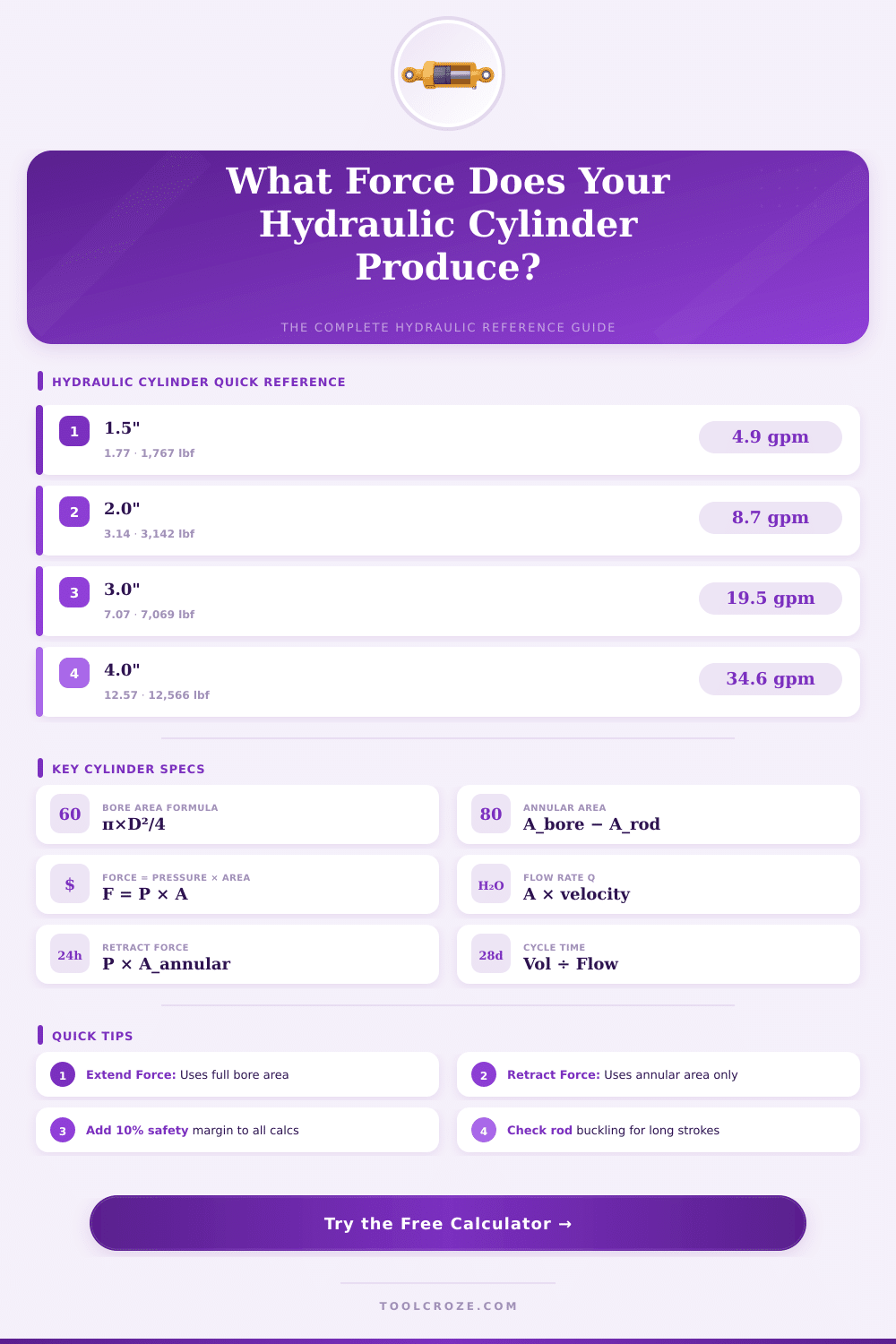
The area of a hydraulic cylinder belongs to those themes that seems hard, but actually is quite easy when one breaks it down. It shows how much force the hydraulic cylinder is able to make. The main idea is that pressure matches force divided by area.
Like this, with bigger surface of the piston, one gets more force for same level of pressure.
How to Find the Area and Force of a Hydraulic Cylinder
To count the area of a hydraulic cylinder one applies the formula: pi times the square of the radius. When the calculator does not have a pi button, simply use 3.14 instead. For instance, a hydraulic cylinder with 3-inch inner diameter has radius of 1.5 inches.
Multiply 1.5 by itself and then by 3.14, and the result is around 7.065 sqaure inches for the area.
A hydraulic cylinder of 4-inch diameter gives around 12.57 square inches of area. If one applies 2000 pounds per square inch of pressure to it, the force reaches 25 140 pounds. The same 4-inch hydraulic cylinder at 3000 pounds per square inch makes 37 698 pounds of force.
It is surprising, as only change of the pressure causes such big impact.
Here is something that matters too recall. The rod side of the hydraulic cylinder delivers less force than the piston side. The reason is that the rod covers part of the piston surface.
So, to figure force at the rod end, the formula comes from pressure times the area of the rod end, which matches the force in pounds. You must consider the rod diameter during the calculation.
Hydraulics works this well because the pressure in the liquid stays same everywhere. When one puts force on a small surface, it creates high pressure. That high pressure then acts on a bigger area and makes even stronger impact.
So one can pump a small hydraulic cylinder with small efforts and still manage to raise a car. If the radius ratio between two hydraulic cylinders is 1:10, the area grows to 1:100. Therefore, 100 kilos of effort can turn into 10 tons of force.
Only mind that the moving distance also follows the same ratio.
A hydraulic cylinder with 2-inch bore has area of around 3.14 square inches. At 4000 pounds per square inch, it gives 12 560 pounds of force. Other sample: 4-inch diameter and 8-inch long hydraulic cylinder with piston area of 12.56 square inches.
At 2500 pounds per square inch from the pump, it reaches maximum load of around 31 400 pounds, which matches almost 15 tons.
The position of the hydraulic cylinder does not affect the lifting force. Either way, force matches pressure times area, regardless of the direction of the hydraulic cylinder. Hydraulic cylinders matter for moving parts in industrial and commercial work.
The force of one side results from the applied force multiplied bythe ratio between the areas of the pistons.