⚙️ Hydraulic Cylinder Cycle Time Calculator
Calculate extend & retract times, flow requirements, and piston speeds for any hydraulic cylinder
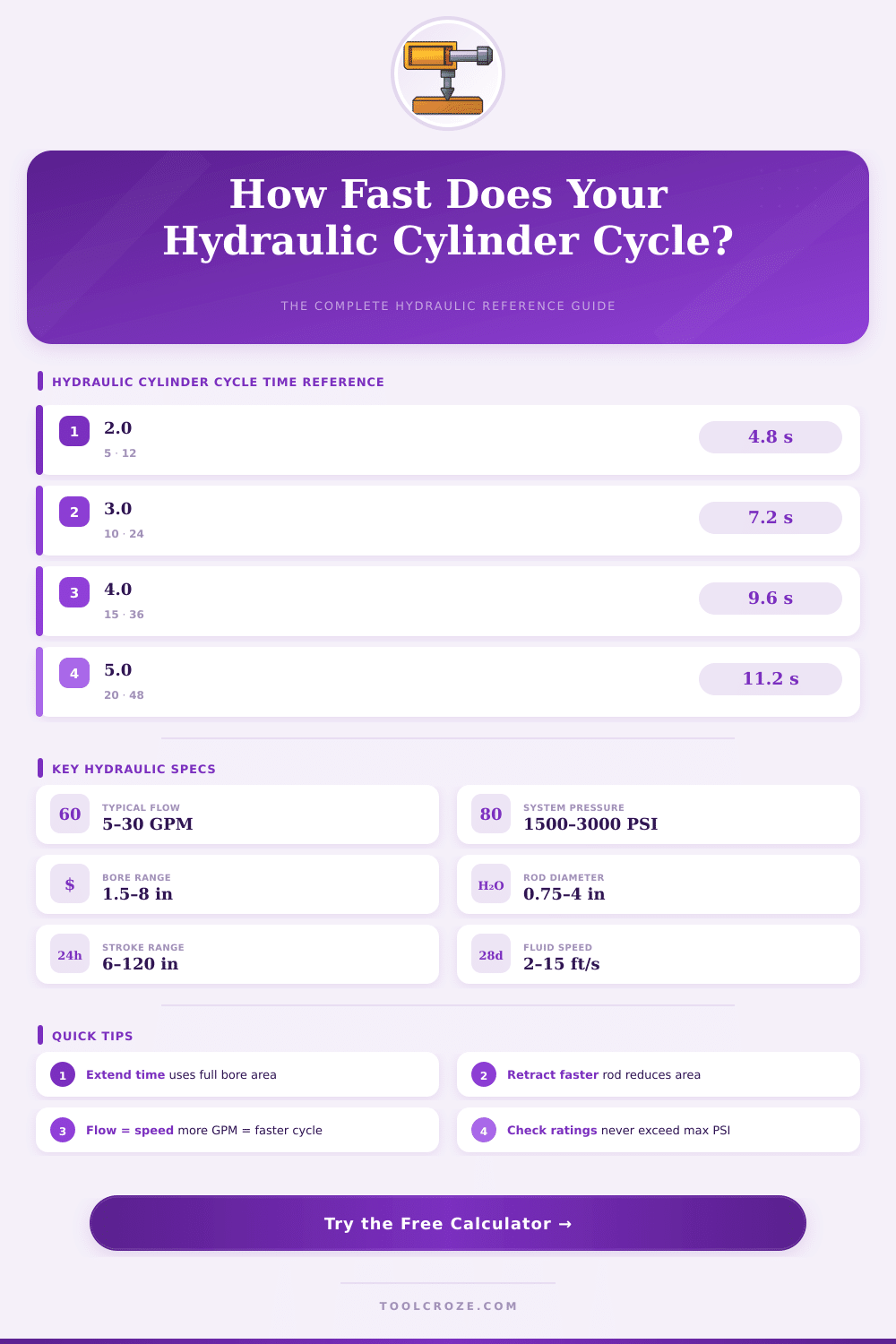
| Bore (in) | Stroke (in) | Flow (GPM) | Extend Vol (gal) | Extend Time (s) | Retract Time (s)* | Extend Speed (in/s) |
|---|---|---|---|---|---|---|
| 2.0 | 12 | 5 | 0.204 | 2.5 | 1.8 | 4.9 |
| 2.5 | 18 | 8 | 0.479 | 3.6 | 2.7 | 5.1 |
| 3.0 | 24 | 10 | 0.735 | 4.4 | 3.3 | 5.5 |
| 3.5 | 30 | 12 | 1.249 | 6.2 | 4.5 | 4.8 |
| 4.0 | 36 | 15 | 1.960 | 7.8 | 5.6 | 4.6 |
| 5.0 | 48 | 20 | 4.084 | 12.3 | 8.9 | 3.9 |
| 6.0 | 60 | 25 | 7.363 | 17.7 | 12.8 | 3.4 |
| 8.0 | 72 | 30 | 17.47 | 35.0 | 24.1 | 2.1 |
*Retract time assumes 1.5 in rod diameter. Actual times vary with rod size.
| Bore (in) | Bore Area (in²) | Force @ 1500 PSI | Force @ 2000 PSI | Force @ 2500 PSI | Force @ 3000 PSI | Force @ 5000 PSI |
|---|---|---|---|---|---|---|
| 1.5 | 1.77 | 2,652 | 3,534 | 4,418 | 5,301 | 8,836 |
| 2.0 | 3.14 | 4,712 | 6,283 | 7,854 | 9,425 | 15,708 |
| 2.5 | 4.91 | 7,363 | 9,817 | 12,272 | 14,726 | 24,544 |
| 3.0 | 7.07 | 10,603 | 14,137 | 17,671 | 21,206 | 35,343 |
| 3.5 | 9.62 | 14,432 | 19,242 | 24,053 | 28,863 | 48,105 |
| 4.0 | 12.57 | 18,850 | 25,133 | 31,416 | 37,699 | 62,832 |
| 5.0 | 19.63 | 29,452 | 39,270 | 49,087 | 58,905 | 98,175 |
| 6.0 | 28.27 | 42,412 | 56,549 | 70,686 | 84,823 | 141,372 |
| Application | Typical Bore (in) | Stroke (in) | Flow (GPM) | Pressure (PSI) | Approx Cycle (s) |
|---|---|---|---|---|---|
| Log Splitter | 3.5–4.5 | 24–30 | 11–16 | 2000–3000 | 8–15 |
| Excavator Arm | 4.0–6.0 | 36–60 | 20–40 | 2500–3500 | 4–12 |
| Dump Truck Hoist | 5.0–8.0 | 48–96 | 20–35 | 2000–2500 | 15–30 |
| Forklift Tilt | 2.5–3.5 | 6–12 | 8–15 | 1500–2500 | 2–6 |
| Agricultural Lift | 3.0–4.5 | 18–36 | 8–20 | 1500–2500 | 5–12 |
| Hydraulic Press | 4.0–10.0 | 12–36 | 5–20 | 2000–5000 | 10–30 |
| Gate Actuator | 2.0–3.0 | 12–24 | 3–8 | 1000–2000 | 6–15 |
| Workholding Clamp | 1.5–2.5 | 2–6 | 2–5 | 1000–2500 | 0.5–2 |
Knowing how many times a hydraulic cylinder needs to finish a whole cycle, from full reach until pulling back to the start. Turns out to be surprisingly useful knowledge. Whether you design a new system or fix problems in an already existing one, understanding the real time makes a big difference.
A good starting point is that special calculators help to solve this exact task. They take the inner area of the hydraulic cylinder and the volumes, add the flow of your pump and the length of the stroke then give the speeds of reach and pull-back together with the whole cycle time.
How to Find the Cycle Time of a Hydraulic Cylinder
Starting to use one of those programs is easy. Enter the flow of your pump in gallons per minute, then the diameter of the barrel in your hydraulic cylinder, the stroke length and the diameter of the rod. When you have decimal values, simply type them directly, fractions are not needed.
Press the button to count, and there, the speed of your hydraulic cylinder appears on the screen.
What makes a calculator like this useful is it guesses the times for extend and pull-back by computing the real flow in the hydraulic cylinder and looking at the amount that your pump can move per minute. Such tools work for many different uses. For instance, if you build a machine for wood, you can learn exactly how much time the reach needs to push a log, and then how much time the return move takes.
Simply enter teh flow of your pump in gallons, together with the sizes of the barrel, stroke and rod for fast rating.
Beyond simply guessing the cycle times, those calculators show interesting trade-offs. Assume that your system is already ready. The program can show what will change if you switch to different sizes of barrel or rods of plunger.
It even works the other weigh, if you know the size of your hydraulic cylinder and want to reach a certain speed for the cycle, it will show how many gallons per minute you must have for your pump, to push the needed flows.
In the real world, cycle times change a lot based on what you work with. One case needed a 10-second cycle with max pressure of 3000 psi in the system, what is typical for hydraulic gear. Another setup had a hydraulic cylinder that cycled one time each 5 minutes during a 20-hour day, with 2-minute pressure hold during every cycle, almost no low movement or low force close pulsing happened here.
There is also a case where someone wanted 5 to 7-second cycles for a press machine, using a 5-inch port with a 16-inch double-acting hydraulic cylinder, fed by a 2-stage piston split pump.
For a typical wood machine, one rough rating puts the cycle time at 12 seconds. The calculations are based on around 302 cubic inches of volume in a 24-inch hydraulic cylinder, what matches to about 1.3 gallons. On the other hand, if your hydraulic cylinder needs 3 liters to move and it works only one time each 10 minutes, then a pump with flow of 0.3 liters per minute would technically be enough; although a bit higher flow for a safetyreserve always makes sense.
The results of those calculators are based on standard formulas for hydraulic systems, but always check your numbers yourself to be safe.