💧 Hydraulic Cylinder Oil Capacity Calculator
Calculate exact oil volume for extend, retract, and full cycle — imperial & metric
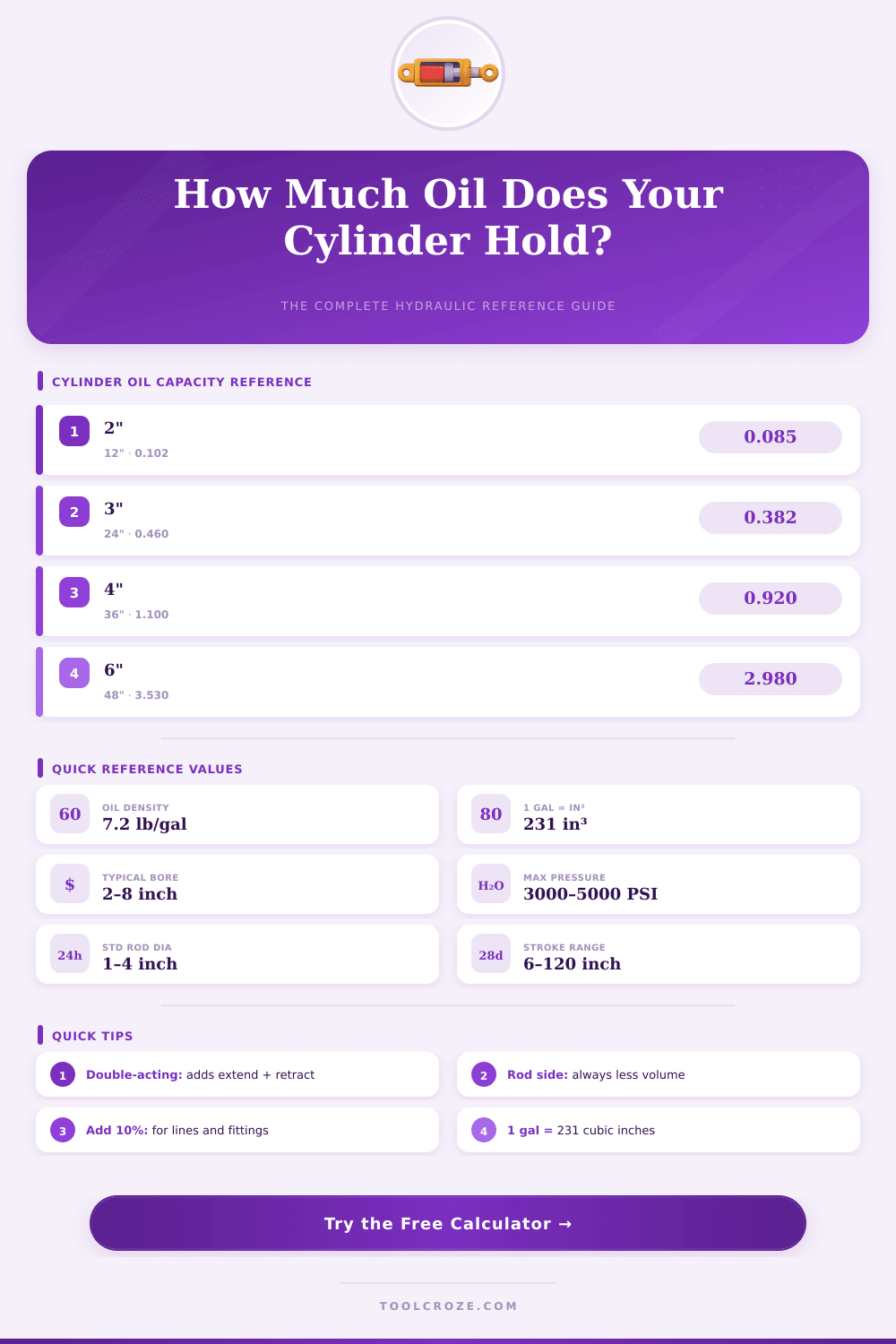
| Bore (in) | Rod (in) | Stroke (in) | Extend Vol (gal) | Retract Vol (gal) | Differential (gal) | Common Application |
|---|---|---|---|---|---|---|
| 1.5 | 0.75 | 8 | 0.046 | 0.037 | 0.009 | Small actuator |
| 2 | 1 | 12 | 0.163 | 0.130 | 0.033 | Compact machine |
| 2.5 | 1.25 | 18 | 0.381 | 0.305 | 0.076 | Ag equipment |
| 3 | 1.5 | 24 | 0.739 | 0.591 | 0.148 | Log splitter |
| 3.5 | 1.75 | 30 | 1.250 | 0.999 | 0.251 | Tractor loader |
| 4 | 2 | 36 | 1.961 | 1.568 | 0.393 | Dump trailer |
| 5 | 2.5 | 48 | 4.082 | 3.265 | 0.817 | Excavator stick |
| 6 | 3 | 60 | 7.347 | 5.878 | 1.469 | Dump truck hoist |
| 7 | 3.5 | 60 | 9.999 | 7.999 | 2.000 | Large press |
| 8 | 4 | 72 | 17.463 | 13.970 | 3.493 | Heavy equipment |
| Fluid Type | ISO Grade | Viscosity @40°C (cSt) | Density (lb/gal) | Density (kg/L) | Temp Range (°F) | Typical Use |
|---|---|---|---|---|---|---|
| AW Mineral Oil | ISO 32 | 32 | 7.18 | 0.861 | -20 to 200 | Indoor machinery |
| AW Mineral Oil | ISO 46 | 46 | 7.22 | 0.865 | -10 to 210 | General hydraulics |
| AW Mineral Oil | ISO 68 | 68 | 7.28 | 0.873 | 0 to 220 | High-temp systems |
| Biodegradable | ISO 46 | 46 | 7.55 | 0.905 | -15 to 195 | Outdoor equipment |
| Fire-Resistant HF | ISO 46 | 46 | 8.20 | 0.983 | 5 to 150 | Steel mills, foundries |
| Water-Glycol HFC | ISO 46 | 46 | 9.00 | 1.078 | 32 to 130 | High fire-risk areas |
| Bore (in) | Standard Rod Options (in) | Rod Ratio | Extend Area (in²) | Retract Area (in²) | Force @2000 PSI (lb) | Retract Force @2000 PSI (lb) |
|---|---|---|---|---|---|---|
| 2 | 1, 1.25 | 0.5 | 3.14 | 2.36 | 6,283 | 4,712 |
| 2.5 | 1.25, 1.5 | 0.5 | 4.91 | 3.68 | 9,817 | 7,363 |
| 3 | 1.5, 2 | 0.5–0.67 | 7.07 | 5.30 | 14,137 | 10,603 |
| 3.5 | 1.75, 2 | 0.5–0.57 | 9.62 | 7.23 | 19,242 | 14,451 |
| 4 | 2, 2.5 | 0.5–0.63 | 12.57 | 9.42 | 25,133 | 18,850 |
| 5 | 2.5, 3 | 0.5–0.6 | 19.63 | 14.73 | 39,270 | 29,453 |
| 6 | 3, 3.5 | 0.5–0.58 | 28.27 | 21.21 | 56,549 | 42,412 |
Hydraulic Cylinder operate as parts in heavy machines to generate force in a direct line. One also calls them hydraulic rams. This power comes from pressed hydraulic liquid, usually hydraulic Oil.
The pressed liquid moves a piston together with the pole bound to the load, what causes linear move. Like this the energy of the liquid transforms in exactly controlled force for one-way move.
How Hydraulic Cylinders Work
Hydraulic Cylinder have central importance in various hydraulic uses. They hand over energy from the pump to a motor or engine. Their uses cover many industries.
So that they work well one must lubricate them by means of Oil.
When only one room receives pressure from the hydraulic liquid, it deals with single action Hydraulic Cylinder. If both rooms are pressed, it is double action. In single action Hydraulic Cylinder, that step receives the presed liquid, depending on the intended task of the Hydraulic Cylinder.
Oil self-lubricates the liquid. It serves at the same time as energy source and lubricant in Hydraulic Cylinder, so they do not require separate lubricant system. The hydraulic Oil quite smoothly coats the pole to reduce friction while it slips through the seal.
Do not lay fat on Hydraulic Cylinder pole. It does not require extra lubrication, if the pole stays bright and smooth. Water technically could bee used as hydraulic liquid, because it does not compress, but it corrodes average steel parts and has very poor lubricant skill.
Different liquids one can use in Hydraulic Cylinder. Between them are mineral-based oils, synthetic Oil and water-based liquids. The most common hydraulic liquids base on mineral Oil or silicone.
Some systems apply automatic transmission liquid from synthetic base. Using the wrong kind of liquid can lead to failure. When one chooses hydraulic liquid, one must consider thickness, temperature range, oxide stability and fit with seals.
Oil for high temperatures is designed to preserve its lubricant impact even while it becomes genuinely warm. They also resist oxide and warm damages. Normal hydraulic Oil is clear, what allows to easily note liquids.
Pure Oil keeps seals more long and reduces wear ofcylinder walls.
Leaking is the main cause of failure in Hydraulic Cylinder. High Oil thickness and wrong filter choice cause also troubles. During the first launch of hydraulic system, one must move the Hydraulic Cylinder forward and backwards to release all air.
Later, Oil residues stay in the system, in tubes and Hydraulic Cylinder.