🔋 Battery Wire Gauge Calculator
Find the correct AWG wire size for your battery system based on current, run length & voltage drop limits
| AWG | Diameter (mm) | Area (mm²) | Resistance (Ω/ft) | Resistance (Ω/m) | Max Amps (75°C) | Typical Use |
|---|---|---|---|---|---|---|
| 0000 (4/0) | 11.68 | 107.2 | 0.0000490 | 0.000161 | 230 | Main battery cables, large inverters |
| 000 (3/0) | 10.40 | 85.0 | 0.0000618 | 0.000203 | 200 | Large motor, main feeds |
| 00 (2/0) | 9.27 | 67.4 | 0.0000780 | 0.000256 | 175 | High current runs, inverters |
| 0 (1/0) | 8.25 | 53.5 | 0.0000983 | 0.000323 | 150 | Winch, large starter cables |
| 1 | 7.35 | 42.4 | 0.000124 | 0.000407 | 130 | Medium-large battery runs |
| 2 | 6.54 | 33.6 | 0.000156 | 0.000512 | 115 | High-power audio, inverters |
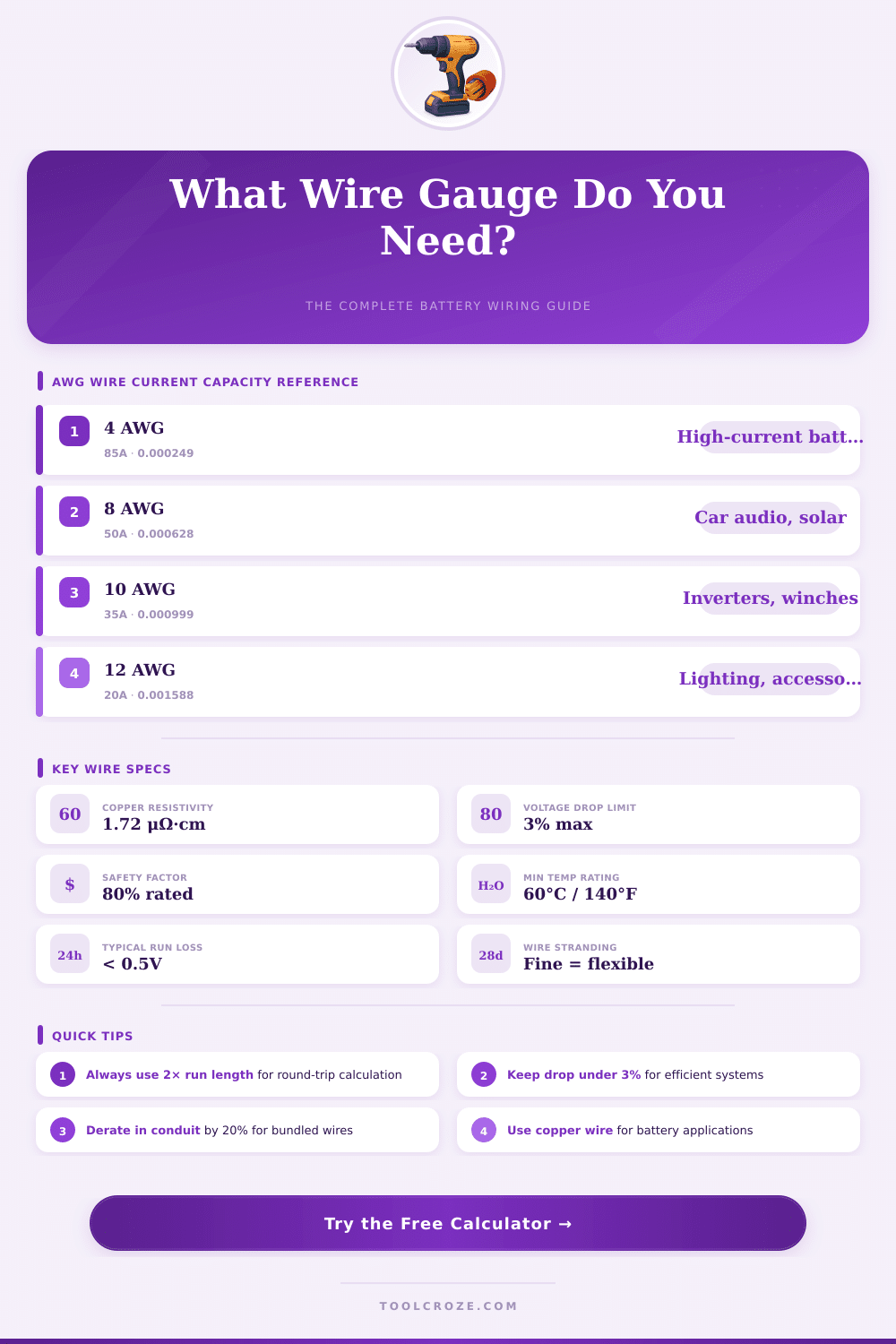
| 4 | 5.19 | 21.2 | 0.000249 | 0.000816 | 85 | Car audio, winch up to 8ft |
| 6 | 4.11 | 13.3 | 0.000395 | 0.001296 | 65 | Solar charge controllers, dual battery |
| 8 | 3.26 | 8.37 | 0.000628 | 0.002060 | 50 | Trolling motors, inverters to 400W |
| 10 | 2.59 | 5.26 | 0.000999 | 0.003277 | 35 | Winches, medium accessories |
| 12 | 2.05 | 3.31 | 0.001588 | 0.005208 | 20 | Lighting, small accessories |
| 14 | 1.63 | 2.08 | 0.002525 | 0.008282 | 15 | LED lights, small loads |
| 16 | 1.29 | 1.31 | 0.004016 | 0.013170 | 13 | Low-current accessories |
| 18 | 1.02 | 0.823 | 0.006385 | 0.020940 | 10 | Sensors, signal wires |
| 20 | 0.812 | 0.519 | 0.010150 | 0.033290 | 7.5 | Signal, small sensors |
| Wire Material | Resistivity (μΩ·cm) | Relative Conductivity | AWG Upsize Needed | Corrosion Resistance | Best Use Case |
|---|---|---|---|---|---|
| Pure Copper | 1.72 | 100% (baseline) | None | Good | General automotive, RV |
| Tinned Copper | 1.75 | 98% | None | Excellent | Marine, humid environments |
| Aluminum | 2.65 | 61% | +2 AWG sizes | Fair (oxidizes) | Long runs where weight matters |
| Copper Clad Aluminum | 2.18 | 79% | +1 AWG size | Fair | Budget installs (not recommended for battery) |
| AWG | 10A / 10ft | 20A / 10ft | 50A / 10ft | 100A / 10ft | 50A / 20ft | 100A / 20ft |
|---|---|---|---|---|---|---|
| 4 AWG | 0.050V (0.4%) | 0.099V (0.8%) | 0.249V (2.1%) | 0.499V (4.2%) | 0.499V (4.2%) | 0.998V (8.3%) |
| 6 AWG | 0.079V (0.7%) | 0.158V (1.3%) | 0.395V (3.3%) | 0.790V (6.6%) | 0.790V (6.6%) | 1.580V (13.2%) |
| 8 AWG | 0.126V (1.0%) | 0.251V (2.1%) | 0.628V (5.2%) | 1.256V (10.5%) | 1.256V (10.5%) | 2.512V (20.9%) |
| 10 AWG | 0.200V (1.7%) | 0.400V (3.3%) | 0.999V (8.3%) | N/A | N/A | N/A |
| 12 AWG | 0.318V (2.6%) | 0.635V (5.3%) | N/A | N/A | N/A | N/A |
| Application | Voltage | Typical Current | Run Length | Recommended AWG | Notes |
|---|---|---|---|---|---|
| Car Audio (500W amp) | 12V | 50A | 10 ft | 8 AWG | Use OFC copper |
| Car Audio (1000W amp) | 12V | 100A | 12 ft | 4 AWG | Add fuse at battery |
| RV Dual Battery | 12V | 50A | 6 ft | 8 AWG | Add isolator |
| Solar Charge Controller | 12V | 30A | 8 ft | 10 AWG | Tinned marine wire |
| 12V Winch | 12V | 250A peak | 4 ft | 2/0 AWG | Intermittent use |
| 1000W Pure Sine Inverter | 12V | 100A | 3 ft | 4 AWG | Keep runs short |
| Trolling Motor (55lb) | 12V | 50A | 5 ft | 8 AWG | Marine grade required |
| Golf Cart Main | 48V | 100A | 2 ft | 4 AWG | Check terminal rating |
| Engine Starter Cable | 12V | 200A | 2 ft | 1/0 AWG | Short burst, heavy cable |
| LED Light Bar | 12V | 10A | 15 ft | 14 AWG | Add inline fuse |
The thickness of wire ratings relate to the size of the wire itself. The bigger the wire the more electricity it fits to carry. One measures them by means of the American system of wire ratings, known also as AWG.
This system extends from 0000 until 40. The less big the number of the rating, the thicker actually is the wire. Here something what can confuse initially, even so it becomes logical after one adjusts to it.
How to Choose the Right Wire Size
The right choice of rating depends on two main factors: the amount of electricity, that flows through the wire, and the length of the cable way. Charts for the size of battery cables help to match the needs of amps with the right rating according to the whole lenght of the cables. For instance, wire of 4 AWG operates well for total length of 10 feet or less, while 2 AWG answers more for ways between 10 and 20 feet.
At very long cables, as those of 15 feet for transfer battery, it is best to choose one grade bigger.
wire of 10 rating commonly uses for starting needs, alternators of low power and leads four accessories. When one plans to start the engine without the battery in place, 8 rating wire makes a good option. For engines V8, usually one chooses 4 ratings for the positive and negative cables of the battery.
Some favour copper cable of 1/0 because of problems with heat loss, that they met before. The downside is the price, because thicker wires cost much more. Welding stores commonly are the best places to get quality cable of 1/0 with threads.
Using bigger wire never hurts. Thicker ratings bear more electricity and stay colder. If one uses 6 AWG, one must particularly observe, do the wires get too warm.
For example, an inverter of 1500 watts working at 12 volts can reach a spike of 250 amps. That requires truly big wire, much more than 10 AWG.
The system of ratings describes also the building of cables. Ratings of 6 until 2/0 are made up of 133 threads, while 3/0 and 4/0 use 361 threads from real copper conducting wire of 21 rating. They are covered by means of strong insulation from PVC, that lasts high temperatures.
Aluminum wire differs from copper. Aluminium owns only around 60 percent of the conductivity of copper.
When the distance from the control to the batteries passes 5 feet, increasing the size of the wires helps to reach better results. Here go to a smaller number of rating, for instance 10 or 8 AWG. Making the cables longer does expand the risk of harm, because more wire stays stripped.
Always check the manual of the maker for particular sizes of wires or fuses, because those match with theprecise needs of the device.
Cables rigid and thick, as that of 2 rating for battery, can be truly hard to handle. Cut them, strip and crimp terminals to them require effort. However the right rating matters more than ease.