⚡ MM to Wire Gauge Calculator
Convert wire diameter (mm) to AWG or SWG gauge — get cross-section area, ampacity & resistance
| AWG | Diameter (mm) | Diameter (in) | Area (mm²) | Resistance (Ω/km Cu) | Ampacity 60°C | Ampacity 75°C | Ampacity 90°C |
|---|---|---|---|---|---|---|---|
| 4/0 (0000) | 11.684 | 0.4600 | 107.2 | 0.1608 | 195A | 230A | 260A |
| 3/0 (000) | 10.405 | 0.4096 | 85.01 | 0.2028 | 165A | 200A | 225A |
| 2/0 (00) | 9.266 | 0.3648 | 67.43 | 0.2557 | 145A | 175A | 195A |
| 1/0 (0) | 8.251 | 0.3249 | 53.48 | 0.3224 | 125A | 150A | 170A |
| 1 | 7.348 | 0.2893 | 42.41 | 0.4066 | 110A | 130A | 150A |
| 2 | 6.544 | 0.2576 | 33.63 | 0.5127 | 95A | 115A | 130A |
| 4 | 5.189 | 0.2043 | 21.15 | 0.8152 | 70A | 85A | 95A |
| 6 | 4.115 | 0.1620 | 13.30 | 1.296 | 55A | 65A | 75A |
| 8 | 3.264 | 0.1285 | 8.367 | 2.060 | 40A | 50A | 55A |
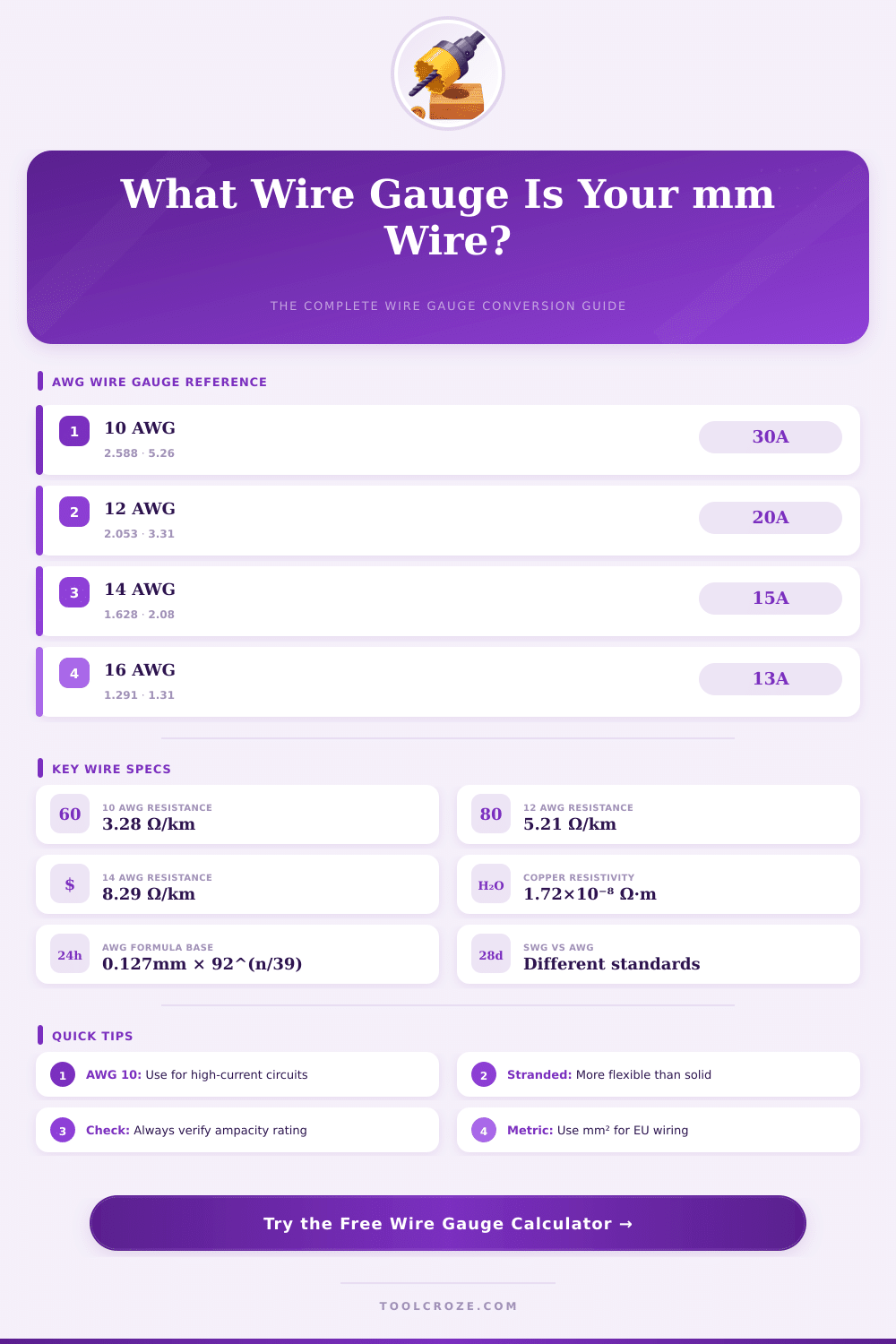
| 10 | 2.588 | 0.1019 | 5.261 | 3.277 | 30A | 35A | 40A |
| 12 | 2.053 | 0.0808 | 3.309 | 5.211 | 20A | 25A | 30A |
| 14 | 1.628 | 0.0641 | 2.081 | 8.286 | 15A | 20A | 25A |
| 16 | 1.291 | 0.0508 | 1.309 | 13.17 | 13A | 13A | 18A |
| 18 | 1.024 | 0.0403 | 0.8231 | 20.95 | 10A | 14A | 16A |
| 20 | 0.8118 | 0.0320 | 0.5176 | 33.31 | — | 11A | 13A |
| 22 | 0.6438 | 0.0253 | 0.3255 | 52.97 | — | 7A | — |
| 24 | 0.5106 | 0.0201 | 0.2047 | 84.22 | — | 3.5A | — |
| 26 | 0.4049 | 0.0159 | 0.1288 | 133.9 | — | 2.2A | — |
| 28 | 0.3211 | 0.0126 | 0.0810 | 212.9 | — | 0.83A | — |
| 30 | 0.2546 | 0.0100 | 0.0509 | 338.6 | — | 0.52A | — |
| SWG | Diameter (mm) | Diameter (in) | Area (mm²) | Resistance (Ω/km Cu) | Common Use |
|---|---|---|---|---|---|
| 0000 (4/0) | 10.160 | 0.4000 | 81.07 | 0.212 | Heavy power cables |
| 000 (3/0) | 9.144 | 0.3600 | 65.61 | 0.263 | Power distribution |
| 00 (2/0) | 8.230 | 0.3240 | 53.16 | 0.324 | Main feed cables |
| 0 (1/0) | 7.620 | 0.3000 | 45.60 | 0.378 | Service entrance |
| 2 | 7.010 | 0.2760 | 38.59 | 0.446 | Heavy equipment |
| 4 | 5.893 | 0.2320 | 27.27 | 0.631 | Sub-panels |
| 6 | 4.877 | 0.1920 | 18.69 | 0.921 | Appliance wiring |
| 8 | 4.064 | 0.1600 | 12.97 | 1.326 | Range / dryer |
| 10 | 3.251 | 0.1280 | 8.302 | 2.074 | A/C units |
| 12 | 2.642 | 0.1040 | 5.480 | 3.143 | General circuits |
| 14 | 2.032 | 0.0800 | 3.243 | 5.312 | Lighting circuits |
| 16 | 1.626 | 0.0640 | 2.076 | 8.302 | Low power loads |
| 18 | 1.219 | 0.0480 | 1.167 | 14.77 | Instrumentation |
| 20 | 0.9144 | 0.0360 | 0.6567 | 26.23 | Control wiring |
| 24 | 0.5588 | 0.0220 | 0.2452 | 70.30 | Signal wiring |
| 28 | 0.3759 | 0.0148 | 0.1110 | 155.3 | Transformer wire |
| 32 | 0.2743 | 0.0108 | 0.0591 | 291.6 | Fine winding wire |
| 36 | 0.1930 | 0.0076 | 0.0293 | 588.3 | Coil winding |
| Application | AWG Range | Typical Diameter | Material | Notes |
|---|---|---|---|---|
| Residential 15A Circuit | 14 AWG | 1.628 mm | Copper | NEC requires 14 AWG min for 15A |
| Residential 20A Circuit | 12 AWG | 2.053 mm | Copper | Kitchens, bathrooms |
| 30A Dryer Circuit | 10 AWG | 2.588 mm | Copper | 240V dedicated circuit |
| 50A Range Circuit | 6 AWG | 4.115 mm | Copper/Al | Electric range / oven |
| Automotive Chassis | 18–22 AWG | 0.64–1.02 mm | Copper | Stranded for flex |
| Automotive Starter | 2–4 AWG | 5.19–6.54 mm | Copper | High current, short run |
| PCB Signal Wire | 24–28 AWG | 0.32–0.51 mm | Copper | Low current signals |
| USB Cable | 28 AWG | 0.321 mm | Copper | Stranded, tinned |
| Speaker Wire (HiFi) | 12–16 AWG | 1.29–2.05 mm | Copper | OFC preferred |
| Guitar Pickup Wire | 42–44 AWG | 0.063–0.079 mm | Copper | Enameled magnet wire |
| Solar Panel Feed | 10–12 AWG | 2.05–2.59 mm | Copper | UV-rated insulation |
| Control Panel (PLC) | 14–16 AWG | 1.29–1.63 mm | Copper | Stranded, 75°C rated |
The rating of wires simply serves as method for showing the real size of wire. It helps to know how much electricity the wire can handle without danger of overheating. The size relates directly to the diameter of the wire itself.
Here commonly happens confusion between folks: rather than expected lower rating shows thicker wire. For instance, wire of 10 rating is much fatter than that of 14 rating. The relation flips; if you climb in the ratings, the wire becomes entirely thinner.
How to Choose the Right Wire Size
In United States, the standard use is AWG (American System of wire Ratings). This standard exists since almost 1857, so it is well set. One applies it mainly in North America for measuring round or solid, metal cables, that carry electricity.
The full details appear in the standard ASTM B 258. Instead of simply saying “this many inches” or “this many millimeters”, the AWG assigns to every wire size its unique rating. Usually, when some mention AWG, one means copper wires.
The mode to produce wires really stikcs, if one thinks it. One draws metallic rod through special plate for pulling, and every passage thins the wire a bit more. In short, it is repeatable cold pressure.
Also exist practical tools, designed specially for checking wire ratings. Those are commonly round or oval discs with slices around the banks in different sizes. Every slice bears stamped rating, and you simply slide the wire to sea, what answers.
Some prefer to use calipers instead and measure the diameter themselves. Wire of 8 AWG measures around 0.1285 inches, while 10 AWG arrives at approximately 0.1019 inches. On the other hand, AWG is not the only method.
The British SWG was once very spread, and there is also a metric version with square millimeters for the cross area.
What rating you choose, depends mainly on what you plan to do with the wire. For wire that bears little power over short ways, ratings of 16 to 18 AWG suffice for the task. 14 AWG acts as reliable all-purpose option for many cases.
At long cable runs, low resistance or high power, one requires 12 AWG or even thicker. While breadboarding of circuits, 18 rating answers for medium power cable, 22 rating bears light loads up to around 1 ampere, and 30 rating serves for signal-only ties.
The voltage drop forms another important reason for care about rating choice. If you pass 1.6 amperes through 12-rating wire in 40 feet, the drop stays only around 0.2 volts. At less thick ratings, the toll grows clearly.
14 rating shows about 0.3 volts, 16 rating around 0.5 volts, and 20 rating reaches 1.2 volts. Choose the right rating to ensure safe flow withoutlost impact. The diameter of wires almost doubles itself every six ratings, what helps fast rating in mind.