⚡ Wire Gauge Selection Calculator
Find the correct AWG wire size for any electrical circuit — enter your current load, run length, and conductor material for instant, code-compliant results.
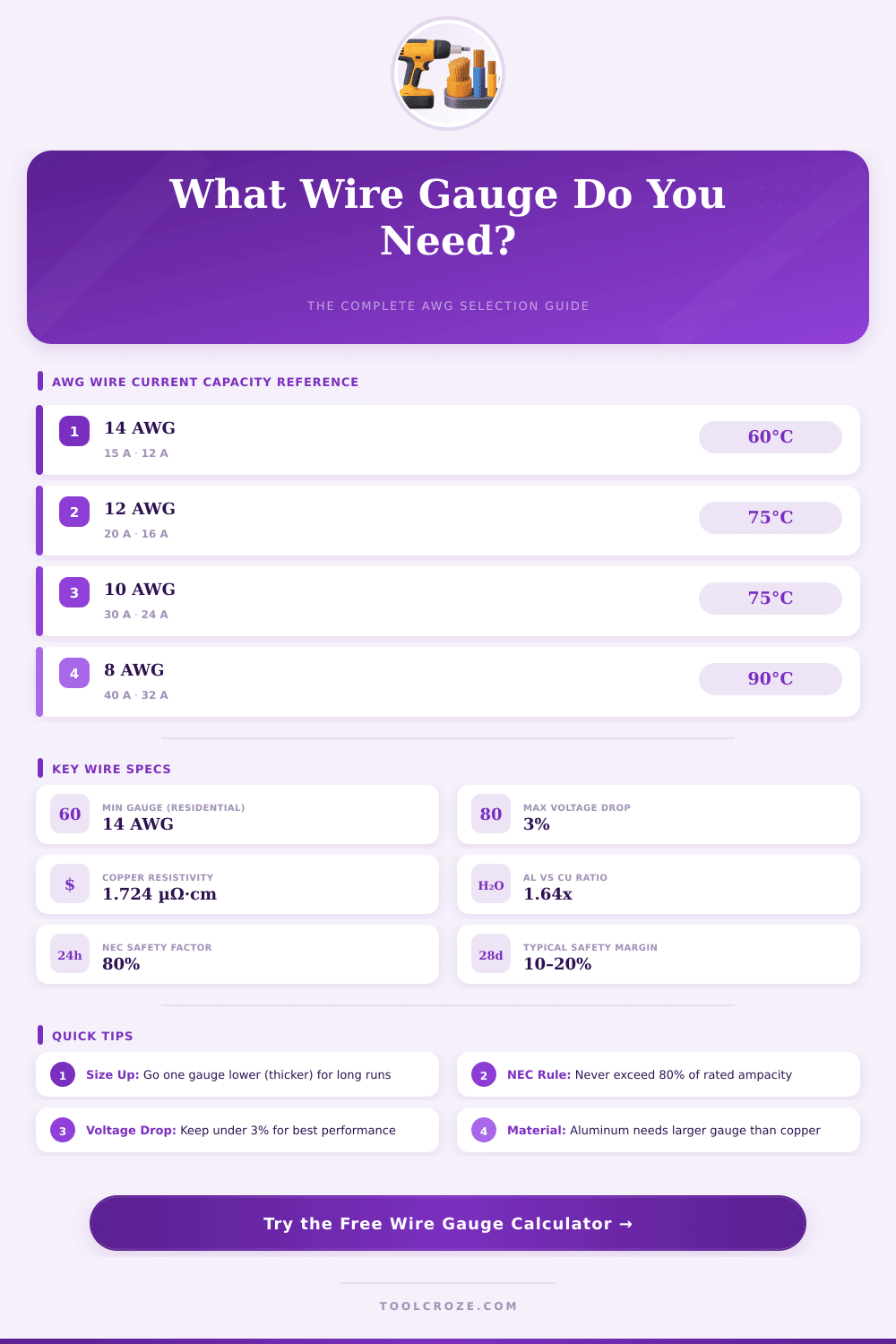
| AWG / kcmil | Copper 60°C (A) | Copper 75°C (A) | Copper 90°C (A) | Aluminum 75°C (A) | Aluminum 90°C (A) | Resistance (Ω/1000ft) |
|---|---|---|---|---|---|---|
| 18 AWG | 7 | 7 | 7 | — | — | 6.385 |
| 16 AWG | 10 | 10 | 10 | — | — | 4.016 |
| 14 AWG | 15 | 20 | 25 | — | — | 2.525 |
| 12 AWG | 20 | 25 | 30 | 20 | 25 | 1.588 |
| 10 AWG | 30 | 35 | 40 | 30 | 35 | 0.999 |
| 8 AWG | 40 | 50 | 55 | 40 | 45 | 0.628 |
| 6 AWG | 55 | 65 | 75 | 50 | 60 | 0.395 |
| 4 AWG | 70 | 85 | 95 | 65 | 75 | 0.249 |
| 3 AWG | 85 | 100 | 110 | 75 | 85 | 0.197 |
| 2 AWG | 95 | 115 | 130 | 90 | 100 | 0.156 |
| 1 AWG | 110 | 130 | 150 | 100 | 115 | 0.124 |
| 1/0 AWG | 125 | 150 | 170 | 120 | 135 | 0.098 |
| 2/0 AWG | 145 | 175 | 195 | 135 | 150 | 0.078 |
| 3/0 AWG | 165 | 200 | 225 | 155 | 175 | 0.062 |
| 4/0 AWG | 195 | 230 | 260 | 180 | 205 | 0.049 |
| 250 kcmil | 215 | 255 | 290 | 205 | 230 | 0.042 |
| 300 kcmil | 240 | 285 | 320 | 230 | 260 | 0.035 |
| 350 kcmil | 260 | 310 | 350 | 250 | 280 | 0.030 |
| 400 kcmil | 280 | 335 | 380 | 270 | 305 | 0.026 |
| 500 kcmil | 320 | 380 | 430 | 310 | 350 | 0.021 |
| AWG | 25 ft run | 50 ft run | 75 ft run | 100 ft run | 150 ft run | 200 ft run |
|---|---|---|---|---|---|---|
| 14 AWG | 1.3% | 2.5% | 3.8% | 5.1% | 7.6% | 10.1% |
| 12 AWG | 0.8% | 1.6% | 2.4% | 3.2% | 4.8% | 6.4% |
| 10 AWG | 0.5% | 1.0% | 1.5% | 2.0% | 3.0% | 4.0% |
| 8 AWG | 0.3% | 0.6% | 0.9% | 1.3% | 1.9% | 2.5% |
| 6 AWG | 0.2% | 0.4% | 0.6% | 0.8% | 1.2% | 1.6% |
| 4 AWG | 0.1% | 0.2% | 0.4% | 0.5% | 0.8% | 1.0% |
| AWG | Diameter (in) | Diameter (mm) | Area (mm²) | Weight (lb/1000ft) | Resistance (mΩ/ft) | Common Use |
|---|---|---|---|---|---|---|
| 18 | 0.0403 | 1.024 | 0.823 | 4.9 | 6.39 | Low-voltage lighting, doorbells |
| 16 | 0.0508 | 1.291 | 1.31 | 7.8 | 4.02 | Extension cords, fixtures |
| 14 | 0.0641 | 1.628 | 2.08 | 12.4 | 2.53 | Lighting circuits (15A) |
| 12 | 0.0808 | 2.053 | 3.31 | 19.8 | 1.59 | General outlets (20A) |
| 10 | 0.1019 | 2.588 | 5.26 | 31.4 | 1.00 | Dryers, A/C (30A) |
| 8 | 0.1285 | 3.264 | 8.37 | 49.9 | 0.628 | Ranges, sub-panels (40A) |
| 6 | 0.1620 | 4.115 | 13.3 | 79.4 | 0.395 | Sub-panels, EV chargers (55A) |
| 4 | 0.2043 | 5.189 | 21.2 | 126 | 0.249 | Large A/C, feeders (70A) |
| 2 | 0.2576 | 6.544 | 33.6 | 200 | 0.156 | Service entrance, panels (95A) |
| 1/0 | 0.3249 | 8.252 | 53.5 | 318 | 0.098 | Main feeders (125A) |
| 2/0 | 0.3648 | 9.266 | 67.4 | 401 | 0.078 | Service entrance (145A) |
| 4/0 | 0.4600 | 11.68 | 107 | 638 | 0.049 | Heavy feeders (195A) |
Choosing the right wire gauge really matters, it is not just something to guess. The size of your wire needs must match what your circuit actually requires for amps, so that everything stays safe and the energy flows without problems. If you work with bigger flow, you need to use thicker wire to handle it.
Using too thin wire you risk that the wire will warm, the coating melts or even worse, maybe will start fire.
How to Choose the Right Wire Size
In the United States, electricians use the AWG system (American wire gauge) for rating wires. Here it gets confusing: high AWG numbers actually point to small wire size. Many folks mess that up.
One often finds workers that choose the thinnest wire that technically works, because it simply saves money on materials.
When one chooses wire gauge, two main factors play a role: how thick it must be and how long will be the run of the wire. The ability to carry current, measured in amps, depends on the wire thickness and on the load that it bears. The distance is very important.
Long runs cause voltage drop, which can hamper the efficiency of your system. For instance, 12 wire gauge wire going 40 feet with 1.6 amps through it shows only around 0.2 voltage drop. That is perfectly fine.
Even so, if one chooses thiner wires, things get harder. 14 wire gauge wire has a drop of about 0.3 volts over that distance, while 16 wire gauge reaches up to 0.5 volts. And 18 wire gauge?
It reaches 0.81 volts. And 20 wire gauge; that already pushes 1.2 volts of drop.
Charts of wire gauge are really helpful. They show the right size, the cross section area and the capacity for every size. That removes a lot of trial and mistakes during the choice of the proper wires.
Also, now there are online calculators for capacity, that care about the electrical code rules for you and give the write wire gauge size without headache.
Another way is to count the voltage drop index. One gets the VDI value, then compares it with a chart of wire gauge capacity to find the size with the lowest VDI and capacity that quite well covers both your planned VDI and the actual flow that you use.
Here is something to recall at home: wires are rated by amps, not by voltage. They are different things. Every wire gauge is designed to safely bear a certain range of flow.
The whole reason to choose the right wire gauge is to make sure that it will not warm or cause damage under the load that it must bear.
For simpler tasks, 14 wire gauge works well for 15 amp circuits. Some electricians prefer 12 wire gauge everywhere to avoid doubts, although 14 wire gauge would do the same job just as well. On the other hand, for short runs with low power one can use 18 wire gauge, if the flow is around 6 amps or less.
Always choose pure copper wire insteadof copper-free aluminum.