⚡ RV Generator Size Calculator
Enter your RV appliances to calculate exact running and surge wattage — and get the perfect generator size recommendation.
| Appliance | Running Watts | Starting Watts | Qty | Priority | Remove |
|---|
| Appliance | Running Watts | Starting Watts | Typical Use | Priority |
|---|---|---|---|---|
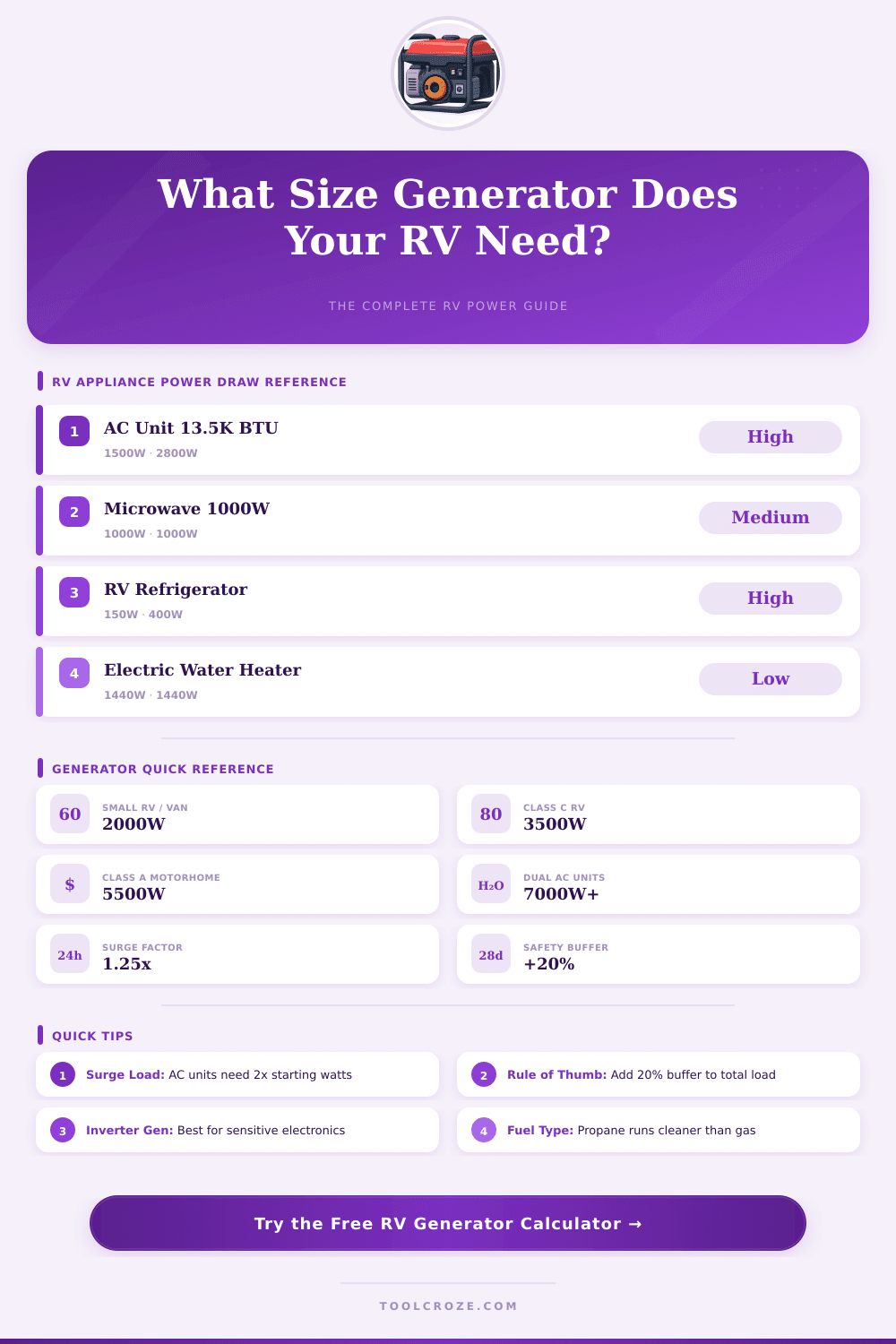
| AC Unit 9,500 BTU | 1,100 W | 1,900 W | Continuous | High |
| AC Unit 13,500 BTU | 1,500 W | 2,800 W | Continuous | High |
| AC Unit 15,000 BTU | 1,800 W | 3,200 W | Continuous | High |
| Microwave (1000W) | 1,000 W | 1,000 W | Short bursts | Medium |
| Microwave (700W) | 700 W | 700 W | Short bursts | Medium |
| Electric Refrigerator | 150 W | 400 W | Continuous | High |
| Propane Fridge (fan) | 20 W | 20 W | Continuous | High |
| Electric Water Heater | 1,440 W | 1,440 W | Intermittent | Medium |
| Coffee Maker | 1,000 W | 1,000 W | Short bursts | Low |
| Hair Dryer | 1,500 W | 1,500 W | Short bursts | Low |
| Toaster | 800 W | 800 W | Short bursts | Low |
| LED TV (32") | 40 W | 40 W | Continuous | Medium |
| LED TV (55") | 80 W | 80 W | Continuous | Medium |
| Laptop | 65 W | 65 W | Continuous | Medium |
| Phone Charger | 15 W | 15 W | Continuous | Low |
| Electric Furnace Blower | 300 W | 600 W | Intermittent | High |
| Water Pump | 60 W | 120 W | Intermittent | High |
| Slide-Out Motor | 400 W | 800 W | Brief | High |
| Electric Grill / Induction | 1,500 W | 1,500 W | Intermittent | Low |
| Space Heater (portable) | 1,500 W | 1,500 W | Continuous | Medium |
| Generator Class | Running Watts | Surge Watts | Best For | Fuel Type | Noise (dBA) |
|---|---|---|---|---|---|
| Micro Inverter | 1,000 W | 1,200 W | Phones, lights, fan | Gas / Propane | 48–53 |
| Small Inverter | 2,000 W | 2,200 W | Van, small trailer | Gas / Propane | 51–57 |
| Mid Inverter | 3,000 W | 3,300 W | Class C, 1 AC unit | Gas / Propane | 55–60 |
| Large Inverter | 4,000 W | 4,500 W | Class C full, trailer | Gas / LP | 57–62 |
| Dual-Fuel Inverter | 5,500 W | 6,875 W | Class A, 5th wheel | Gas / LP | 60–65 |
| Conventional Open | 6,500 W | 8,125 W | Heavy loads, tools | Gas | 68–76 |
| Large Dual-Fuel | 9,000 W | 11,250 W | Full-time, dual AC | Gas / LP | 70–78 |
| Diesel Quiet | 7,000 W | 8,000 W | Extended boondocking | Diesel | 58–65 |
| AC Size (BTU) | Running Watts | Starting Watts (EMS) | Starting Watts (No EMS) | Min. Generator |
|---|---|---|---|---|
| 9,500 BTU | 1,100 W | 1,900 W | 2,500 W | 2,000 W |
| 11,000 BTU | 1,200 W | 2,100 W | 2,700 W | 2,500 W |
| 13,500 BTU | 1,500 W | 2,800 W | 3,500 W | 3,000 W |
| 15,000 BTU | 1,800 W | 3,200 W | 4,000 W | 3,500 W |
| 18,000 BTU | 2,200 W | 4,000 W | 5,000 W | 4,500 W |
| Dual 13,500 BTU | 3,000 W | 5,600 W | 7,000 W | 6,000 W |
Your generator must handle the single highest surge (starting) wattage as an instantaneous peak — usually an AC unit at startup. Size your generator so its rated surge capacity exceeds this value, not just the total running load.
Inverter generators produce clean sine-wave power (∼3% THD) safe for electronics, laptops, and CPAP machines. Conventional generators produce rough power (up to 25% THD) that can damage sensitive electronics. For most RV use, an inverter-type generator is strongly preferred.
Election of the right size for RV Generator can seem hard. Not always the biggest model is the best. The main target is deliver enough energy to operate devices and charge batteries, without risk to damage anything.
When you choose the right size consider three main elements: watts, volts and amps. Before the purchase, count the physical size and the electrical needs.
How to Choose the Right RV Generator Size
RV Generator must be strong enough, but not so big that it takes too much place. For smaller vehicles, as sporting utility vehicles, small buses or tiny travel trailers with few energy needs, compact model as the EcoFlow River 2 Pro operate well. Bigger RVs, as Class A motorhomes, fifth wheel trailers and truck campers, has more internal space and requires more energy.
System of 30 amps for RV reach maximum of 3,600 watts outside, because 30 amps multiplied by 120 volts give that amount. Usually for 30-amp system a RV Generator between 2,500 and 4,000 watts answers. It is enough to launch coffee maker, microwave and even small air conditioner.
For 50-amp RV with 120-volt service, it can handle until 12,000 watts. Like this, RV Generator of 12,000 or 12,500 watts would be the best choice for such setup. On the other hand, 50 amps at 120 volts match 6,000 watts, so the RV Generator must fit to bear that permannet burden.
Air conditioners commonly is the main energy users. They require around 1,500 until 1,800 watts for continuous work, but the starting spike can rise to 2,800 until 3,500 watts. The most common units of 13,500 BTU require at least 3,500-watt RV Generator.
Units of 15,000 BTU require at least 4,000 watts. Device with soft start help a lot. It is possible too operate 15,000 BTU air with soft start on Honda 2500 RV Generator without problems.
RV Generator of 2,000 watts answers for small RVs, as pop-up campers and travel trailers with limited electricity. Around 2,500 watts is good average. In many situations you do not need something more than 3,600 watts.
Good inverter RV Generator of 3,200 watts provides enough energy for air conditioner, stay fairly silent for camping and are efficient on fuel for camping on your own. Some big 40-feet motorhomes come with 8,000-watt RV Generators, because they have residential refrigerators, two big air conditioners and other heavy devices. Many motorhomes of 35 until 37 feet have 4,000-watt RV Generators.
Inverter RV Generators are silent, efficient on fuel and safe for sensitive electronics. Their small size makes them good choice for camping. Two units of 2,000 watts can work together for easier carrying.
Smaller generators are also lighter and more simply kept. Any RV Generator that fits with the budget and give at least 2,000 watts of running energy, are goodinitial spot.