🔧 Bolt Torque Calculator
Calculate precise tightening torque for any bolt size, grade, and material using industry-standard formulas
| Bolt Size | Grade 2 Dry | Grade 5 Dry | Grade 8 Dry | Grade 5 Lubed | Grade 8 Lubed |
|---|---|---|---|---|---|
| #10 (0.190") | 3 | 5 | 7 | 4 | 5 |
| 1/4" | 5 | 8 | 12 | 6 | 9 |
| 5/16" | 10 | 17 | 24 | 13 | 18 |
| 3/8" | 19 | 31 | 44 | 23 | 33 |
| 7/16" | 30 | 49 | 70 | 37 | 53 |
| 1/2" | 47 | 76 | 108 | 57 | 81 |
| 9/16" | 67 | 110 | 154 | 82 | 116 |
| 5/8" | 94 | 150 | 212 | 113 | 159 |
| 3/4" | 163 | 267 | 376 | 200 | 282 |
| 7/8" | 267 | 436 | 616 | 327 | 462 |
| 1" | 400 | 654 | 924 | 490 | 693 |
| Bolt Size | Class 4.6 | Class 8.8 | Class 10.9 | Class 12.9 | A2-70 (Dry) |
|---|---|---|---|---|---|
| M5 | 2.4 | 5.6 | 8.0 | 9.5 | 4.5 |
| M6 | 4.2 | 9.5 | 13.5 | 16.0 | 7.5 |
| M8 | 10 | 23 | 33 | 39 | 18 |
| M10 | 20 | 46 | 65 | 77 | 37 |
| M12 | 35 | 80 | 113 | 133 | 64 |
| M14 | 55 | 127 | 180 | 212 | 102 |
| M16 | 85 | 195 | 278 | 327 | 157 |
| M20 | 165 | 385 | 543 | 640 | 308 |
| M24 | 285 | 660 | 938 | 1100 | 530 |
| M30 | 575 | 1330 | 1890 | 2230 | 1065 |
| Condition | K Factor (Nut Factor) | Effect on Torque | Notes |
|---|---|---|---|
| Dry, plain steel | 0.20 | Baseline | Most common |
| Light oil / machine oil | 0.15 | −25% | General lubed |
| Anti-seize compound | 0.13 | −35% | High-temp bolts |
| Zinc plated (dry) | 0.17 | −15% | Galv fasteners |
| Hot-dip galvanized | 0.19 | −5% | Structural bolts |
| PTFE / waxed | 0.12 | −40% | Very slick |
| Black oxide dry | 0.18 | −10% | Socket head cap |
| Grade / Class | Proof Strength | Yield Strength | Tensile Strength | Material |
|---|---|---|---|---|
| SAE Grade 2 | 57 ksi / 393 MPa | 57 ksi / 393 MPa | 74 ksi / 510 MPa | Low carbon steel |
| SAE Grade 5 | 85 ksi / 586 MPa | 92 ksi / 634 MPa | 120 ksi / 827 MPa | Med carbon steel |
| SAE Grade 8 | 120 ksi / 827 MPa | 130 ksi / 896 MPa | 150 ksi / 1034 MPa | Alloy steel |
| Metric 4.6 | 225 MPa | 240 MPa | 400 MPa | Low carbon steel |
| Metric 8.8 | 600 MPa | 640 MPa | 800 MPa | Med carbon steel |
| Metric 10.9 | 830 MPa | 940 MPa | 1040 MPa | Alloy steel |
| Metric 12.9 | 970 MPa | 1100 MPa | 1220 MPa | Alloy steel |
| Stainless A2-70 | 450 MPa | 450 MPa | 700 MPa | 304 Stainless |
| Stainless A4-80 | 600 MPa | 640 MPa | 800 MPa | 316 Stainless |
bolt torque is basically about the amount of turning force that is applied during the tightening of bolt. It measures the spinning energy. Usually one measures it in pound-feet in the imperial system or newton-metres in the metric.
Think of it as the pressure of one-pound mass at the end of one-foot lever. To turn nuts and bolts to precise torque, one must use a torque wrench.
Bolt Torque: What It Is and Why It Matters
During the tightening of bolts in the process of tightening, they work like a strong spring that keeps the parts flat together. As long as the pulling load does not pass the clamping load, the parts stay joined. When the shear load stays low enough the extra friction stops the bits from slipping one against the other, thus avoiding damage to the material.
So the precise calculation of torque really matters.
Many things affect the choice of torque value. Everything like the size of the bolt, coarse or fine thread, material of the bolt, size of the washer, material of the washer, the surface treatment of the material, whether it is oiled, what loads teh bolt regarding shearing and tension, and how much preload one wants, all this plays a role. Designs of bolted joints have several ways to fail, and the chosen torques must be checked against those various risks.
One aims to commonly reach 60 to 90 percent of the proof force for permanent ties, while for parts that must be easily removed, the percent is lower. One method offers 90 percent for permanent bolts and 75 percent four temporary ones. In addition, one applies a safety factor of 150 to 200 percent, to make up for relaxation and mistakes during assembly.
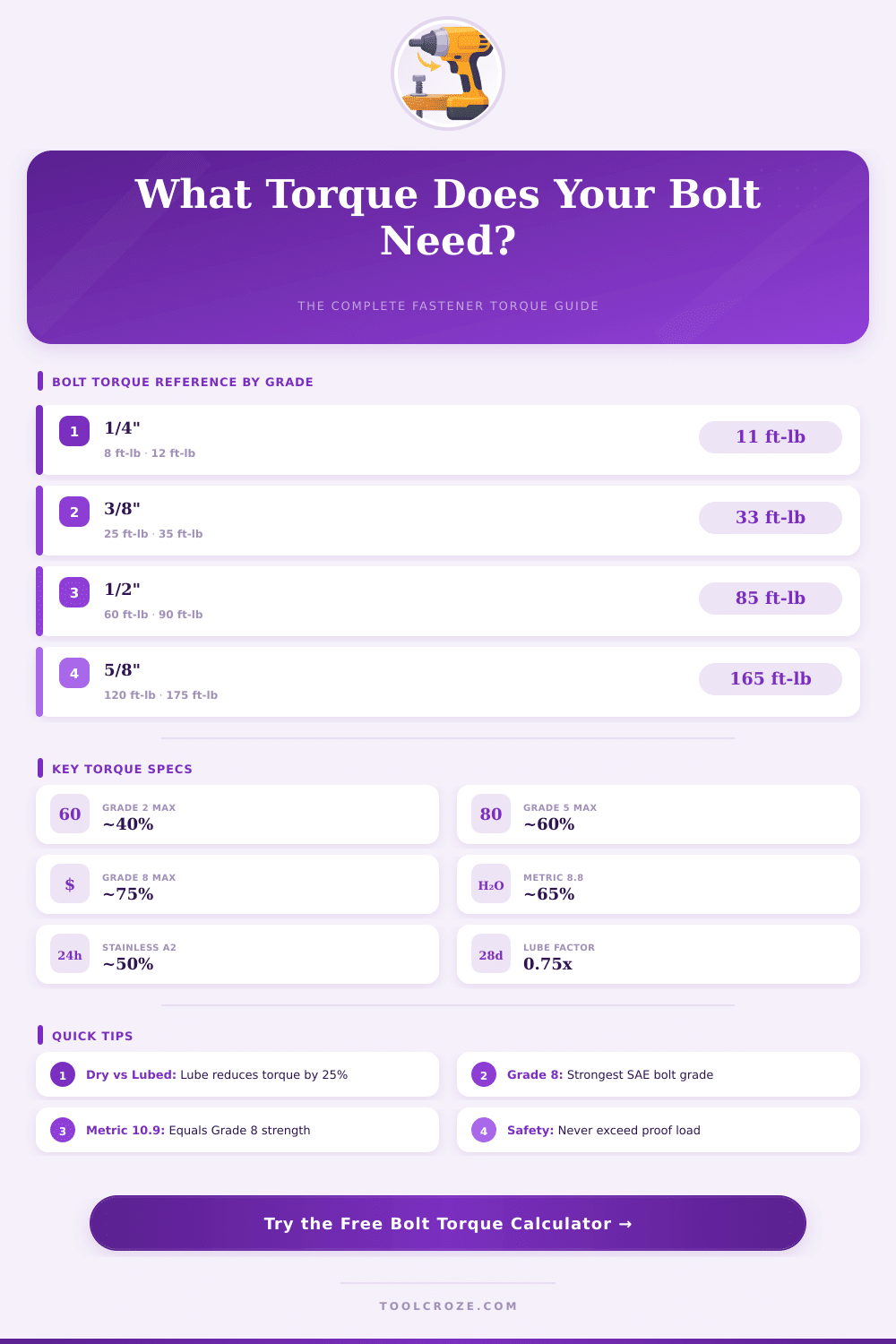
Lubrication changes the results a lot. When one uses lubricant, the dry torque values must be multiplied by a certain number. Various surface treatments have different values of K. For waxed bolts it is around 0.10, for hot galvanised bolts around 0.25, and for bare without treatment around 0.20.
Also the friction differs between a new bolt and a used one, so the state of the bolts matters during the choice of torque.
For bolts that cannot be secured against vibration, one uses higher torques, sometimes up to the yield point. The high load strengthens the resistance to vibration, but if the bolt passes its yield limit, it will give in and will loosen. Ties with preload experience fewer load changes, which indeed lowers the fatigue of the bolt.
If several parts meet at one single tie, the best plan is to use the lowest torque from them. Whether one tightens the nut or the head of the bolt depends on the used method of tightening. Because accuracy is key, the rating of bolt tension is the most reliable way to control how muchtorque the bolt reached, if both sides are accessible.
Micrometers also work, if they fit.