☀️ Solar Generator Size Calculator
Enter your appliances to find the exact solar generator wattage & battery capacity you need
| Appliance | Running Watts (W) | Starting Watts (W) | Hours / Day | Qty | Remove |
|---|
| Appliance | Running Watts | Starting Watts | Typical Hours/Day | Daily Wh |
|---|---|---|---|---|
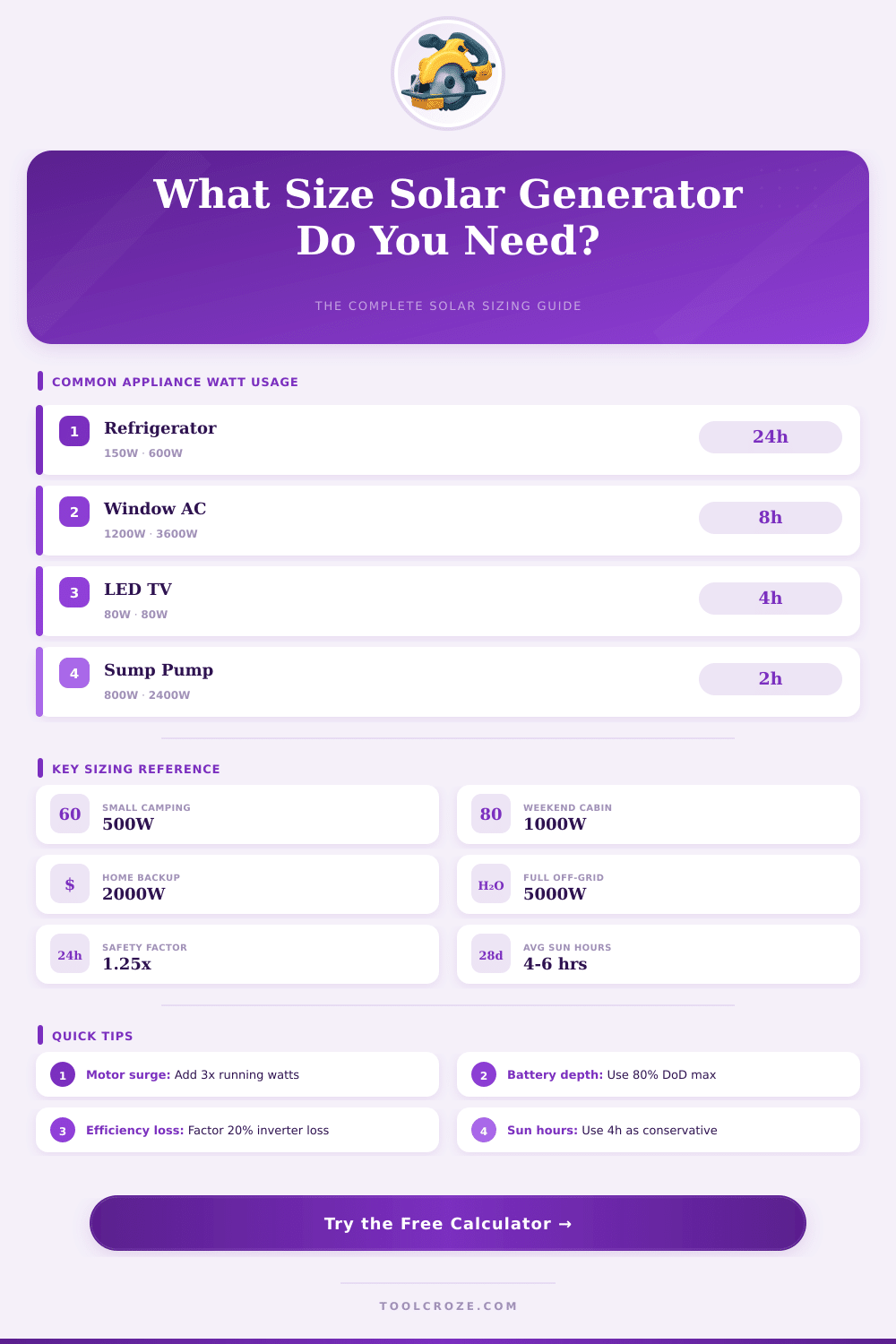
| Refrigerator (full-size) | 150 W | 600 W | 24 h (cycles) | 360 Wh |
| Chest Freezer | 100 W | 300 W | 24 h (cycles) | 240 Wh |
| Window AC (5,000 BTU) | 500 W | 1,500 W | 8 h | 4,000 Wh |
| Window AC (10,000 BTU) | 1,200 W | 3,600 W | 8 h | 9,600 Wh |
| LED Light Bulb | 10 W | 10 W | 6 h | 60 Wh |
| LED TV (50") | 80 W | 80 W | 4 h | 320 Wh |
| Laptop Computer | 65 W | 65 W | 6 h | 390 Wh |
| Phone Charger | 10 W | 10 W | 4 h | 40 Wh |
| CPAP Machine (no heat) | 40 W | 40 W | 8 h | 320 Wh |
| CPAP with Humidifier | 120 W | 120 W | 8 h | 960 Wh |
| Microwave (1,000W) | 1,000 W | 1,000 W | 0.5 h | 500 Wh |
| Coffee Maker | 800 W | 800 W | 0.25 h | 200 Wh |
| Sump Pump (1/3 HP) | 800 W | 2,400 W | 2 h | 1,600 Wh |
| Electric Drill | 600 W | 900 W | 1 h | 600 Wh |
| Circular Saw (7.25") | 1,400 W | 2,200 W | 1 h | 1,400 Wh |
| Table Fan | 50 W | 50 W | 8 h | 400 Wh |
| Space Heater (750W) | 750 W | 750 W | 4 h | 3,000 Wh |
| Oxygen Concentrator | 300 W | 300 W | 24 h | 7,200 Wh |
| Generator Size (Wh) | 12V — Ah Required | 24V — Ah Required | 48V — Ah Required | Typical Use Case |
|---|---|---|---|---|
| 500 Wh | 42 Ah | 21 Ah | 11 Ah | Camping, charging devices |
| 1,000 Wh | 83 Ah | 42 Ah | 21 Ah | Weekend cabin, RV basics |
| 2,000 Wh | 167 Ah | 83 Ah | 42 Ah | Home backup, fridge + lights |
| 3,000 Wh | 250 Ah | 125 Ah | 63 Ah | Small off-grid + AC unit |
| 5,000 Wh | 417 Ah | 208 Ah | 104 Ah | Full off-grid, light AC use |
| 10,000 Wh | 833 Ah | 417 Ah | 208 Ah | Whole home backup |
| Region / Location | Avg Peak Sun Hours | 200W Panel Daily Output | 400W Panel Daily Output | Notes |
|---|---|---|---|---|
| US Southwest (AZ, NV) | 6.5 h | 1,300 Wh | 2,600 Wh | Best US solar resource |
| US Southeast (FL, TX) | 5.5 h | 1,100 Wh | 2,200 Wh | Good year-round |
| US Midwest (IL, OH) | 4.5 h | 900 Wh | 1,800 Wh | Seasonal variation |
| US Northeast (NY, MA) | 4.0 h | 800 Wh | 1,600 Wh | Lower winter output |
| US Pacific NW (WA, OR) | 3.5 h | 700 Wh | 1,400 Wh | High cloud cover |
| UK / Northern Europe | 2.5 h | 500 Wh | 1,000 Wh | Low winter sun |
| Australia (inland) | 6.0 h | 1,200 Wh | 2,400 Wh | Excellent resource |
| Use Case | Recommended Wh | Panel Watts Needed | Battery Ah (12V) | Run Time Estimate |
|---|---|---|---|---|
| Day Hiking / Charging | 100–300 Wh | 50–100W | 10–25 Ah | Phone 10x, laptop 3x |
| Weekend Camping | 300–600 Wh | 100–200W | 25–50 Ah | Lights, phone, small fan |
| Tailgate / Events | 500–1,000 Wh | 100–200W | 42–83 Ah | Mini-fridge, speakers, TV |
| RV / Van Life | 1,000–2,000 Wh | 200–400W | 83–167 Ah | Fridge, lighting, devices |
| Off-Grid Cabin | 2,000–5,000 Wh | 400–800W | 167–417 Ah | Full basics, no AC |
| Home Emergency | 2,000–4,000 Wh | 400–600W | 167–333 Ah | Fridge, lights, CPAP |
| Full Off-Grid Home | 10,000+ Wh | 2,000W+ | 833+ Ah | All appliances, light AC |
Choosing the right size for a solar generator is really important. The right size depends mostly on the amount of electricity that the family uses. Use your current electricity bill as a good guide Share the monthly kilowatt-hours by the number of days, and you will get a rough idea about the needed size of the system.
For small uses, like charging phones, or running lights and personal devices, a small solar generator of 500 watts or even less works for some days. There are also very compact options around 512 Wh, that handle basic outdoor needs, for instance lights and phones. Those small devices are easily carried and handy for basic tasks.
How to Choose the Right Size Solar Generator
To operate a typical house, a solar generator of 2000 watts commonly can cover the everyday energy needs. Various sources advise between 2000 and 3000 watts as an ideal range for an average home. Basically, a solar generator is made up of solar panels, a battery and an inverter, that work togehter.
Different houses require various sizes according to their place and the amount of energy that they consume.
A full home system is a whole other case. So, plan for a solar generator between 10,000 and 20,000 watts. That level of energy can run the most common home devices, including lights, refrigerator, freezer and even central air conditioning.
For instance, one home in north California operates with solar energy using a 48-volt system with 40 kWh of batteries and 8,500 watts of solar panels, to feed a small normal house with a heat pump.
Counting which devices you want too use at the same time is also important. Add up the total watts and amp values for everything that could start up at once. Do not add only one big item, because small ones, like lights, televisions and computers, rarely pass 1,000 watts together.
A clear rule is to choose a solar generator 50 percent more than the expected load. For instance, if you expect 2 kW of use, plan for a 3 kW solar generator.
For heavy tools, match the watt number of the tool with the capacity of the solar generator. Commonly electric hammer drills need 900 watts, and even a medium solar generator can handle that. When you need more power, combine a solar generator with a lightweight gas generator, which helps to save energy during longer times.
When a power outage will last more than 12 hours, consider investing in solar panels to recharge the battery. Separate sheds also can run on solar energy. One such shed before used a gas generator, but someone changed it to an 800-watt solar system.
Planand research the sizes of the system well, and that will make all the difference.