🔧 Bolt Torque & Clamping Force Calculator
Calculate required torque, clamping force, and bolt stress for any fastener size and grade
| Bolt Size | Grade 2 / 4.6 | Grade 5 / 8.8 | Grade 8 / 10.9 | Stress Area (in²) | K=0.20 Dry |
|---|---|---|---|---|---|
| 1/4"-20 | 5 ft-lb | 8 ft-lb | 12 ft-lb | 0.0318 | Standard K |
| 5/16"-18 | 11 ft-lb | 17 ft-lb | 24 ft-lb | 0.0524 | Standard K |
| 3/8"-16 | 19 ft-lb | 31 ft-lb | 44 ft-lb | 0.0775 | Standard K |
| 7/16"-14 | 31 ft-lb | 49 ft-lb | 70 ft-lb | 0.1063 | Standard K |
| 1/2"-13 | 47 ft-lb | 75 ft-lb | 106 ft-lb | 0.1419 | Standard K |
| 5/8"-11 | 94 ft-lb | 150 ft-lb | 212 ft-lb | 0.2260 | Standard K |
| 3/4"-10 | 167 ft-lb | 267 ft-lb | 376 ft-lb | 0.3340 | Standard K |
| M8 x 1.25 | 8 Nm | 25 Nm | 35 Nm | 36.6 mm² | Standard K |
| M10 x 1.5 | 16 Nm | 49 Nm | 70 Nm | 58.0 mm² | Standard K |
| M12 x 1.75 | 27 Nm | 86 Nm | 120 Nm | 84.3 mm² | Standard K |
| M16 x 2.0 | 67 Nm | 210 Nm | 295 Nm | 157 mm² | Standard K |
| M20 x 2.5 | 131 Nm | 411 Nm | 580 Nm | 245 mm² | Standard K |
| Grade / Class | Proof Load (ksi/MPa) | Yield Strength | Tensile Strength | Material | Marking |
|---|---|---|---|---|---|
| SAE Grade 2 | 57 ksi | 57 ksi | 74 ksi | Low carbon steel | None |
| SAE Grade 5 | 85 ksi | 92 ksi | 120 ksi | Med carbon steel | 3 radial lines |
| SAE Grade 8 | 120 ksi | 130 ksi | 150 ksi | Med carbon alloy | 6 radial lines |
| ISO Class 4.6 | 225 MPa | 240 MPa | 400 MPa | Low carbon steel | 4.6 |
| ISO Class 8.8 | 580 MPa | 660 MPa | 830 MPa | Med carbon steel | 8.8 |
| ISO Class 10.9 | 830 MPa | 940 MPa | 1040 MPa | Alloy steel | 10.9 |
| ISO Class 12.9 | 970 MPa | 1100 MPa | 1220 MPa | Alloy steel | 12.9 |
| Stainless A2-70 | 450 MPa | 450 MPa | 700 MPa | 304 Stainless | A2-70 |
| Stainless A4-80 | 600 MPa | 600 MPa | 800 MPa | 316 Stainless | A4-80 |
| Application | Typical Bolt | Grade | Torque Range | Notes |
|---|---|---|---|---|
| Automotive lug nut | 1/2"-20 or M12 | Grade 8 / 10.9 | 80–120 ft-lb | Always retorque after 50mi |
| Engine cylinder head | M10 or 3/8" | Grade 8 / 10.9 | Per OEM spec | Use torque-to-yield method |
| Structural steel frame | 3/4"-10 A325 | ASTM A325 | 267 ft-lb | Snug tight + 1/2 turn |
| Pipe flange (low pressure) | 5/8"-11 | Grade 5 | 90–130 ft-lb | Star pattern tightening |
| Machinery base plate | M16 x 2.0 | Class 8.8 | 150–200 Nm | Check flatness first |
| Electronic enclosure | M4 or 8-32 | SS A2-70 | 1.5–2 Nm | Do not overtorque plastic |
| Wood decking lag bolt | 5/16" lag | Grade 5 | 25–35 ft-lb | Pre-drill to prevent splitting |
| Bicycle stem / handlebar | M5 or M6 | Class 8.8 SS | 5–7 Nm | Use carbon paste on CF parts |
When one tightens a bolt, something remarkable happens. The torque that one applies during the turning of the bolt changes itself into tension inside the thread. That tension creates clamping force between the two joined parts.
Simply, the clamping force is that pressing load that pulls the joined parts one to the other and holds everything in its place.
How Tightening a Bolt Holds Parts Together
Here the main point even so. Not only the torque decides about everything. The resulting pre-load truly is what keeps the parts firmly together.
The pre-load matches the tension in the bolt itself and almost equals the clamping force between the two parts. At a small level, the tension of the bolt itself creates that clamping force. As the threads of bolt and assembly meet, the clamping force grows all along the threads.
The friction aslo builds along the thread, which stops the loosening of the bolt.
There is a basic formula for use: T matches K times D times P, divided by 12. In this equation, T shows the torque in pounds-feet, D points to the nominal diameter in inches, P represents the wanted clamping force in pounds, and K is the coefficient of friction. The value of K ranges according to the state of the surfaces.
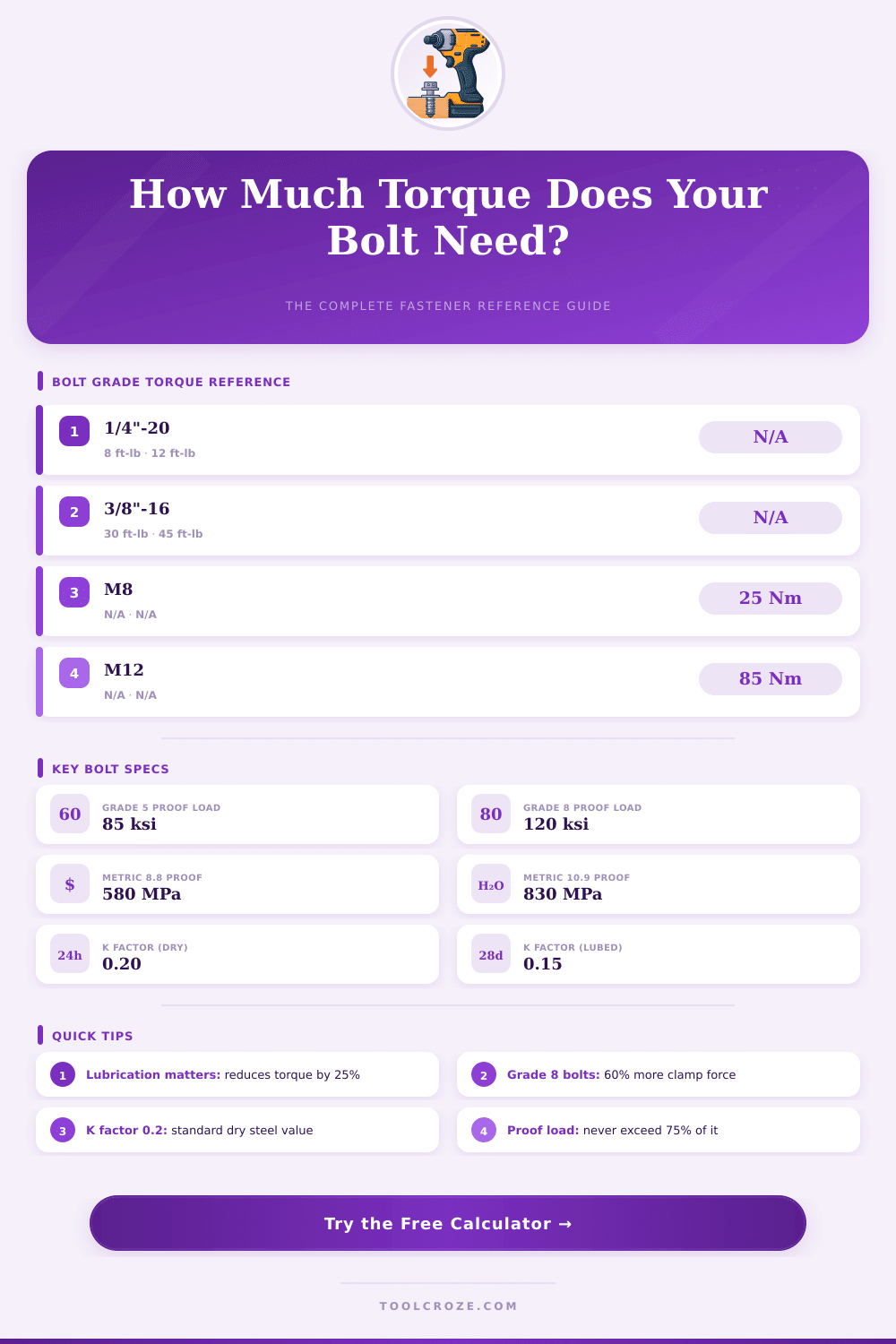
A typical pattern around 0.2 works four dry steel, while for lubricated thread one uses about 0.15.
The friction has a very important part. In many cases, around 80 percent of the torque is spent only to beat the friction. So the torque itself is not fully reliable for tightening bolts.
More torque does give more tension, but the exact clamping force can vary. Truly, the tension in the bolt is the most important element.
The standard values of torque for sections usually aim to produce pulling tension in the bolt equal to around 70 percent of the minimal pulling force or 75 percent of the proof force. The best clamping reaches when the internal tensions pass the elastic limit by only around 10 percent, but no more than that. Too little torque creates failure, and too much torque also causes problems.
Bolts with torque-to-yield method work somewhat differently. By stretching until a particular spot in the material, one can predict the clamping force very reliably, regardless of outside factors. When one plots the torque against the pre-load, one finds a line almost directly until the spot of plastic limit.
The clamping force keeps growing almost straight passing that spot.
Using more bolts one also changes the situation. Doubling the amount of bolts almost doubles the whole clamping force, if one assumes that the tension depends straight on the torque. However the order of tightening matters, because it affects the final pre-load.
When a seal or its thread can not handle the involved clamping force, one needs to fix something; whether by means of replacing the bolt or byexpanding the seal.