🔩 Metric Bolt Torque Calculator
Calculate the correct tightening torque for metric bolts by grade, size, lubrication & material
| Bolt Size | Thread Pitch (mm) | Grade 4.6 | Grade 8.8 | Grade 10.9 | Grade 12.9 | A2-70 SS |
|---|---|---|---|---|---|---|
| M4 | 0.70 | 1.5 Nm | 3.0 Nm | 4.2 Nm | 5.0 Nm | 2.8 Nm |
| M5 | 0.80 | 2.9 Nm | 6.0 Nm | 8.5 Nm | 10 Nm | 5.5 Nm |
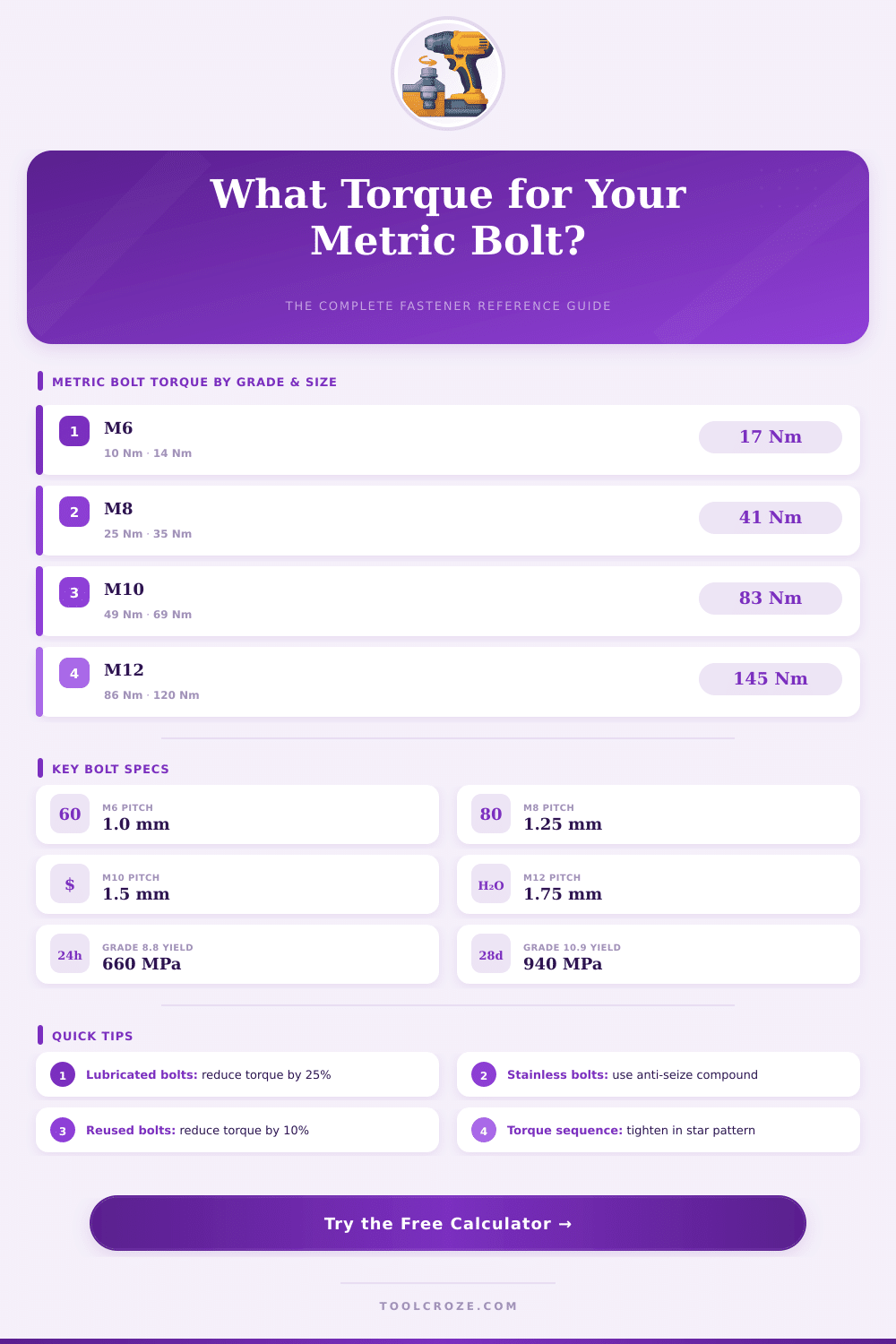
| M6 | 1.00 | 5.0 Nm | 10 Nm | 14 Nm | 17 Nm | 9.5 Nm |
| M8 | 1.25 | 12 Nm | 25 Nm | 35 Nm | 41 Nm | 23 Nm |
| M10 | 1.50 | 24 Nm | 49 Nm | 69 Nm | 83 Nm | 45 Nm |
| M12 | 1.75 | 42 Nm | 86 Nm | 120 Nm | 145 Nm | 78 Nm |
| M14 | 2.00 | 66 Nm | 135 Nm | 190 Nm | 230 Nm | 125 Nm |
| M16 | 2.00 | 100 Nm | 210 Nm | 295 Nm | 355 Nm | 195 Nm |
| M18 | 2.50 | 140 Nm | 290 Nm | 410 Nm | 490 Nm | 265 Nm |
| M20 | 2.50 | 200 Nm | 410 Nm | 580 Nm | 700 Nm | 375 Nm |
| M22 | 2.50 | 270 Nm | 560 Nm | 790 Nm | 950 Nm | 510 Nm |
| M24 | 3.00 | 345 Nm | 710 Nm | 1000 Nm | 1200 Nm | 650 Nm |
| M27 | 3.00 | 510 Nm | 1050 Nm | 1480 Nm | 1780 Nm | 960 Nm |
| M30 | 3.50 | 680 Nm | 1400 Nm | 1980 Nm | 2380 Nm | 1280 Nm |
| Lubrication Condition | K-Factor (Nut Factor) | Torque Effect | Common Use |
|---|---|---|---|
| Dry (clean, uncoated) | 0.20 | Baseline | Standard structural |
| Lightly Oiled / SAE30 | 0.15 | ~25% less torque | Engine, gearbox |
| Anti-Seize (copper) | 0.13 | ~35% less torque | Exhaust, high temp |
| PTFE / Thread Tape | 0.17 | ~15% less torque | Plumbing, fittings |
| Zinc Plated (as received) | 0.17 | ~15% less torque | General fastening |
| Waxed / Cadmium plated | 0.12 | ~40% less torque | Aerospace |
| Bolt Size | Pitch (mm) | Nominal Dia (mm) | Stress Area (mm²) | Min. Engagement Length | Max Bolt Dia (mm) |
|---|---|---|---|---|---|
| M4 | 0.70 | 4.0 | 8.78 | 4.0 mm | 4.0 |
| M5 | 0.80 | 5.0 | 14.2 | 5.0 mm | 5.0 |
| M6 | 1.00 | 6.0 | 20.1 | 6.0 mm | 6.0 |
| M8 | 1.25 | 8.0 | 36.6 | 8.0 mm | 8.0 |
| M10 | 1.50 | 10.0 | 58.0 | 10.0 mm | 10.0 |
| M12 | 1.75 | 12.0 | 84.3 | 12.0 mm | 12.0 |
| M14 | 2.00 | 14.0 | 115 | 14.0 mm | 14.0 |
| M16 | 2.00 | 16.0 | 157 | 16.0 mm | 16.0 |
| M20 | 2.50 | 20.0 | 245 | 20.0 mm | 20.0 |
| M24 | 3.00 | 24.0 | 353 | 24.0 mm | 24.0 |
| M30 | 3.50 | 30.0 | 561 | 30.0 mm | 30.0 |
| Clamped Material | Max Bearing Stress | Torque Adj. Factor | Special Notes |
|---|---|---|---|
| Steel | High (300+ MPa) | 1.00 (baseline) | Use specified grade torque |
| Aluminum | Medium (150 MPa) | 0.85–0.90 | Risk of stripping; use washers |
| Cast Iron | Medium (100 MPa) | 0.80–0.90 | Brittle; avoid over-torque |
| Stainless Steel | High (200+ MPa) | 0.90–0.95 | Use anti-galling lubricant |
| Brass | Low (80 MPa) | 0.60–0.70 | Soft material; easy to strip |
| Plastic / Nylon | Very Low (30 MPa) | 0.30–0.50 | Use low torque; thread inserts preferred |
| Titanium | High (250+ MPa) | 0.80–0.90 | Galling risk; use anti-seize always |
| Carbon Fiber Composite | Low (50 MPa) | 0.40–0.60 | Use bushings; large washers |
When you tie metric bolts, the right Torque is simply the turning force that you apply with a wrench to set everything flat. It matters a lot to reach the right values. Especially when working with different sizes and strengths of bolts, too low or high Torque can decide between a strong joint and one that will break soon.
So, what exactly does Torque mean? It measures the turning energy and usually one says it with two different units depending on the place in the world. In the United States one uses pounds-feet (lb-ft) or sometimes unit-inches.
How to Choose the Right Torque for Metric Bolts
Everywhere else one uses newton-metres (N-m). Torque always is made up of two parts: the force itself and the distance from the central axis. Think of it this way: in the imperial system one works with pounds and units for force, while inches and feet serve for length.
Metric tools replace that with grams and kilos, then with centimetres and metres. The most tools in the United States follow the imperial standard, while the rest of the world uses the metric.
To count Torque in newton-metres, you need two facts: the force in newtons and the distance, as far away from the pivot spot one applies that force, in metres.
There are standard tables for metric bolts, that show the maximum Torque values by diameter and grade. They are based directly on ISO 898, the rule about mechanical traits of carbon steel fasteners. The values in those tables reach 85 percent of the proof load.
Most commonly one assumes slightly oiled threads, and the real advantage is, that the suggested numbers count directly in newton-metres or pound-feet.
Bolts show there grade with marks printed on them. Commonly one finds metric grades like 8.8 or 10.9. SAE bolts use other signs for different strengths.
The standards differ by countries: DIN for Germans, JIS for Japanese and so on. Each of them ties the details of bolts to the right Torque.
Here it becomes hard. Simply turning a Bolt does not ensure the same clamping force. For that you must properly tighten it.
The size of the fastener affects how much clamping you truly reach from given Torque values. And if you add thread lock or heavy grease? Everything changes.
From my experience, one applies around 0.7 factor to the advised Torque during use of thread lock.
Charts for socket head fasteners detail different types. Socket head, low profile, button head, flat head, cap screws, from M3 until M30. They combine DIN and ISO details together with sizes of hex nuts. Those values assume regular threads and dry conditions, unless notes point otherwise.
While you indeed figure out the write kind of Torque, many factors come up quickly. First the size of fastener, the grade, the materials, sizes of washers, whether one greases, the directions of load, the pre-tension; that only for starters. The trouble here shows, thatwell chosen Bolt Torque is not cause for guessing.