⚡ Welding Rod Calculator
Calculate electrode amperage, rod quantity, deposition rate & weld time for any joint or material
| Electrode | Diameter | Amperage Range | Deposition Rate (lb/hr) | Polarity | Positions | Best For |
|---|---|---|---|---|---|---|
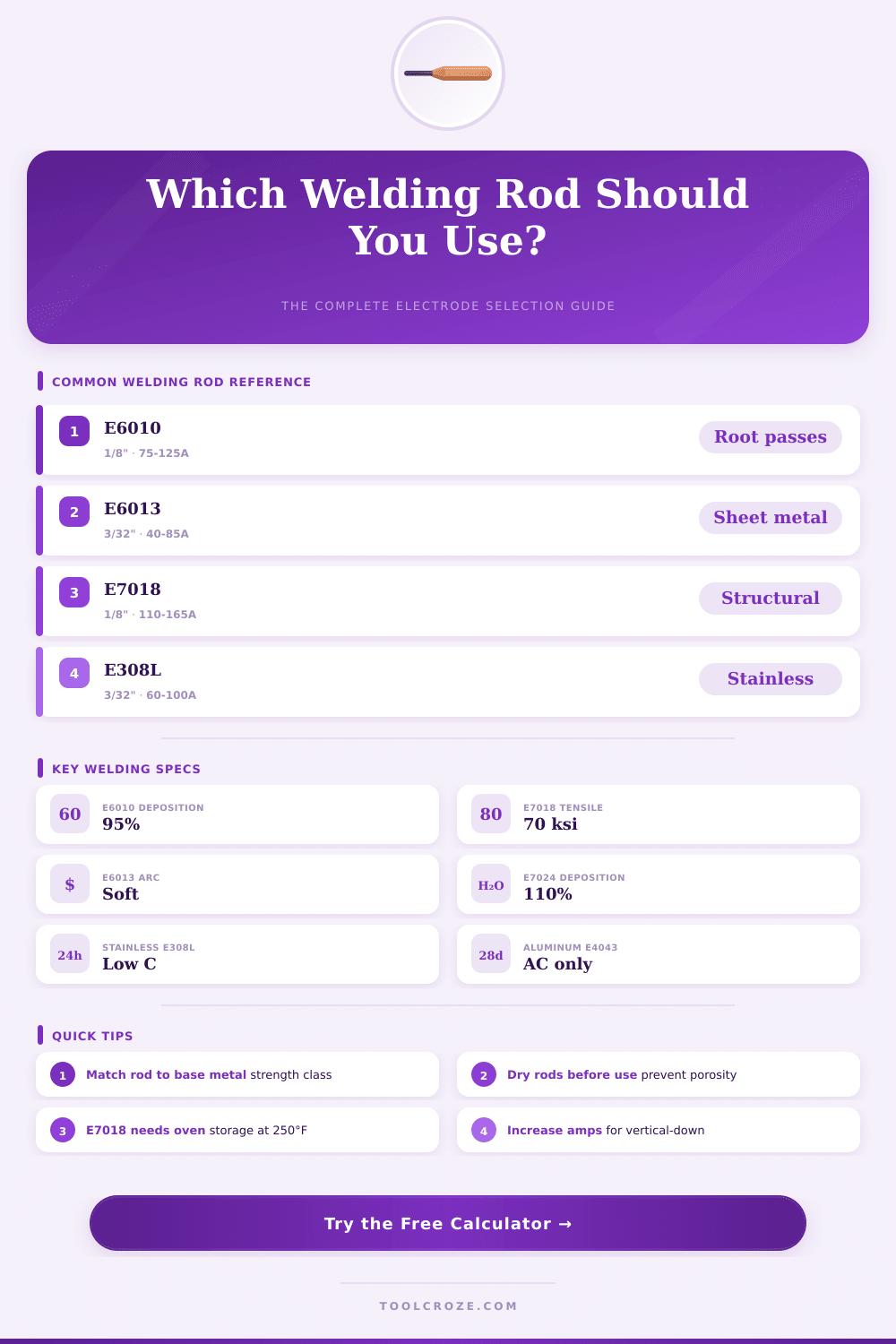
| E6010 | 3/32" (2.4mm) | 40–80 A | 0.9–1.4 | DC+ | All | Root passes, pipe |
| E6010 | 1/8" (3.2mm) | 75–125 A | 1.4–2.0 | DC+ | All | Root passes, pipe |
| E6011 | 3/32" (2.4mm) | 40–80 A | 0.9–1.4 | AC/DC+ | All | Dirty/rusty metal |
| E6011 | 1/8" (3.2mm) | 80–120 A | 1.4–2.0 | AC/DC+ | All | Field repairs |
| E6013 | 3/32" (2.4mm) | 40–85 A | 0.9–1.5 | AC/DC | All | Sheet metal, beginners |
| E6013 | 1/8" (3.2mm) | 80–130 A | 1.5–2.2 | AC/DC | All | Light structural |
| E7018 | 3/32" (2.4mm) | 65–110 A | 1.1–1.8 | DC+ | All | Structural, code work |
| E7018 | 1/8" (3.2mm) | 110–165 A | 1.8–2.8 | DC+ | All | Pressure vessels |
| E7018 | 5/32" (4.0mm) | 150–220 A | 2.5–3.8 | DC+ | Flat/H | Heavy structural |
| E7024 | 1/8" (3.2mm) | 100–150 A | 2.0–3.2 | AC/DC | Flat/H only | High deposition flat |
| E7024 | 5/32" (4.0mm) | 140–200 A | 3.2–4.8 | AC/DC | Flat/H only | Production welding |
| E8018-C3 | 1/8" (3.2mm) | 110–160 A | 1.8–2.6 | DC+ | All | High-strength steel |
| E308L-16 | 3/32" (2.4mm) | 60–100 A | 0.8–1.4 | AC/DC+ | All | 304/308 stainless |
| E308L-16 | 1/8" (3.2mm) | 90–140 A | 1.4–2.0 | AC/DC+ | All | 304/308 stainless |
| E4043 | 3/32" (2.4mm) | 60–90 A | 0.7–1.1 | AC | Flat/H | Aluminum alloys |
| ENiFe-CI | 3/32" (2.4mm) | 50–90 A | 0.6–1.0 | DC+ | All | Cast iron repair |
| Rod Diameter | Metric | Material Thickness Range | Typical Amperage | Deposition (lb/hr) | Best Application |
|---|---|---|---|---|---|
| 1/16" | 1.6 mm | Up to 1/8" (3mm) | 20–45 A | 0.4–0.7 | Sheet metal, thin gauge |
| 3/32" | 2.4 mm | 1/16" – 3/16" (1.5–5mm) | 40–110 A | 0.8–1.6 | Light structural, repairs |
| 1/8" | 3.2 mm | 1/8" – 1/2" (3–12mm) | 75–165 A | 1.4–2.8 | General fabrication |
| 5/32" | 4.0 mm | 3/16" – 3/4" (5–19mm) | 140–220 A | 2.5–4.2 | Heavy structural |
| 3/16" | 4.8 mm | 3/8"+ (10mm+) | 200–280 A | 3.5–5.5 | Heavy plate, shipbuilding |
| 1/4" | 6.4 mm | 1/2"+ (12mm+) | 250–350 A | 5.0–8.0 | Very heavy section |
| Position | Code | Travel Speed (in/min) | Travel Speed (mm/min) | Amperage Factor | Notes |
|---|---|---|---|---|---|
| Flat | 1G / 1F | 6–14 | 150–360 | 100% (base) | Fastest, highest deposition |
| Horizontal | 2G / 2F | 5–11 | 125–280 | 90–100% | Slightly reduce amperage |
| Vertical Up | 3G / 3F | 3–7 | 75–180 | 75–90% | Weave or step technique |
| Vertical Down | 3G / 3F | 8–15 | 200–380 | 80–95% | E6010/E6013 preferred |
| Overhead | 4G / 4F | 4–8 | 100–200 | 70–85% | Lower amps, smaller puddle |
Welding rod, or simply electrode, are made up of metal wire that binds two metal parts when one welds. During the process it melts and serves as filler material that forms the weld after cooling. The stick welding, known also as Shielded Metal Arc Welding or SMAW, ranks between the most used methods in various branches, and the welding rod forms its main element.
Welding rods come in all possible thicknesses. The thinnest of them measures 1/16 inches. Electrode for welding has two main elements: the core metal and the cover with flux.
Welding Rods: Types, Uses, and Storage
The metal itself ranges from soft steel to stainless steel, high-strength steel, copper, bronze, brass or aluminium.
The figures marked on welding rods inform you a lot. The two first point to the pulling strength. The third figure explains in what positions one can use the welding rod.
For instance, “1” shows that it works in all directions, like up, vertically, flat and on flat surface. The fourth figure details the type of the cover. Like this 7018 points to 70 000 psi of pulling fource, use in all positions and a certain kind of cover.
There is no “best” welding rod for everything. The right type depends on the welded material and the used welder. One can not apply the same welding rod for stainless metal same as for aluminium.
Hobbyists usually choose what matches the metal and the tool that they have. For work with soft steel commonly one uses 6013 or 6011 with diameter of 1/8 inches.
7018 works well for welds with high strength and for structures, even though it requires storage in sealed tin. That welding rod is low-hydrogen and meant four steel that tends to crack. If one lacks a rod oven, 7014 makes a good replacement.
Against dirty or rusty surfaces 6010 and 6011 work very well. 6011 simply is the version for AC of 6010. 6013 ranks between the most common electrodes for AC and DC, although it can trap slag. 7024 excels in flat welding and lays much metal.
The preference for brands differs between folks. At 7018 ESAB stands out, but costs a lot. Blue and Bohler are cheaper, however their flow is not as good.
For 6010 Lincoln 5P+ is seen as the best, while for 6011 Lincoln Fleetweld 180 is hardly passed. In hobby use the markprobably does not matter a lot, if one does not weld daily.
The storage of welding rods is very important. Some folks lay them in sections of PVC tubes with closed ends. Others prefer special rod ovens.