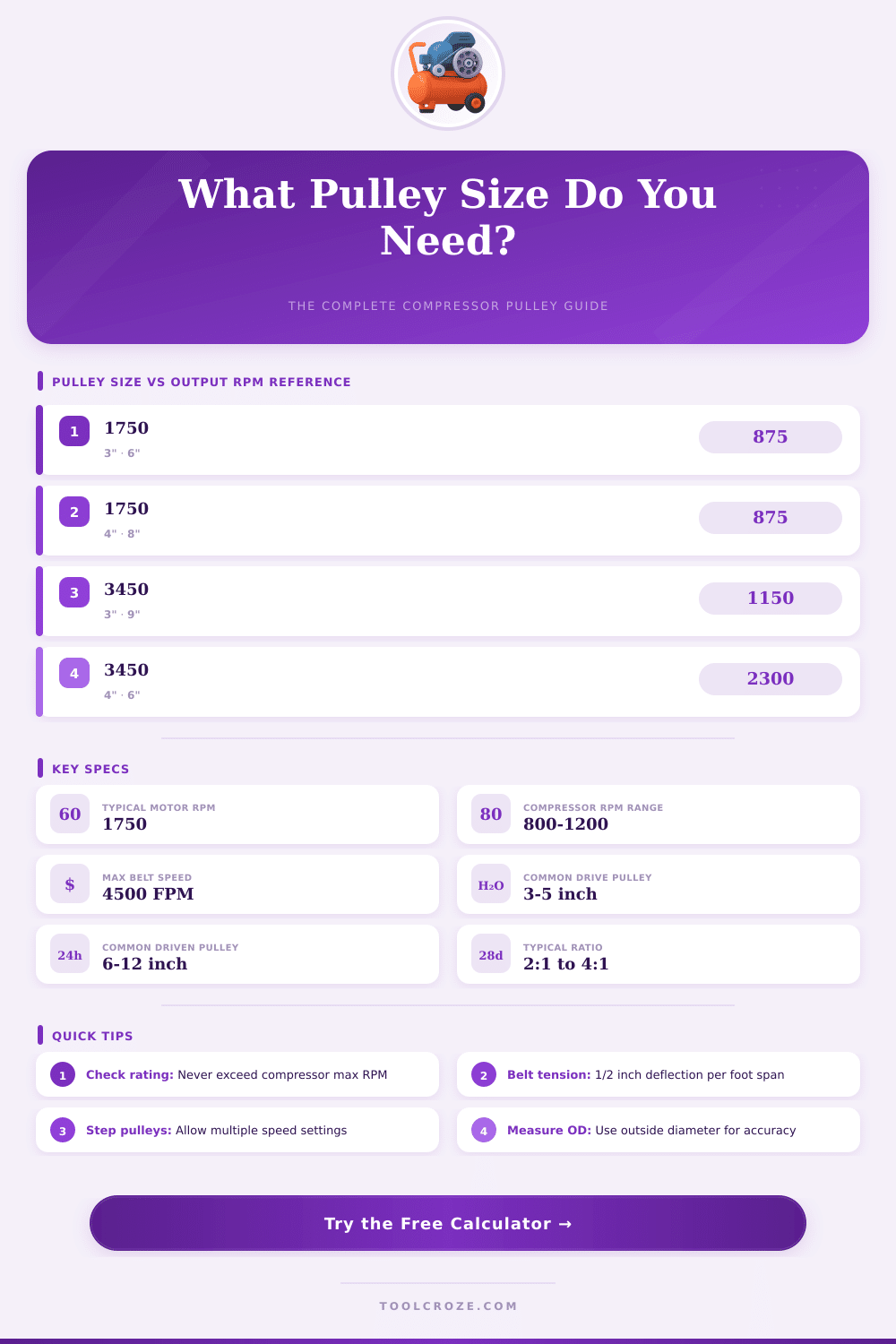
⚙️ Air Compressor Pulley Size Calculator
Calculate output RPM, pulley ratio, belt speed, and driven pulley size using real drive mechanics formulas
| Drive Pulley (in) | Driven Pulley (in) | Ratio | Output RPM | Belt Speed (FPM) | Suitable For |
|---|---|---|---|---|---|
| 2 | 6 | 3.00:1 | 583 | 916 | Twin-Stage Heavy Duty |
| 2.5 | 7 | 2.80:1 | 625 | 1,145 | Twin-Stage Standard |
| 3 | 6 | 2.00:1 | 875 | 1,649 | Single-Stage Standard |
| 3 | 8 | 2.67:1 | 656 | 1,649 | Single-Stage Low Speed |
| 4 | 8 | 2.00:1 | 875 | 2,199 | Single-Stage Medium |
| 4 | 10 | 2.50:1 | 700 | 2,199 | Single-Stage Low Speed |
| 5 | 10 | 2.00:1 | 875 | 2,749 | Industrial Single Stage |
| 6 | 12 | 2.00:1 | 875 | 3,299 | Industrial Large Frame |
| 3 | 5 | 1.67:1 | 1,050 | 1,649 | High-Speed Single Stage |
| 4 | 6 | 1.50:1 | 1,167 | 2,199 | High-Speed Applications |
| Belt Type | Cross Section | Max Speed (FPM) | HP Range | Slip % | Best Use |
|---|---|---|---|---|---|
| A-Section V-Belt | 0.50" x 0.31" | 4,000 | 0.5–5 | 1–3% | Small compressors up to 5HP |
| B-Section V-Belt | 0.66" x 0.41" | 4,500 | 1–10 | 1–3% | Mid-size compressors 3–10HP |
| C-Section V-Belt | 0.88" x 0.53" | 4,500 | 5–25 | 1–3% | Industrial & large compressors |
| Cogged V-Belt | Various | 5,000 | 1–30 | <1% | High-efficiency, reduced heat |
| Poly-V / Ribbed | Multi-rib | 6,000 | 0.5–15 | <1% | Compact, high-flex drives |
| Flat Belt | Varies | 6,000+ | 0.25–50 | 2–5% | High-speed, long center distances |
| Compressor | Motor RPM | Drive Pulley | Driven Pulley | Comp RPM | Max PSI |
|---|---|---|---|---|---|
| Porter Cable C2002 | 3,450 | 1.75" | 5.5" | 1,097 | 150 |
| Ingersoll Rand 2340 | 1,750 | 4.5" | 11" | 716 | 175 |
| Campbell Hausfeld 30-Gal | 1,750 | 3" | 7" | 750 | 135 |
| Quincy QT-54 | 1,750 | 5" | 11" | 795 | 175 |
| DeWalt DXCM301 | 1,750 | 3.5" | 8" | 766 | 155 |
| Craftsman 60-Gal | 1,750 | 4" | 9" | 778 | 175 |
| Generic 5HP Single | 3,450 | 3" | 9" | 1,150 | 125 |
| Rotary Screw 7.5HP | 3,550 | Direct | Direct | 3,550 | 125 |
| Center Dist (in) | Drive 3" / Driven 6" | Drive 4" / Driven 8" | Drive 3" / Driven 9" | Belt Section |
|---|---|---|---|---|
| 8 | ~38" | ~42" | ~44" | A or B |
| 10 | ~42" | ~46" | ~49" | A or B |
| 12 | ~46" | ~51" | ~54" | B |
| 14 | ~50" | ~55" | ~59" | B or C |
| 16 | ~55" | ~60" | ~64" | B or C |
| 20 | ~63" | ~69" | ~74" | C |
Choosing the right size of Pulley for Air Compressor really matters although many folks ignore it. This part decides the speed of the pump, and this one detail affects everything, from the fill of the tank to the life of the pump itself.
Here is the basic reason. If you put a bigger Pulley on the engine, the pump of the compressor spins more quickly. Choosing a smaller one, it slows down.
How to Choose the Right Pulley Size for an Air Compressor
The ratio depends on sizes. When the Pulley of the engine must have half of the width of that on the compressor, that happens because the engine itself runs at almost double speed than the pump really needs.
Consider a real case: Air Compressor with 14-inch Pulley on the pump and 7.5-inch on the engine, that spins at 1725 RPM, would make the pump turn at around 924 RPM. That is a good balance, that sits nicely in the safe range, with top pump speed of around 1060 and lowest at about 400. Small changes on the motor Pulley can change those values a lot.
A Pulley of 5 inches on the engine gives you around 89 percent of the original speed. Growing it to 5.5 inches, you reach almost 98 percent. And a 6-inch Pulley?
It would force the pump to spin more than 7 percnet more quickly than before, which probably does not help it long term.
Online calculators for Pulley and RPM ratios are very useful when one works with belt-driven systems. Air Compressors especially benefit from such tools, that are easily found.
A smart way to find the size of Pulley is too stay inside certain limits. In many setups, one does well with a Pulley between 3.5 and 3.8 inches. Faster spinning of the pump clearly fills the tank more soon, but it is a trade-off (parts wear sooner).
A big Pulley on the engine brings higher RPM to the pump, and extra speed needs more power for the same pressure.
The speed of the engine itself makes a big difference. When some switch from an engine at 3450 RPM to one at 1750 RPM, one must almost double the width of the Pulley to keep the same speed at the pump. A Pulley of 8 inches with a 1750-RPM engine works very well.
Also, such a 1750-RPM engine gives double the turning force, so that you do not lose anything.
Most Air Compressors run with standard 5/8-inch belts. Using a small grooved Pulley can need a ribbed or split belt instead, that costs more and does not last as long. When a standing Air Compressor falls, the Pulley commonly takes the hit.
The guide rail could break, and the crankshaft bends along with it. Before removing the Pulley, it is worth checking if the crank turns straight. That saves a lot of time.
A Pulley of 3.5 inches on the engine can reach thesame groove speed in some setups, so finding the right match surely deserves the time spent.