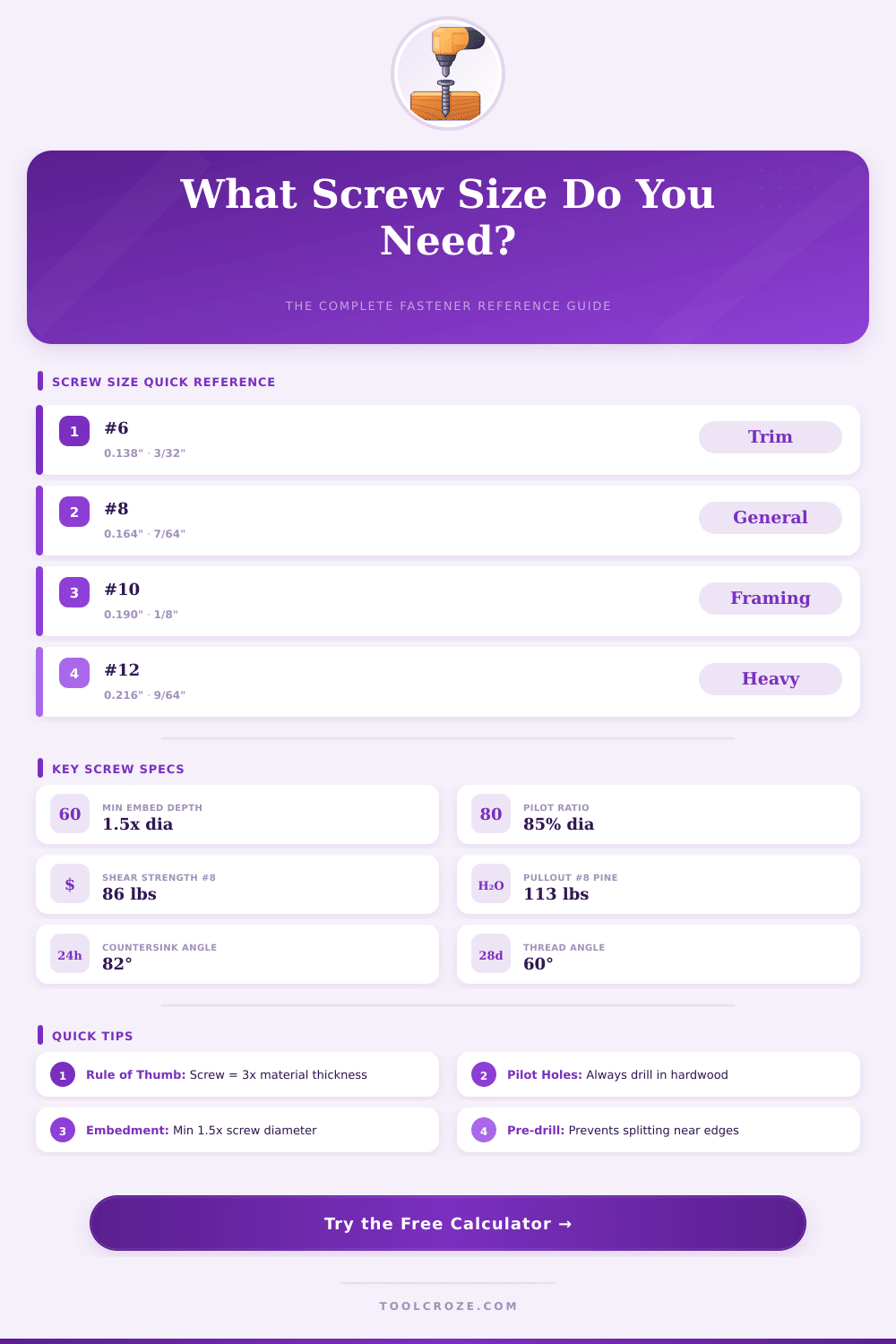
🔧 Screw Size Calculator
Find the right screw diameter, length, pilot hole size, and embedment depth for any material and project
| Screw Size | Shank Dia (in) | Shank Dia (mm) | Pilot Hole Softwood | Pilot Hole Hardwood | Clearance Hole | Countersink Dia |
|---|---|---|---|---|---|---|
| #2 | 0.086" | 2.18 mm | 1/16" | 5/64" | 3/32" | 1/4" |
| #3 | 0.099" | 2.51 mm | 5/64" | 3/32" | 7/64" | 9/32" |
| #4 | 0.112" | 2.84 mm | 5/64" | 3/32" | 1/8" | 5/16" |
| #5 | 0.125" | 3.18 mm | 1/16" | 7/64" | 9/64" | 11/32" |
| #6 | 0.138" | 3.51 mm | 3/32" | 7/64" | 9/64" | 3/8" |
| #7 | 0.151" | 3.84 mm | 3/32" | 1/8" | 5/32" | 13/32" |
| #8 | 0.164" | 4.17 mm | 7/64" | 1/8" | 11/64" | 7/16" |
| #10 | 0.190" | 4.83 mm | 1/8" | 9/64" | 3/16" | 1/2" |
| #12 | 0.216" | 5.49 mm | 9/64" | 5/32" | 7/32" | 9/16" |
| #14 | 0.242" | 6.15 mm | 11/64" | 3/16" | 15/64" | 5/8" |
| 5/16 Lag | 0.3125" | 7.94 mm | 3/16" | 7/32" | 3/8" | — |
| 3/8 Lag | 0.375" | 9.53 mm | 1/4" | 9/32" | 7/16" | — |
| 1/2 Lag | 0.500" | 12.70 mm | 5/16" | 3/8" | 9/16" | — |
| Screw Size | Material | Shear Strength (lb) | Pullout Strength (lb/in embed) | Min Embed Depth | Rec. Torque (in-lb) |
|---|---|---|---|---|---|
| #6 | Softwood | 52 | 68 | 1.0" | 12 |
| #8 | Softwood | 86 | 113 | 1.25" | 20 |
| #10 | Softwood | 120 | 148 | 1.5" | 30 |
| #8 | Hardwood | 104 | 145 | 1.0" | 28 |
| #10 | Hardwood | 148 | 190 | 1.25" | 42 |
| #8 | Plywood | 78 | 95 | 1.0" | 18 |
| #8 | MDF | 55 | 70 | 1.5" | 14 |
| 5/16 Lag | Softwood | 310 | 220 | 2.5" | 110 |
| 3/8 Lag | Softwood | 480 | 310 | 3.0" | 180 |
| #10 | Aluminum | 185 | — | 0.5" | 15 |
| Project | Material | Rec. Screw Size | Rec. Length | Pilot Hole | Notes |
|---|---|---|---|---|---|
| Deck boards (2x6) | Softwood / Composite | #10 Deck | 3" | 7/64" | Stainless or coated |
| Framing (2x4 to 2x4) | Softwood | #10 or 16d | 3.5" | 1/8" | Structural screws preferred |
| Cabinet face frame | Hardwood | #8 | 2.5" | 1/8" | Countersink required |
| Drywall to stud | Drywall + Softwood | #6 Coarse | 1.25" | None needed | Self-drilling tip |
| MDF shelving | MDF | #8 | 2.0" | 9/64" | Pre-drill always |
| Plywood subfloor | Plywood + Joist | #8 or #10 | 1.75" | 7/64" | Every 8" on edges |
| Aluminum panel | Aluminum Sheet | #8 SMS | 3/4" | #29 drill | Self-tapping |
| Lag into ledger | LVL / Softwood | 1/2 Lag | 4" | 5/16" | Washer required |
The sizes of screws can seem confusing at first, but when you understand the basics, everything makes sense. You usually call the small sizes by screw number, while for the bigger ones you use fractions like 1/4″, 5/16″ or 3/8″. When the size is 1/4″ or smaller the number is the most common way to show it.
You call that the nominal size. The thread pitch in American sizes is measured by threads per inch, also called TPI.
How to Read Screw Sizes
A name like “#8 x 1-1/2″ for a screw may seem weird at first. However the first number shows the diameter, and the second shows the length. For instance, a screw 6-32 x 1 1/2” has diameter #6, 32 threads per inch and length of one and a half inches.
That thread count almost duobles that of a typical wood screw. Similarly a 3/8″-16 screw works the same way; here 3/8″ is the diameter, and 16 shows the threads per inch.
American screws in the usual number system go from 0 to 12, and they are typical machine screws. Interestingly, now people mostly use the even sizes, and #12 is not very common. A #10 wood screw matches the same pilot whole as a #10 machine screw, which is useful to know.
Metric screws work a bit differently. An M2 screw has 2 mm outer thread diameter, with pitch in millimeters. A #2 screw in the imperial system has a diameter around 0.086 inches and uses TPI instead.
In the metric system, if the thread pitch is not listed, it is probably the standard for that size. M3 is among the most popular metric sizes. Some products on the American market use the metric system, for instance, a certain maker of computer cases prefers M3 screws instead of the American 6-32 standard.
You most simply measure the length of a screw from the flat surface of the head to the tip below. The head is bigger than the body. The sizes for a pilot hole show how big a hole the body and the head need.
Info about main diameter usually counts for screws with flat head and oval head, while those with round head are about 15% smaller.
Identifying screws can be hard, because they often are a bit smaller than the stated nominal size in areas around the thread. A 10-32 UNF screw has a diameter of 0.19″, and a 5 mm metric screw with coarse thread is 0.1968″… Really close, but not the same.
A digital caliper helps a lot here. A good one costs around 50 dollars and lets you quickly figure out what screw it is by hand.
Fine and coarse threads also matter. Standard fine thread usually has 24 TPI, while for coarse it is 16 TPI. The screw usually should pass through the thinner part and enter by thread into the thicker.
There is no strict rule for the length of a screw… Sometimes theconstruction details limit the possible choices.