⚡ AC Wire Gauge Calculator
Find the correct AWG wire size for any AC circuit — NEC-compliant with voltage drop analysis
| AWG / kcmil | Diameter (mm) | Area (mm²) | 60°C Ampacity | 75°C Ampacity | 90°C Ampacity | DC Resistance (Ω/km) | Typical Use |
|---|---|---|---|---|---|---|---|
| 14 AWG | 1.63 | 2.08 | 15A | 20A | 25A | 8.286 | Lighting, low-load outlets |
| 12 AWG | 2.05 | 3.31 | 20A | 25A | 30A | 5.211 | General outlets, 20A circuits |
| 10 AWG | 2.59 | 5.26 | 30A | 35A | 40A | 3.277 | Dryers, A/C units, ranges |
| 8 AWG | 3.26 | 8.37 | 40A | 50A | 55A | 2.061 | Large appliances, water heaters |
| 6 AWG | 4.11 | 13.3 | 55A | 65A | 75A | 1.296 | Subpanels, EV chargers (50A) |
| 4 AWG | 5.19 | 21.2 | 70A | 85A | 95A | 0.8152 | 60-70A circuits, small subpanels |
| 3 AWG | 5.83 | 26.7 | 85A | 100A | 115A | 0.6459 | 100A subpanels |
| 2 AWG | 6.54 | 33.6 | 95A | 115A | 130A | 0.5118 | 100-125A service |
| 1 AWG | 7.35 | 42.4 | 110A | 130A | 145A | 0.4066 | 125A service entrance |
| 1/0 AWG | 8.25 | 53.5 | 125A | 150A | 170A | 0.3224 | 150A service, large subpanels |
| 2/0 AWG | 9.27 | 67.4 | 145A | 175A | 195A | 0.2557 | 175-200A service |
| 3/0 AWG | 10.4 | 85.0 | 165A | 200A | 225A | 0.2028 | 200A service entrance |
| 4/0 AWG | 11.7 | 107 | 195A | 230A | 260A | 0.1608 | 200-230A service |
| 250 kcmil | 12.8 | 127 | 215A | 255A | 290A | 0.1356 | 230-250A service |
| 350 kcmil | 15.2 | 177 | 260A | 310A | 350A | 0.09699 | 300-350A service |
| AWG / kcmil | Diameter (mm) | 60°C Ampacity | 75°C Ampacity | 90°C Ampacity | DC Resistance (Ω/km) | Copper Equivalent |
|---|---|---|---|---|---|---|
| 12 AWG (Al) | 2.05 | 15A | 20A | 25A | 8.550 | 14 AWG Cu |
| 10 AWG (Al) | 2.59 | 25A | 30A | 35A | 5.376 | 12 AWG Cu |
| 8 AWG (Al) | 3.26 | 30A | 40A | 45A | 3.380 | 10 AWG Cu |
| 6 AWG (Al) | 4.11 | 40A | 50A | 60A | 2.127 | 8 AWG Cu |
| 4 AWG (Al) | 5.19 | 55A | 65A | 75A | 1.338 | 6 AWG Cu |
| 2 AWG (Al) | 6.54 | 75A | 90A | 100A | 0.8394 | 4 AWG Cu |
| 1/0 AWG (Al) | 8.25 | 100A | 120A | 135A | 0.5290 | 2 AWG Cu |
| 2/0 AWG (Al) | 9.27 | 115A | 135A | 150A | 0.4197 | 1 AWG Cu |
| 3/0 AWG (Al) | 10.4 | 130A | 155A | 175A | 0.3325 | 1/0 AWG Cu |
| 4/0 AWG (Al) | 11.7 | 150A | 180A | 205A | 0.2637 | 2/0 AWG Cu |
| AWG | 15A @ 25 ft | 15A @ 50 ft | 20A @ 25 ft | 20A @ 50 ft | 30A @ 50 ft | 30A @ 100 ft |
|---|---|---|---|---|---|---|
| 14 AWG | 0.62% | 1.24% | 0.83% | 1.66% | — | — |
| 12 AWG | 0.39% | 0.78% | 0.52% | 1.04% | 1.56% | 3.12% |
| 10 AWG | 0.25% | 0.49% | 0.33% | 0.65% | 0.98% | 1.96% |
| 8 AWG | 0.16% | 0.31% | 0.21% | 0.41% | 0.62% | 1.23% |
| 6 AWG | 0.10% | 0.20% | 0.13% | 0.26% | 0.39% | 0.78% |
| Application | Typical Load (A) | Min Wire (Cu) | Min Wire (Al) | Breaker Size | Notes |
|---|---|---|---|---|---|
| General Lighting | 10–15A | 14 AWG | 12 AWG | 15A | Max 80% continuous |
| Standard Outlets | 12–16A | 12 AWG | 10 AWG | 20A | GFCI in wet areas |
| Kitchen Appliances | 15–20A | 12 AWG | 10 AWG | 20A | Dedicated circuits required |
| Electric Dryer | 24A | 10 AWG | 8 AWG | 30A | 4-wire required (NEC 2011+) |
| Electric Range | 40A | 8 AWG | 6 AWG | 50A | 4-wire, 240V |
| Electric Water Heater | 18.75A | 10 AWG | 8 AWG | 30A | Continuous load, 240V |
| Central A/C (3 ton) | 20–25A | 10 AWG | 8 AWG | 30–40A | Check MCA on nameplate |
| EV Charger (Level 2) | 32–40A | 8 AWG | 6 AWG | 40–50A | Continuous load, 240V |
| 100A Subpanel | 80A | 4 AWG | 2 AWG | 100A | Check voltage drop on long runs |
| 200A Service | 160A | 3/0 AWG | 4/0 AWG | 200A | Main service entrance |
Choosing the right size of wire for keeping of short-lived air conditioner? It seems easy, but quickly it becomes confusing. The American system of wire sizes, known as AWG, exists since 1857 and it is used in North America.
Basically it defines the thicknesses of round electrical cables according to their diameter, and if you want everything about the technical details, the standard ASTM B 258 will care about that.
Choose the Right Wire Size for a Short-Lived Air Conditioner
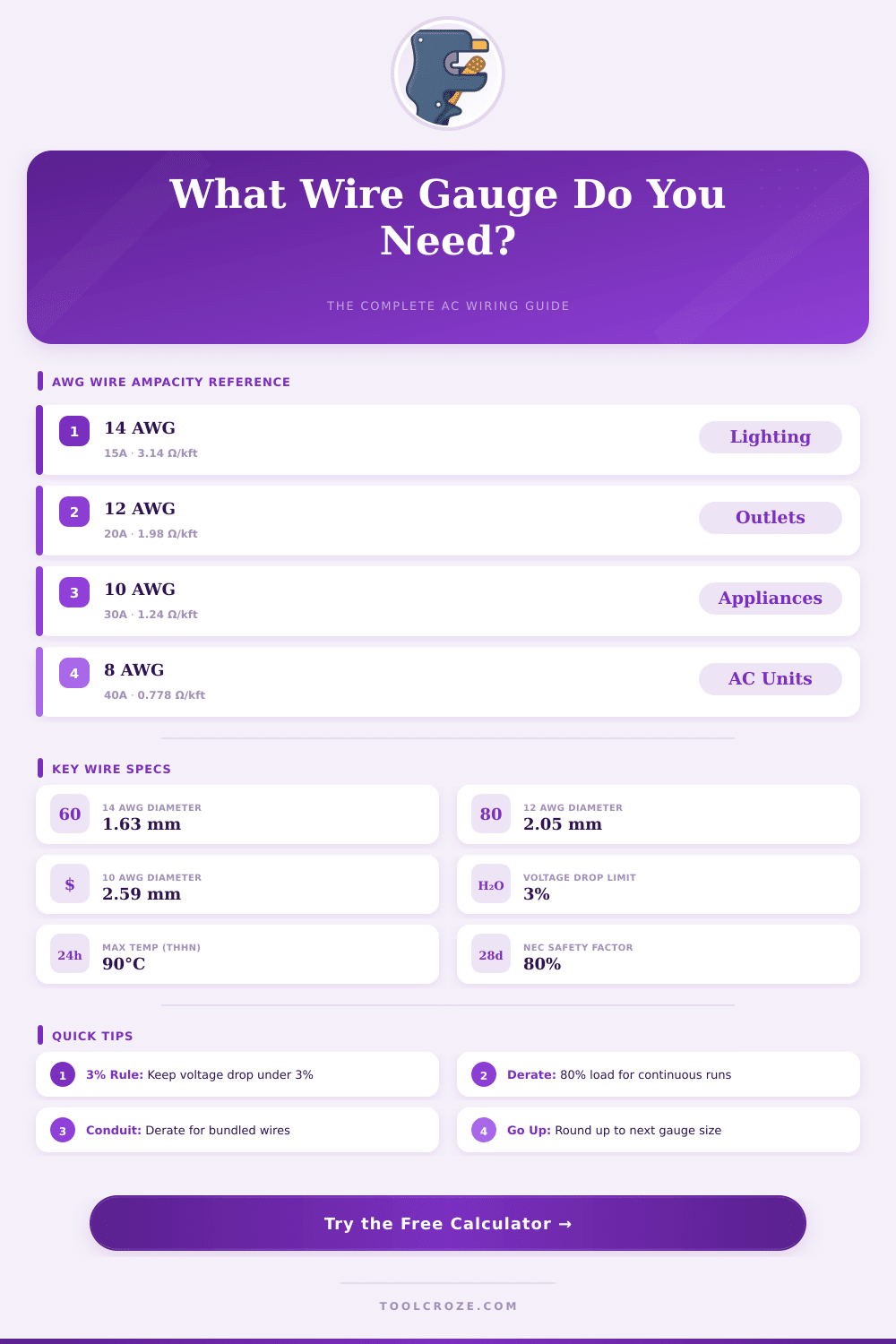
Here the key spot: the sizes of wires relate to the ability to carry amps. For typical home installation in 120 volts, circuit of 15 amps require wire in 14 AWG. For 20 amps?
It is 12 AWG. And for 30 amps, choose 10 AWG. Use something more thin than 14th size for 120 volts?
That breaks the rules. When you read label of wire, the first number points the thickness, while the second show how many separate conductors rest inside. The bare conductors do not affect that count.
For finding the size of wire for short-lived air conditioner, start with simple action: check the nameplate. Every unit has label that poitns the needed amps and voltage. For dedicated circuit, the size must hold 125 percent of the called continuous amp force.
Calculator for wire size helps to find the smallest right thickness for safe power, whether for DC or for AC system.
Real cases become interesting. For instance, I saw little unit that required at least 12th size with 35-amp breaker. Usually, copper wire in 12 AWG limits too 20 amps.
Other time, the unit required minimal ability of 21.5 amps and one installs it with 8th size THHN/THWN wire in conduit with 40-amp breaker. Use 8th size can seem too much, truly, it is hard to handle. In most cases, 10th size is more practical.
The drop of voltage is other part of the problem. In roughly 50 feet, wire 14/2 lose only a bit more than 3 percent of voltage. If the cable is too long or too thin, the unit will not cool well.
Unit of 24 000 BTU on too thin installation easily loses power. The distance matters, just as the surrounding temperature; sometimes that mix requires thickness bigger than the basic rules point.
THHN is one of the common insulating type; Thermoplastic High Heat Resistant Nylon Cover. Most 120-volt outlets use 12/2 or 14/2 Romex. 14th size will not work for big short-lived unit, but it answers for good fan.
Use heavier than suggested will not change the first actions or theimpact of energy. I found in manuals that 12th size is minimal in 60 and 75 degrees, with maximum length between 49 and 51 feet.