⚡ Generator Size Calculator
Add your appliances and get an accurate generator wattage recommendation instantly
| Appliance | Running Watts | Starting Watts | Surge Factor | Category |
|---|---|---|---|---|
| Refrigerator (18 cu ft) | 150 W | 600 W | 4x | Essential |
| Central AC (1.5-ton) | 1,800 W | 5,400 W | 3x | Comfort |
| Window AC (10,000 BTU) | 1,200 W | 3,600 W | 3x | Comfort |
| Sump Pump (1/2 HP) | 800 W | 2,400 W | 3x | Essential |
| Well Pump (1 HP) | 1,000 W | 3,000 W | 3x | Essential |
| Electric Water Heater | 4,000 W | 4,000 W | 1x | Comfort |
| Electric Furnace (10 kW) | 10,000 W | 10,000 W | 1x | Heating |
| Microwave (1,000 W) | 1,000 W | 1,000 W | 1x | Kitchen |
| Electric Range (1 burner) | 1,200 W | 1,200 W | 1x | Kitchen |
| Dishwasher | 1,200 W | 1,800 W | 1.5x | Kitchen |
| Washing Machine | 500 W | 2,300 W | 4.6x | Laundry |
| Clothes Dryer (electric) | 5,400 W | 6,750 W | 1.25x | Laundry |
| LED Lighting (10 bulbs) | 100 W | 100 W | 1x | Lighting |
| TV (55" LED) | 100 W | 100 W | 1x | Electronics |
| Desktop Computer | 300 W | 300 W | 1x | Electronics |
| Laptop Computer | 65 W | 65 W | 1x | Electronics |
| CPAP Machine | 30 W | 30 W | 1x | Medical |
| Oxygen Concentrator | 300 W | 400 W | 1.3x | Medical |
| Table Saw (10") | 1,800 W | 3,600 W | 2x | Workshop |
| Circular Saw (7-1/4") | 1,400 W | 2,800 W | 2x | Workshop |
| Air Compressor (2 HP) | 1,500 W | 4,500 W | 3x | Workshop |
| Angle Grinder (4.5") | 850 W | 1,700 W | 2x | Workshop |
| Electric Grill / Griddle | 1,500 W | 1,500 W | 1x | Outdoor |
| String Lights (LED 50 ft) | 25 W | 25 W | 1x | Outdoor |
| Generator Size | Gasoline (gal/hr) | Propane (lb/hr) | Diesel (gal/hr) | Nat. Gas (cu ft/hr) |
|---|---|---|---|---|
| 1,000 W (1 kW) | 0.10 | 0.23 | 0.07 | 1.4 |
| 2,000 W (2 kW) | 0.20 | 0.46 | 0.15 | 2.8 |
| 3,000 W (3 kW) | 0.30 | 0.69 | 0.22 | 4.2 |
| 5,000 W (5 kW) | 0.50 | 1.15 | 0.37 | 7.0 |
| 7,500 W (7.5 kW) | 0.75 | 1.73 | 0.55 | 10.5 |
| 10,000 W (10 kW) | 1.00 | 2.30 | 0.74 | 14.0 |
| 15,000 W (15 kW) | 1.50 | 3.46 | 1.10 | 21.0 |
| 20,000 W (20 kW) | 2.00 | 4.60 | 1.47 | 28.0 |
| Generator Size | Best Use Case | Typical Running Time | Key Limitation |
|---|---|---|---|
| 1,000–2,000 W | Camping, tailgate, phone/laptop charging | 8–10 hrs (1 gal gas) | No AC, no large motors |
| 2,000–4,000 W | RV, small workshop, essential home circuits | 6–8 hrs (2 gal gas) | One large motor at a time |
| 4,000–6,500 W | Home backup, construction, window AC | 7–9 hrs (3 gal gas) | No central AC |
| 6,500–9,000 W | Full home essentials + 1 central AC | 8–10 hrs (6 gal gas) | Multiple large motors |
| 9,000–12,000 W | Whole-house backup, small business | 8–12 hrs (8 gal gas) | Requires heavy-duty transfer switch |
| 12,000–20,000 W | Large home, commercial, farm operations | Continuous (standby) | Professional install required |
| Scenario | Total Running W | Peak Starting W | Recommended Generator |
|---|---|---|---|
| Weekend Camping | 300 W | 300 W | 1,000–2,000 W Inverter |
| RV with Rooftop AC | 2,000 W | 5,500 W | 4,000 W Portable |
| Home Power Outage (basic) | 2,500 W | 5,000 W | 5,000–6,500 W Portable |
| Home Power Outage (full) | 6,000 W | 12,000 W | 10,000–12,000 W Standby |
| Construction Site | 3,500 W | 7,200 W | 7,500 W Portable |
| Workshop (power tools) | 4,000 W | 8,000 W | 8,000 W Portable |
| Food Truck | 4,500 W | 6,000 W | 6,500 W Portable/Inverter |
| Tailgate Party | 800 W | 1,500 W | 2,000 W Inverter |
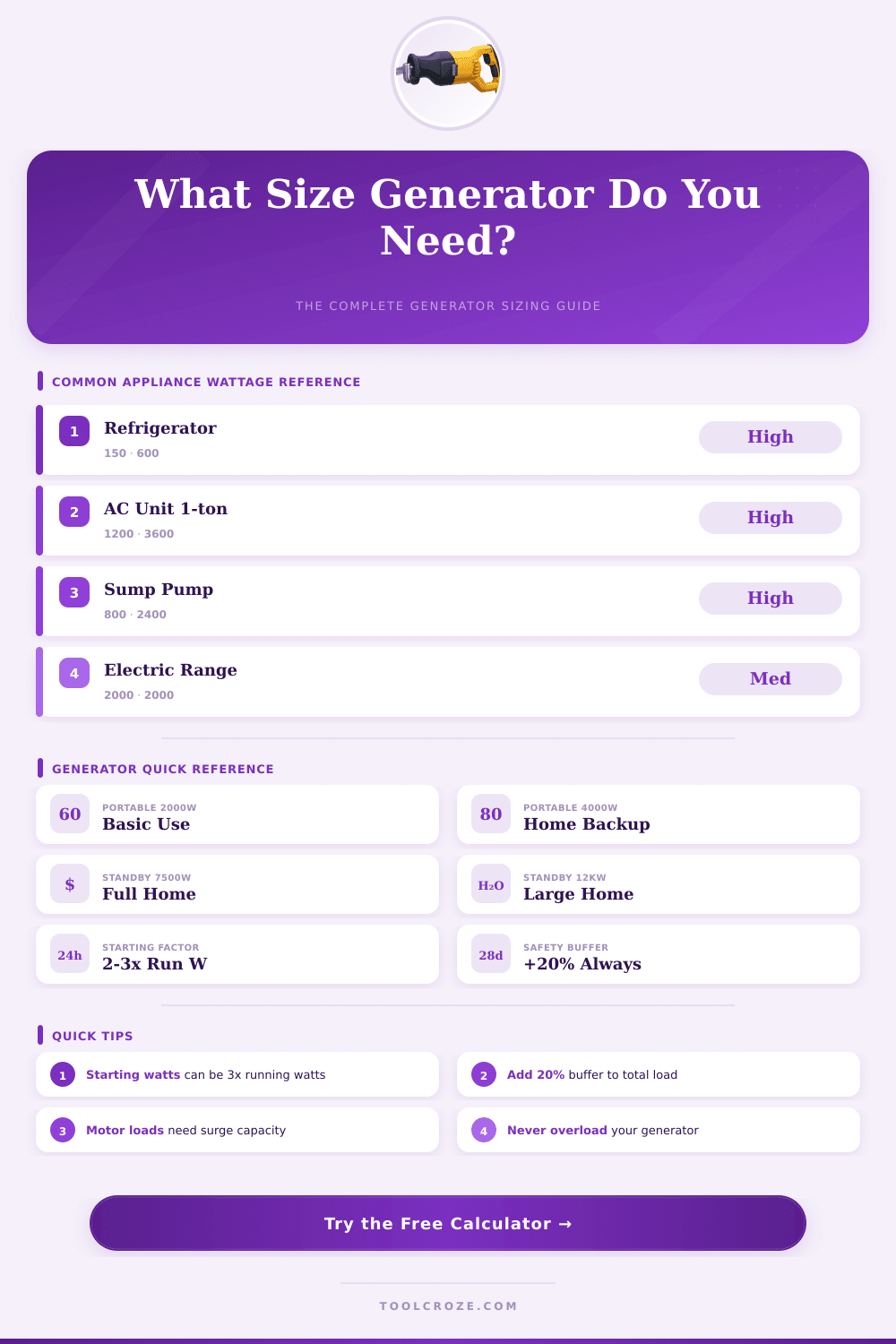
Find the right size of generator genuinely depends on final balance. Choose too little and it will turn during the outage Choose too big and you waste money for capacity, that you simply will not use. Find the ideal place and you remove serious headache.
Generators are not one-size-fits-all, they have very different power in watts according to what you want to keep working. Little model can work for some regular devices. But whole-home back-up generator?
How to choose the right generator size
That truly is other case. For big house with electrical kitchen, several air conditioners and heating systems in function, or simply large amount of electrical loads, you probably require something around 20 kW or more, so that nothing struggles durnig the darkness.
Here where many folks err: they set themselves on total watts and end here. You believe, that 5300-watt generator will work, but later come the realities. The main thing, that catches folks off guard, are the starting watts…
Sometimes called surge watts. They entirely differ from the running watts. When devices first switch, they require big power-burst, and that sudden spike can overload little unit before it even starts.
Other mistake is the sizing according to daily energy. That is false. Seriously are your simultaneous loads, that, what runs at the same moment.
If everything turns on at once, you require stronger generator. If devices twist according to cycle threw the day, much more little model does the task. The wise way is simply add the running watts of those devices, that you want to use together.
The square feet of your house genuinely are not the main factor here. Houses of 3000 square feet with mostly gas devices commonly require much less generator power than one would think. Take for instance four-story place with five bedrooms, that ran well by means of 7500-watt generator, because heating went on oil and cook on gas.
Compare that with 2200-square foot house with all-electrical devices, that required 9500-watt full-load unit for cover around 90% of typical needs.
If you have 100-amp service and want grid-like results? You intend around 22 kW. For only basic needs, go to smaller solutions.
22 kW-system could be too much for houses under 2100 square feet. On the other hand, running generator at full gas always is not smart. The best balance is use your generator at 30 to 50 percent of his maximum load the most of the time.
When you reach the 7500-watt range, mobility takes real hit. Most units weigh well above 200 pounds. Rather, those extra watts allow you to power whole workspace.
Lights, heaters, several tools running at once. Simply recall, what your generator genuinely fits, and resist the temptation toshare too many power-hungry devices in turn.