⚡ DC Wire Gauge Calculator
Find the correct AWG wire size for any 12V, 24V, or 48V DC circuit based on current, run length, and allowable voltage drop
| AWG Size | Diameter (in) | Diameter (mm) | Max Amps (open air) | Max Amps (conduit) | Resistance (Ω/1000ft) | Common Applications |
|---|---|---|---|---|---|---|
| 20 AWG | 0.032 | 0.81 | 11A | 7A | 10.15 | Signal wires, sensors |
| 18 AWG | 0.040 | 1.02 | 16A | 10A | 6.39 | 12V accessories, lighting |
| 16 AWG | 0.051 | 1.29 | 22A | 13A | 4.02 | Tail lights, small motors |
| 14 AWG | 0.064 | 1.63 | 32A | 17A | 2.53 | General 12V circuits, pumps |
| 12 AWG | 0.081 | 2.05 | 41A | 23A | 1.59 | High-draw 12V, 24V lighting |
| 10 AWG | 0.102 | 2.59 | 55A | 33A | 0.999 | Solar panels, RV mains |
| 8 AWG | 0.128 | 3.26 | 73A | 46A | 0.628 | Large motors, inverters |
| 6 AWG | 0.162 | 4.11 | 101A | 65A | 0.395 | High-current DC, battery cables |
| 4 AWG | 0.204 | 5.19 | 135A | 85A | 0.249 | Battery banks, large inverters |
| 2 AWG | 0.258 | 6.54 | 181A | 115A | 0.156 | Starter cables, alternators |
| 1/0 AWG | 0.325 | 8.25 | 245A | 155A | 0.098 | High-current battery systems |
| 2/0 AWG | 0.365 | 9.27 | 285A | 185A | 0.078 | Large vehicle battery cables |
| 4/0 AWG | 0.460 | 11.7 | 360A | 230A | 0.049 | Welding cables, bus bars |
| AWG | 10A @ 10ft | 10A @ 20ft | 20A @ 10ft | 20A @ 20ft | 30A @ 10ft | 30A @ 20ft |
|---|---|---|---|---|---|---|
| 18 AWG | 1.28V (10.6%) | 2.56V (21%) | 2.56V (21%) | — | — | — |
| 16 AWG | 0.80V (6.7%) | 1.61V (13%) | 1.61V (13%) | 3.22V (27%) | — | — |
| 14 AWG | 0.51V (4.2%) | 1.01V (8.4%) | 1.01V (8.4%) | 2.02V (17%) | 1.52V (13%) | 3.04V (25%) |
| 12 AWG | 0.32V (2.7%) | 0.64V (5.3%) | 0.64V (5.3%) | 1.27V (11%) | 0.95V (7.9%) | 1.91V (16%) |
| 10 AWG | 0.20V (1.7%) | 0.40V (3.3%) | 0.40V (3.3%) | 0.80V (6.7%) | 0.60V (5.0%) | 1.20V (10%) |
| 8 AWG | 0.13V (1.1%) | 0.25V (2.1%) | 0.25V (2.1%) | 0.50V (4.2%) | 0.38V (3.1%) | 0.75V (6.3%) |
| 6 AWG | 0.08V (0.7%) | 0.16V (1.3%) | 0.16V (1.3%) | 0.32V (2.6%) | 0.24V (2.0%) | 0.47V (3.9%) |
| Project | Voltage | Typical Current | Typical Run | Recommended AWG | Notes |
|---|---|---|---|---|---|
| LED Light Strip | 12V | 2–5A | 10–20ft | 18 AWG | Use 16 AWG for longer runs |
| 12V Water Pump | 12V | 8–15A | 15–30ft | 14 AWG | Size for startup surge |
| RV House Battery | 12V | 50–100A | 3–8ft | 4–2 AWG | Short runs, high current |
| Solar Panel to Controller | 12–48V | 15–30A | 20–60ft | 10–8 AWG | Minimize voltage drop |
| 12V Car Stereo Amp | 12V | 20–40A | 10–20ft | 8–6 AWG | Fuse within 18in of battery |
| DC Motor (small) | 24V | 5–15A | 10–40ft | 14–12 AWG | Derate for motor starting |
| E-Bike Battery | 36–52V | 15–30A | 2–5ft | 12–10 AWG | Use high-flex silicone wire |
| Boat Bilge Pump | 12V | 8–20A | 15–25ft | 12 AWG | Use tinned copper for marine |
| 12V Winch | 12V | 80–400A | 5–15ft | 2–4/0 AWG | Short cable, heavy gauge critical |
| 24V Sprinkler Valve | 24V | 0.5–1A | 50–200ft | 18–16 AWG | Voltage drop less critical |
| Material | Resistivity (nΩ·m) | Relative Conductivity | Temp Coefficient (/°C) | Best For | Vs Copper Factor |
|---|---|---|---|---|---|
| Copper (annealed) | 1.724 | 100% | 0.00393 | All DC applications | 1.00x |
| Tinned Copper | 1.741 | 99% | 0.00393 | Marine, humid environments | 1.01x |
| Aluminum | 2.82 | 61% | 0.00429 | Long runs, weight-sensitive | 1.64x |
| CCA (Copper-Clad Al) | 2.50 | 69% | 0.00410 | Budget applications only | 1.45x |
Choosing the right wire for permanent electricity matters a lot. It ensures safety and good working of the electrical systems. One finds such wires in electronic devices, cars and solar panels.
Choose the right kind and it can help to keep everything safe and efficient.
How to Choose the Right Wire for Permanent Electricity
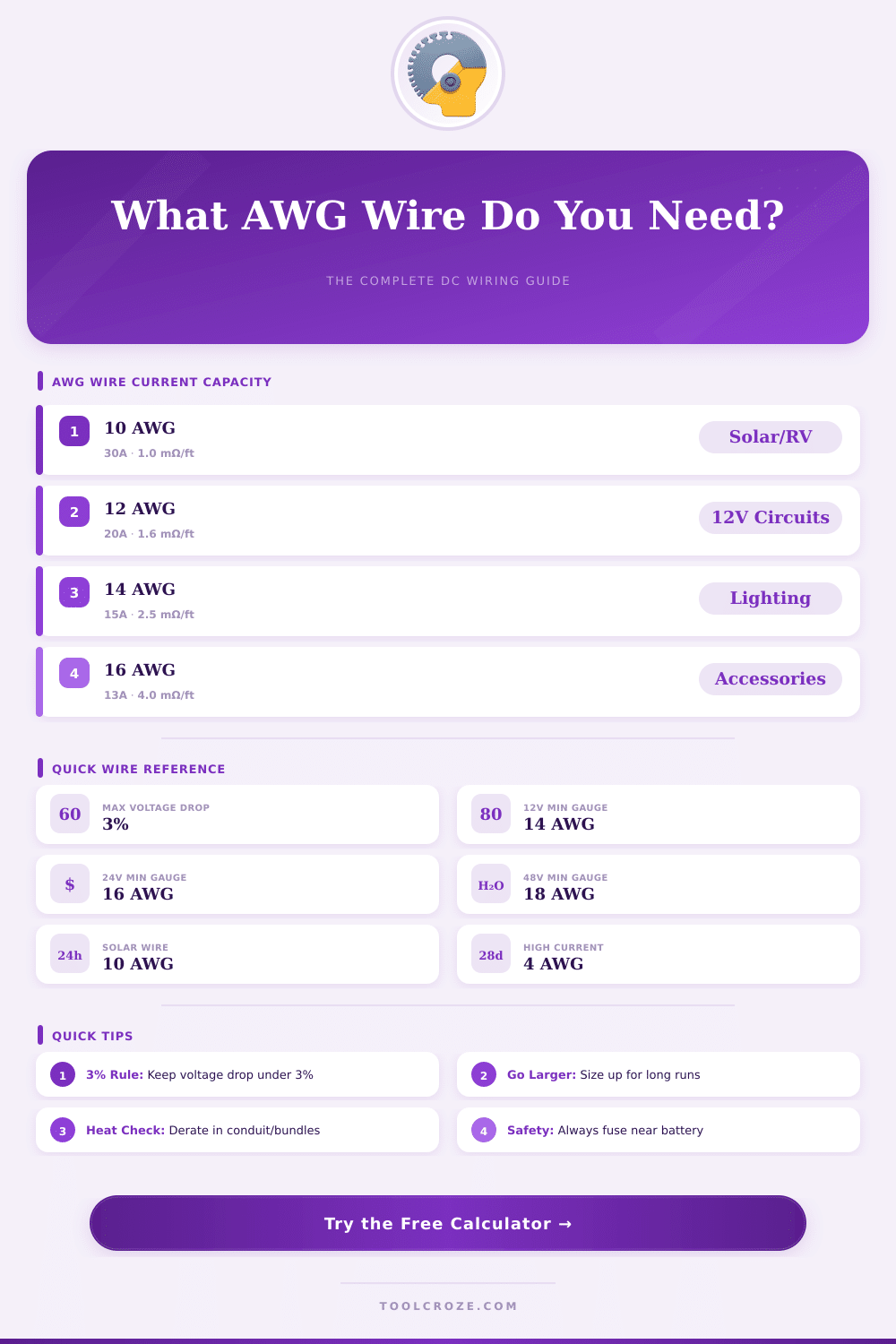
The thickness of wires measures according to the American system of wire gauge ratings, usually called AWG. Low number in AWG points to thicker wire. Thick wires fit to carry bigger loads.
Tables about AWG data show the maximum amp rating for various thicknesses, what helps to count the wanted size.
In systems with permanent electricity the voltage fall is an important topic. For instance, using 12 wire gauge during 6 feet in 12 volts and 20 amps results in around 3.4 percent voltage fall, so that at the finish stay only about 11.6 volts. For a 12-volt heater, that requires 40 amps, on 10 wire gauge the maximum distance is only 2.8 feet, before the voltage fall becomes a problem.
If one doubles the length, the toll reaches around 4 percent, what does not work for heaters.
The distance changes everything. For guide of a trolley the recommended thicknesses start at 8 wire gauge for 5 feet and reach 2 wire gauge at 20 feet. A water pump in 24 volts and 4 amps with 40-foot wire run requires according to tables 10 wire gauge or maybe 12 wire gauge.
At permanent current engine with 8.5 amps on a 20-foot way 10 wire gauge is the best choice.
The resistance of wire commonly is listed in ohms for 1000 feet. For a 10-foot way it is enough to share that number by 100, to get the total resistance in both parts of the wire. Copper owns very low specific resistance, because of what it is so liked.
In systems with alternating electricity 10 wire gauge works for 30 amps, but for permanent electricity the rating depends on the voltage and the length of the wire.
For systems with low power in permanent electricity it is more simple to use one type of wire four the whole setup. In alternating electricity, where circuits have different needs about power and many wires, it is best to choose the thickest rating for every circuit. Wire in panels for permanent electricity does not always follow the same minimums as for alternating electricity.
For instance, wiring up to PLC-cards one can use 16- or 18-AWG-wire, if the circuits are for permanent electricity.
At 20 amps of steady use 12 wire gauge works for permanent electricity just as well as for alternating. At around 6.5 amps 14 AWG is a reliable option. 22-AWG-wire one can use for 12-volt permanent electricity in around 0.5 amps without problems.
Too thin wires commonly cause smoke or break at the weakest place, so mind that. Too thick wires never create safety risks, unless they lack a proper fuse. The amp rating of any chosen wire should be at least 125 percent of thesteady current flow through it.