
Both Black & Decker and DeWalt are owned by Stanley Black & Decker, so why wouldn’t their batteries be interchangeable? They’re not. In fact, their designs couldn’t be any different than each other.
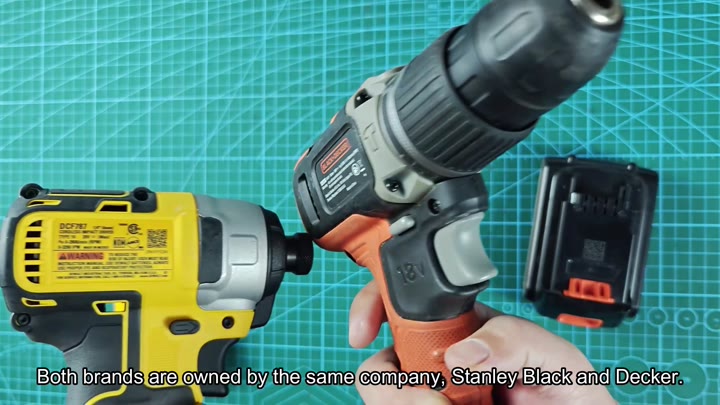
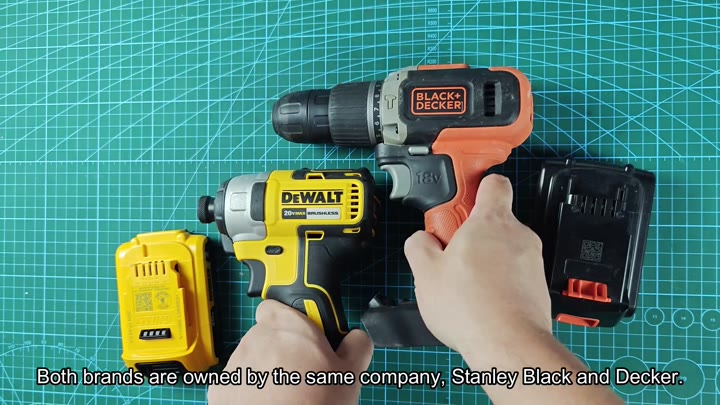
If you put a Stanley drill side-by-side with a DeWalt drill on a work bench, you’ll notice that they’re quite similar. They’re substantial-feeling tool in your hands too. Typically shared ownership mean some degree of part sharing. That is not necessarily the case here.
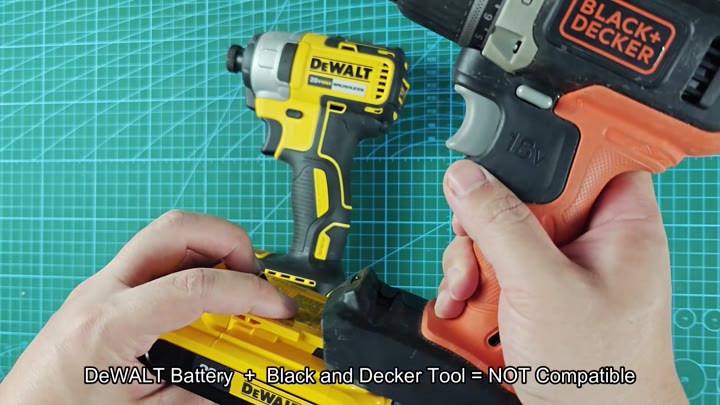
Looking at the 20V MAX brushless from DeWalt next to the 18V from Black & Decker, you see that they do not line up physically. Both batteries fits snugly onto each of their drills, but the two designs don’t align.
Why The Batteries Are Not Interchangeable
What’s causing the problem is the connector pins. While the DeWalt battery has five pins for a connection, the Black & Decker version contains just four pins. That one additional pin make them incompatible with each other. It’s a hard mechanical stop.
Take any old Black and Decker battery and attempt to connect it to a DeWALT tool. It simply doesn’t fit. Physically there is no way for them to align. The latch won’t catch on the housing. The contacts don’t line up. You can’t force it to go safely.
Reverse the experiment. It is the same thing. No way in hell those pins are going to cross that gap and make the geometry work. That tool isn’t taking your power source.
Testing both combinations verifies complete incompatibility. One brand will not accept the other’s power cell. You can’t swap packs from line to line in either case; there is no similarity in battery architecture despite being under one corporate umbrella.
For someone building a tool collection, that difference makes a difference. It will save you some time and frustration. Just because they share a corporate umbrella doesn’t mean you can use them interchangeably.
Pin count is everything
The pin configuration dictates the standard.
Five pins will not fit into four slots, and four pins cannot power a five-pin system.
You can’t plug five pins into four slots; you can’t power a five pin system with four pins.
Also keep in mind that there is differences in voltage as well, although voltage isn’t really the roadblock. The roadblock is the physical interface. There is no way around it. That connector won’t match up.
Each brand does a good job catering to its market. Black & Decker is geared towards the do-it-yourself homeowner while DeWalt is aimed at the commercial construction scene. Why? Because they each has their own ecosystem for a reason. Combining them will result in more issues than benefits.
What was the verdict on the tests? The batteries cannot be interchanged. The myth is busted. Match batteries with the tools they work with.
Labeling your battery packs is fine if you have different brands of batteries for each tool, but make sure they’re stored apart from one another so you don’t mix them up. It’s easier to charge, and easier to store. Fewer adapters equals fewer potential points of failure. Consistency helps in the shop too.
That’s a restriction mixed brand owners should of lived with. No magic adapter hack. Safety standards prevent makeshift solutions. Follow the OEM instructions; do not modify the connectors.
The visual contrast emphasizes the difference in designs. Orange/gray denote one lineage, yellow/black another. Form factor indicates different engineering emphases; each is a good choice on its own merits. Counting pins? Intentional.
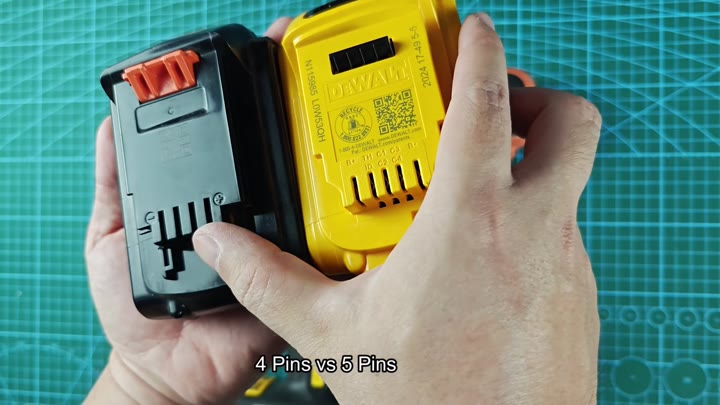
The pin count difference is intentional.
The systems are closed loops. They prevent any possible user error/damage.
Future buyers should plan accordingly.
Buyers, please take note.
Choose one ecosystem and commit to it. Avoid splitting your investment across brands, because it leads to redundant chargers and packs. Simplicity reduces clutter.
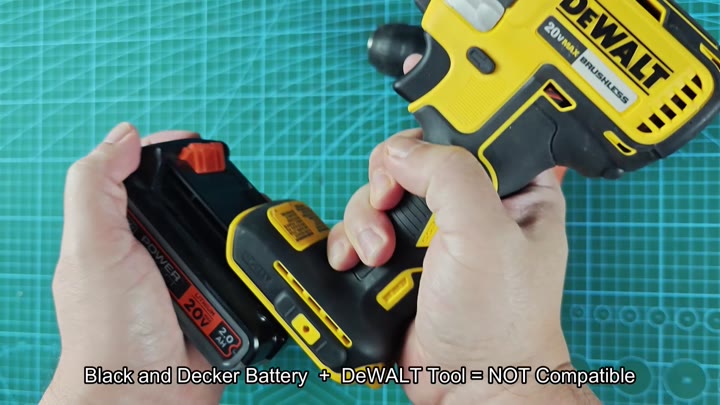
Stick with one ecosystem. Don’t buy multiple brands or you’ll end up with a pile of packs and chargers. The fewer products you own, the less stuff you have to worry about.
It’s a mechanical mismatch; there’s nothing in firmware that will change that. Function follows hardware on this one.
Do you have tools already? If so, take inventory and see what platform you run. Buy more packs of the same line. Don’t buy accessories until you know they are compatible.
Read the specs carefully. Visual inspection alone is not enough, so you really need to double-check the connectors yourself. The batteries work well for each tool individually, just don’t mix and match them. Maintain the separate ecosystems to save money and stay safe.
