
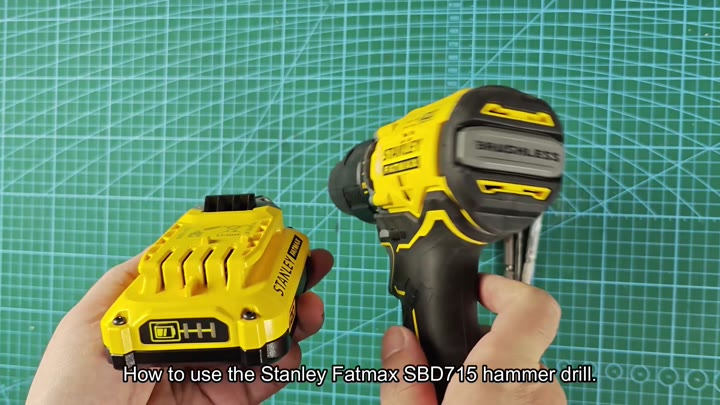
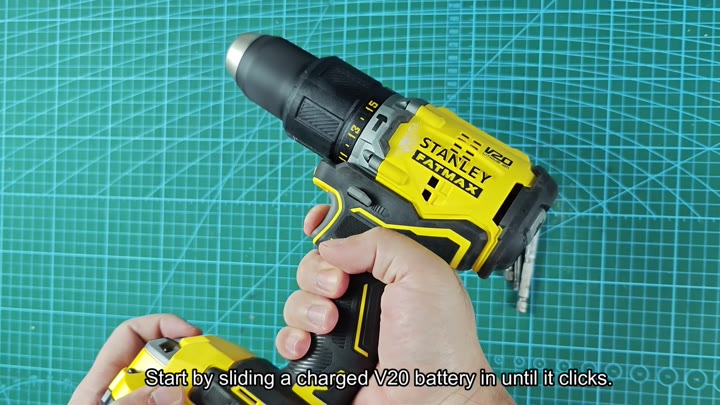
Next, you grab the V20 battery pack and slip it into bottom of the Stanley Fatmax SBD715. It snaps snugly into place and the charge indicator light lets you know it’s got plenty of juice for the job.
The build is hefty in your grasp with ergonomics to boot so now’s a good time to see what this thing will do on the job site.
Performance in Action
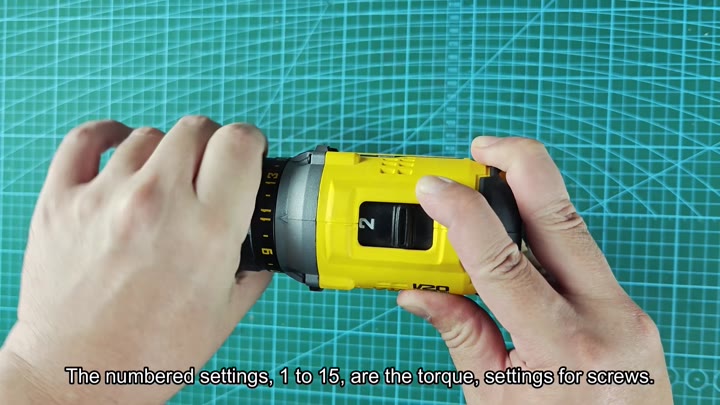
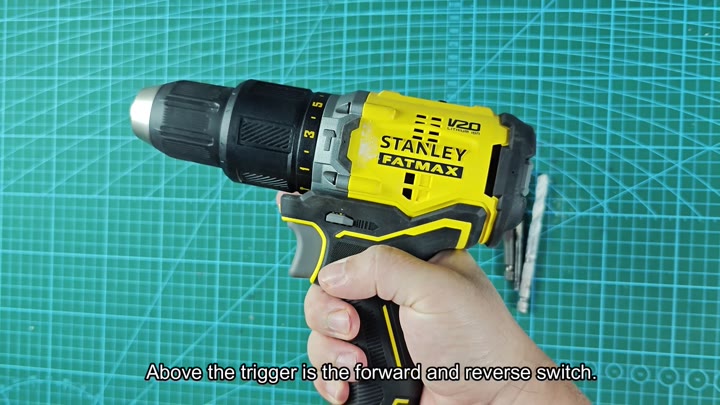
The torque collar have 15 numbered screw driving positions that let you have exact control of the amount of pressure needed to tighten your screws. Each position on the dial equates to a different torque setting, so as you work your way around the dial you will notice the increased resistance at each number.
When you’re learning how this tool behaves, it’s best to start with the lows.
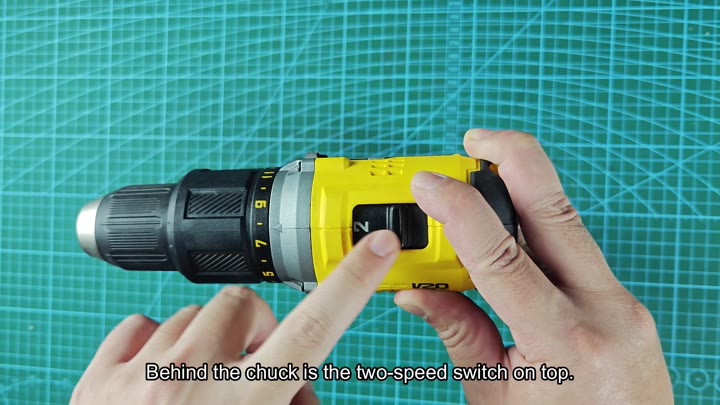
The two-speed switch is located behind the chuck. Position one has lower speed with higher torque while position two drill at a higher RPM. The gear shift is smooth and you can flip the switch to test the transition.
The forward and reverse switch are above the trigger. It controls which way the bit rotates. When set on forward, the tool is ready to drive screws.
You set the collar to a low torque setting for the first test.
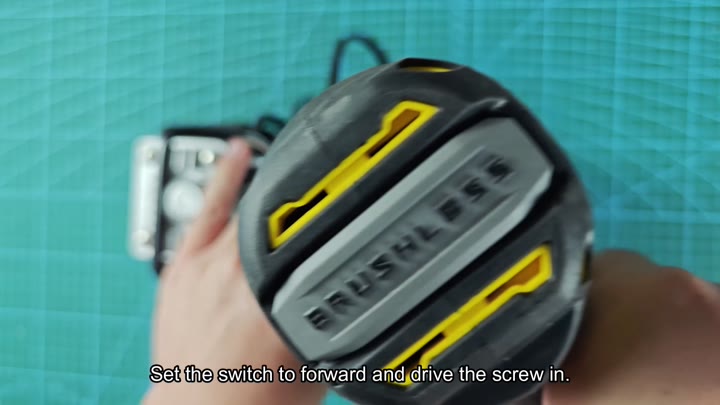
For the initial test, you adjust the collar to its lowest torque setting. Next, you insert a wood screw into a predrilled pilot hole, then engage the trigger.
The screw turns perfectly straight without any danger of head stripping. Because no head stripping has took place, reversing the switch also ejects the screw with equal ease. The control is impressive.
You set the collar to a low torque setting for the first test. You place a wood screw into a pre-drilled pilot hole and squeeze the trigger. The screw drives in evenly, and the clutch prevents stripping the head. You can reverse the switch to remove the screw just as easily because no stripping occur. The control is impressive.
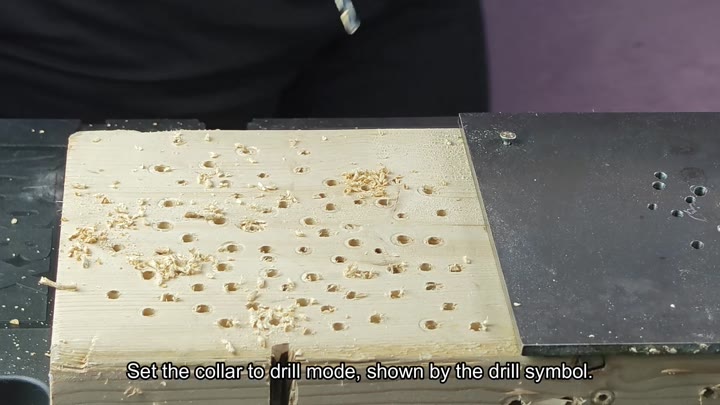
Then you flip the mode collar over to the drill symbol. That disconnects the clutch so you have continuous rotation. Pick up a regular twist bit and point it toward a chunk of softwood.
Engage the trigger and you’re off. And thanks to the brushless motor, even with the wood in there the drill will keep running at full speed as long as you squeeze the trigger. Shavings come right away and the hole is precise and clean. It drills all the way through without binding.
Then at last, you try out the hammer feature on a concrete wall. You switch the mode selector to hammer drill, slide in your masonry bit, and engage.
It kicks into high gear, rotating while impacting rapidly. As soon as it makes contact, dust flies off the spot where it bites into the surface and the tool vibrates hard as its motor powers through the thick stuff at speeds of up to 32,300 blows per minute. It doesn’t require any more force then necessary; you can tell how much more effective this is.
Finally, you test the hammer function on a concrete wall.

In terms of function, you get the ability to drill in whatever setting you need, thanks to the LED work light that lights up the work area well. Whether it’s a dark room or you’re working in a small corner, everything gets lit up so much better, which drastically increases your accuracy. You know right where the bit penetrates the material.
Overall, it’s just an all-around good tool. Screws? No problem. Wood? Sure. Concrete? Of course. Your concerns won’t even exist.
The LED work light illuminates the drilling area clearly.
Turns out it’s not half bad.
All of the above was tested with the V20 battery. The battery lasts long enough for whatever you need. There is no loss in voltage. Changing out the battery is fast and simple. The whole system just seems to work well together.
There’s a good balance between weight and power. It doesn’t weigh down your arm after using it for hours at a time. The brushless technology appears to be as advertised. Overall, you’re happy with what you get. It is worth it.
It’s got several uses that don’t require different tools. You can switch from one mode to the next easily, saving room in your tool kit.
Everything feels natural as you work with your fingertips. The buttons are well thought out and where they should be. And you don’t need to read the instruction booklet to understand how to use it.
It’s a nice addition to your set of tools that you’re going to grab often. It makes a noticeable difference.
