Screw Torque Calculator
Estimate tightening torque from fastener size, thread pitch, proof strength, friction condition, and target preload.
Calculated Screw Torque
Common thread stress areas
| Screw Size | Thread | Nominal Diameter | Stress Area | Typical Use |
|---|---|---|---|---|
| #6 | 32 TPI | 0.138 in | 0.00909 in² | Electronics covers, light brackets |
| #8 | 32 TPI | 0.164 in | 0.0140 in² | Machine panels, small clamps |
| #10 | 24 TPI | 0.190 in | 0.0175 in² | Equipment panels, guards |
| 1/4 | 20 TPI | 0.250 in | 0.0318 in² | Brackets, fixtures, small mounts |
| 3/8 | 16 TPI | 0.375 in | 0.0775 in² | Frames, chassis, machinery guards |
| 1/2 | 13 TPI | 0.500 in | 0.142 in² | Heavy mounts and base plates |
| M4 | 0.7 mm | 4.0 mm | 8.78 mm² | Electronics, inserts, instrument panels |
| M6 | 1.0 mm | 6.0 mm | 20.1 mm² | Clamps, covers, light machine parts |
| M8 | 1.25 mm | 8.0 mm | 36.6 mm² | Machine frames, mounts, brackets |
| M10 | 1.5 mm | 10.0 mm | 58.0 mm² | Structural clamps and equipment bases |
Fastener proof strength comparison
| Specification | Proof Strength | Usual Preload Target | Torque Sensitivity | Use Note |
|---|---|---|---|---|
| Low carbon steel / A307 | 33 ksi | 50% to 65% | Medium | Use lower torque for general hardware |
| SAE Grade 5 / Class 8.8 | 85 ksi | 65% to 75% | Medium | General machinery and brackets |
| SAE Grade 8 / Class 10.9 | 120 ksi | 65% to 75% | Medium | Higher clamp loads in steel joints |
| Alloy socket cap / Class 12.9 | 140 ksi | 65% to 75% | Medium | Compact heads with high preload |
| Stainless A2-70 / 18-8 | 65 ksi | 50% to 65% | High | Galling risk; lubricant strongly matters |
| Brass | 45 ksi | 40% to 55% | High | Reduce torque for inserts and soft mating parts |
| Aluminum | 30 ksi | 35% to 50% | High | Low thread strength and easy head damage |
| Nylon 6/6 | 8 ksi | 20% to 35% | Very high | Use inch-ounces or low-range torque tools |
Thread condition nut factors
| Condition | Nut Factor K | Torque Change vs Dry | Best Use | Watch Point |
|---|---|---|---|---|
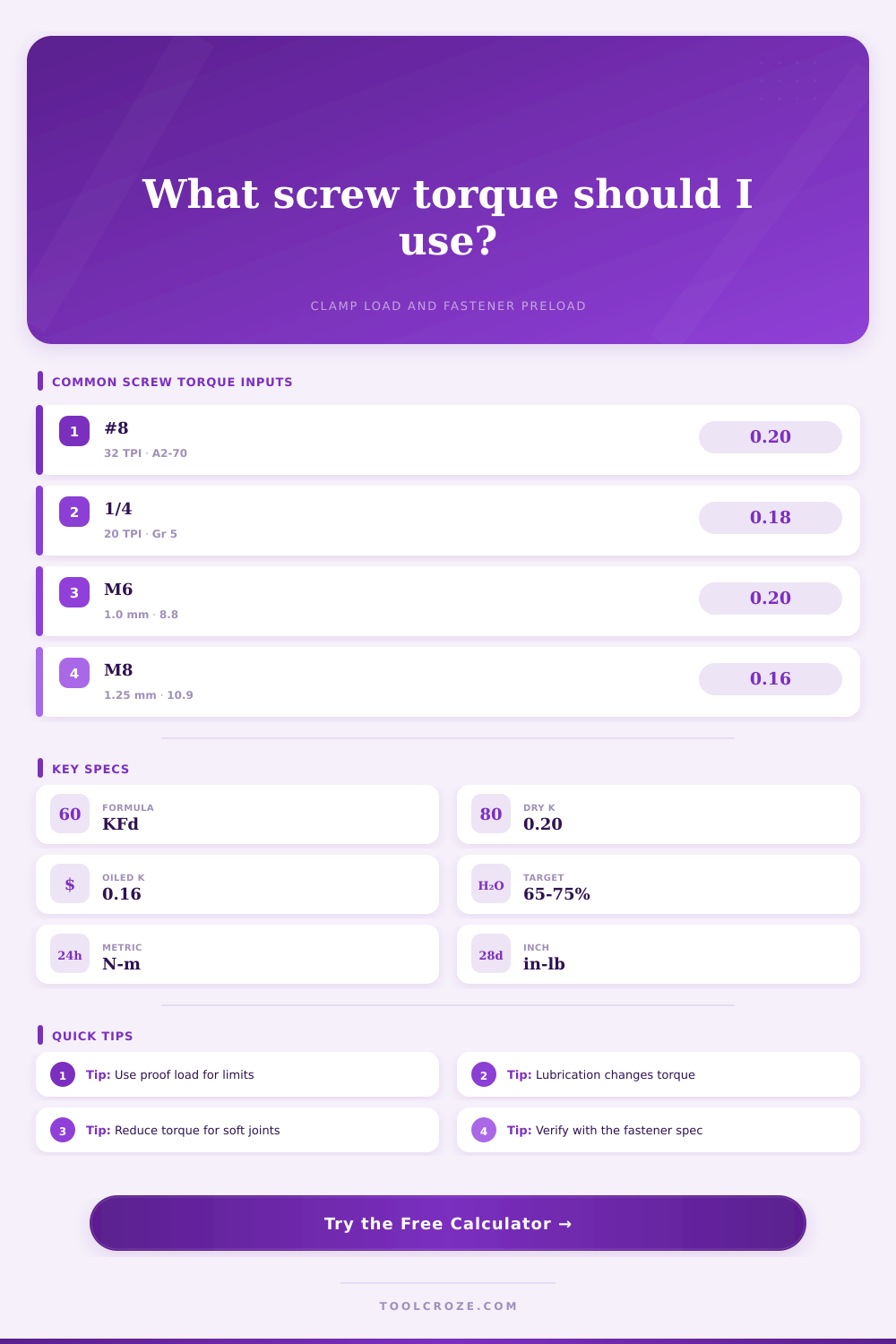
| Dry plain or zinc | 0.20 | Baseline | General shop hardware | Highest scatter in clamp load |
| Waxed zinc plating | 0.18 | About 10% lower | Plated assembly screws | Confirm plating supplier data |
| Light machine oil | 0.16 | About 20% lower | Repeatable steel assemblies | Too much oil may reduce K further |
| Anti-seize compound | 0.13 | About 35% lower | Stainless and heat-exposed fasteners | Dry torque values can overload the screw |
| PTFE low-friction coating | 0.11 | About 45% lower | Specified coated fasteners | Use only the coating-specific chart |
| Nylon patch lock | 0.24 | About 20% higher | Light vibration resistance | Prevailing torque is not all clamp load |
Application preload adjustments
| Application | Multiplier | Why It Changes | Practical Limit | Preferred Check |
|---|---|---|---|---|
| Rigid metal joint | 1.00 | Stable bearing surfaces hold preload well | Stay below proof load | Torque wrench or torque-angle |
| Soft gasket or plastic joint | 0.72 | Joint creep reduces preload after tightening | Avoid crushing the gasket | Compression or leak test |
| Slotted bracket or oversized hole | 0.85 | Lower bearing support and slip risk | Use washer contact area | Slip mark inspection |
| Electronics standoff or insert | 0.55 | Small inserts strip before screw proof load | Respect insert data | Low-range torque driver |
| Vibration-prone assembly | 0.95 | Clamp load helps resist loosening | Use locking method if specified | Witness mark and recheck |
There’s a metallic crunch, a sound we recognize as coming from a stripped screw head. That sound mean you’ve lost the moment. You’re attempting to secure a chassis mount or tighten a bracket, and the driver turn in place. The fastener is broken, the hole is shot, and your job comes to a halt.
In most cases, folks look at quality of hardware and fault the torque wrench. What they fail to understand is that there is typicaly a misunderstanding of relationship between torque and clamp load. Torque is nothing more than a measure of friction. Up to ninety percent of the torque you deliver are used to overcome the thread-to-thread drag of the fastener and its drag underneath the head of the screw. It’s only a fraction that actualy pulls on the bolt and provides the stretch required for clamp load, the clamping force that keeps things together.
Why Your Screws Slip
Why is this important? Because friction is a crazy variable. A speck of dirt, a drop of oil or even a thin coating like zinc plating make all the difference in the world. Apply the same amount of torque to a dry screw and a slick one and see how they compare. That slick one stretch way far until… BOOM! It fails at the yield point.
The calculator does that math for you. It’ll account for whatever friction factor you choose. It uses the fastener’s proof strength and stress area to calculate safe torque needed to reach your desired preload. Choose the grade of material, the thread pitch, whether threads are clean or dirty. It’ll tell you how much twisting you need to get to the clamp load you want while leaving your hardware intact.
This is generally an experienced choice… What preload do I want? Usually, sixty-five to seventy-five percent of proof load is best for most general uses. Proof load is the maximum tension a fastener can handle without permanent deformation. Below that number and you’re in the elastic range. That means your screw become a spring holding the joint together. Push on it past there and the bolt has stretched itself and lost its grip on the material, it will never go back.
If you’re using softer materials such as aluminum insert or plastic, you’ll want to drop that target even lower. You can set stiffness of the joint and it will adjust for that. A joint with a nylon insert in a circuit board won’t be able to hold nearer as much as a solid steel-to-steel joint. This tool will help you get that sweet spot. And it will tell you how far from failure you are.
The one thing overlooked in most shops is lubrication. A light coating of machine oil versus a dry zinc finish reduce needed torque by 20% or more at a given clamp load. In other words, if you have a torque table for dry hardware and then apply it to an oiled bolt, you’ll overtighten it. Snap. Or, if you change to anti-seize compound but don’t adjust your torque setting down you’ll stretch the bolt way too far. Eventually it fails due to vibration.
That’s where the page with its tables comes into play. It lays all that out in plain view. It showcases how various factors of the nut changes the amount of input required. It is not just turning the wrench. It is about managing the force transmission.
There is another wrinkle: vibration. To withstand vibration without loosening, you require greater clamp load in vibrating assemblies. But torquing up endlessly isn’t an option either. Joint material affects this. Soft or uneven mating surfaces moves and eventually relax the clamp load. These types of application-based multipliers can be factored into your analysis using the calculator. For example, less torque is better in a slotted bracket different than a rigid frame assembly since the bearing surface is unstable. This avoids the all-too-common error of thinking that tight is always right. Less torque could of been safer.
In conclusion: A torque calculator for screws is a tool, not a solution. Yes, it’s a good guess based off material properties and basic physical principles. However, the real world is filled with variables such as contaminated surfaces, damaged heads, and worn out threads. Always check your hardware first. Clean the threads. Make sure the head is flat. Use a properly calibrated tool. Once you know that torque represents nothing more than the cost of overcoming friction, you stop guessing, and you begin to control the assembly.
Because it isn’t just about tightening the screw, it’s about locking down the joint. That mental shift is what prevents the screw from ripping itself away and the assembly from coming undone.