Wood Shelf Load Capacity Calculator
Estimate a shelf's safe added load from material strength, span, depth, thickness, edge stiffening, support type, bracket rating, and deflection limit.
Calculated Shelf Capacity
| Material | Density | Elastic Modulus | Allowable Bending | Shelf Notes |
|---|---|---|---|---|
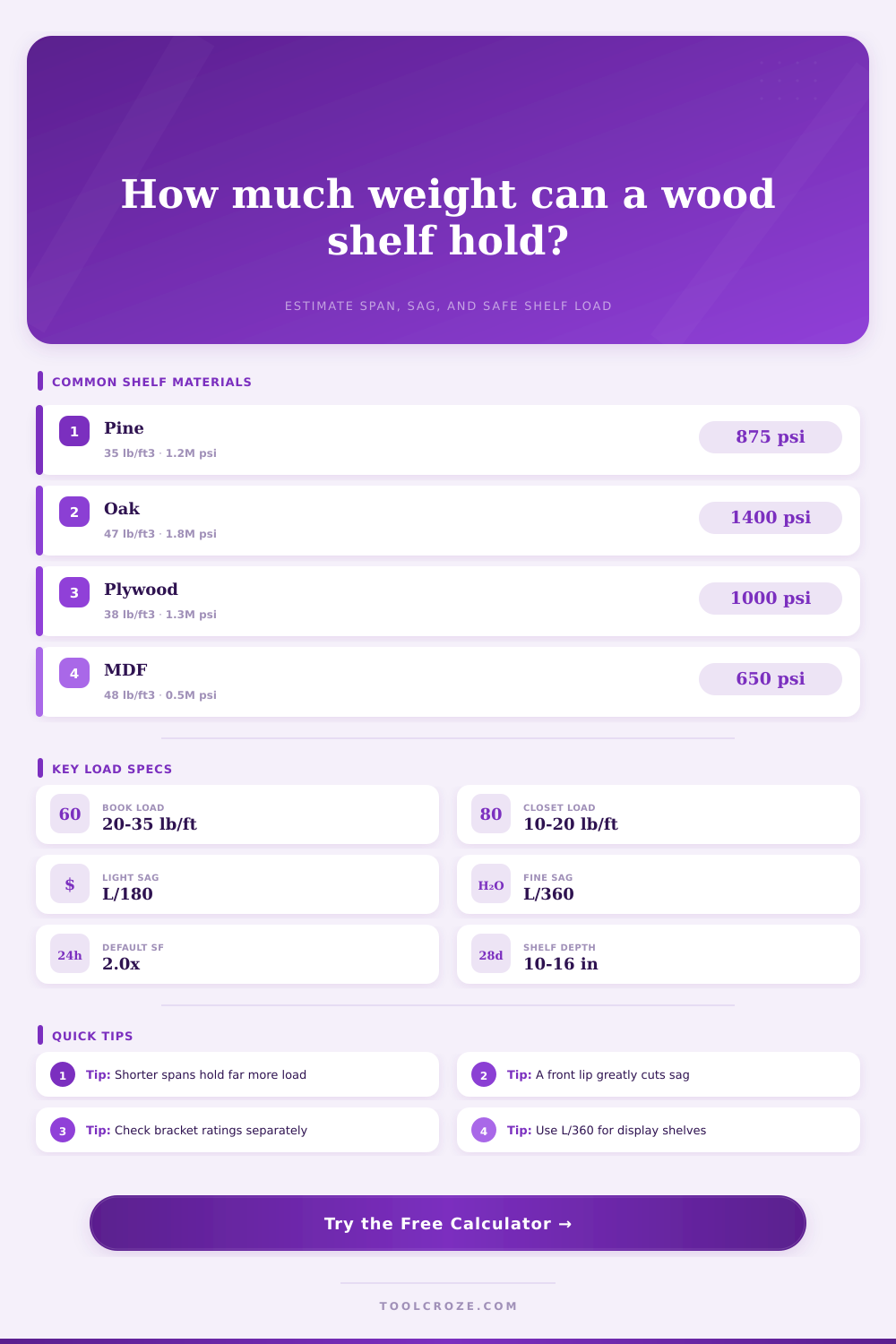
| Solid pine or spruce | 35 lb/ft³ | 1,200,000 psi | 875 psi | Light, workable, good for closets with modest spans. |
| Douglas fir | 32 lb/ft³ | 1,600,000 psi | 1,200 psi | Stiffer softwood option for utility shelving. |
| Red oak | 47 lb/ft³ | 1,800,000 psi | 1,400 psi | Strong hardwood shelf, heavier self-weight. |
| Hard maple | 44 lb/ft³ | 1,830,000 psi | 1,500 psi | Excellent for display shelves and casework. |
| Cabinet plywood | 38 lb/ft³ | 1,300,000 psi | 1,000 psi | Stable panel choice; face grain direction matters. |
| Baltic birch plywood | 43 lb/ft³ | 1,700,000 psi | 1,300 psi | Very stiff panel with uniform plies. |
| MDF | 48 lb/ft³ | 500,000 psi | 650 psi | Smooth but sag-prone; benefits from front edging. |
| Particleboard | 45 lb/ft³ | 400,000 psi | 500 psi | Use short spans and strong edge support. |
| Melamine particleboard | 46 lb/ft³ | 450,000 psi | 550 psi | Similar to particleboard with durable surface. |
| Bamboo panel | 40 lb/ft³ | 2,000,000 psi | 1,600 psi | High stiffness when laminations are continuous. |
| Shelf Scenario | Typical Span | Common Thickness | Typical Load | Design Note |
|---|---|---|---|---|
| Closet shelf | 24-36 in | 3/4 in | 10-20 lb/ft | Side cleats usually govern less than sag. |
| Bookcase shelf | 28-36 in | 3/4 in | 20-35 lb/ft | Use L/240 or L/360 to control visible bowing. |
| Pantry shelf | 30-42 in | 3/4-1 in | 25-45 lb/ft | Add front lip for cans, jars, and small appliances. |
| Garage shelf | 36-60 in | 3/4-1-1/2 in | 40-80 lb/ft | Bracket count and wall anchorage often govern. |
| Floating shelf | 18-36 in | 1-1/2-2 in | 10-30 lb/ft | Rod embedment and wall framing are critical. |
| Display shelf | 24-48 in | 1-1-1/2 in | 5-20 lb/ft | Use L/360 or L/480 for a straighter look. |
| Support Style | Model Used | Capacity Adjustment | Best Use | Watch Point |
|---|---|---|---|---|
| Side cleats or shelf pins | Simple span | 1.00x | Cabinets, closets, bookcases | Pin pullout and end bearing. |
| Wall brackets | Simple span with connection loss | 0.85x | Open storage shelves | Wall anchors and bracket spacing. |
| Full-depth dado or sockets | Partially restrained span | 1.20x | Built-ins and casework | Side panel strength and glue quality. |
| Back cleat plus side support | Partially restrained span | 1.25x | Pantries and shop shelving | Back rail fasteners into framing. |
| Floating rods | Connection-limited span | 0.55x | Short decorative shelves | Rod diameter, embedment, and wall framing. |
| Center divider or middle support | Reduced effective span | Uses half span | Long bookcases and cabinets | Center support must transfer load to floor or frame. |
| Stored Items | Approximate Load | Load Pattern | Preferred Sag Limit | Practical Check |
|---|---|---|---|---|
| Decor and framed photos | 5-12 lb/ft | Even or sparse | L/360 | Appearance usually governs. |
| Folded clothes and linens | 8-18 lb/ft | Even | L/240 | Closet cleats usually work well. |
| Paperback and mixed books | 20-30 lb/ft | Even | L/240 | Watch long 3/4 in spans. |
| Cookbooks and binders | 30-45 lb/ft | Even | L/360 | Use hardwood, plywood, or front rail. |
| Canned goods and small appliances | 35-60 lb/ft | Front-heavy | L/240 | Brackets and wall anchorage often govern. |
| Paint cans and garage bins | 50-90 lb/ft | Mixed | L/180 | Use short spans, many brackets, or a frame. |
You stare at a piece of plywood spanning 36 inches in front of you, standing in your garage. You believe that’s enough ply to support your power tools. After all, it appears solid. It feels solid. Tap on it; it sounds solid.
Wood doesn’t give a damn about your assumptions. All wood cares about is physics. This includes the forces attempting to bend it, its span, and how stiff it needs to be to resist bending. So, calculation are important: What you see with your eyes is almost never the full story regarding structural integrity.
How to Build a Strong Shelf
You’ll notice two variables: span (distance across) and thickness. Most folks is concerned with thickness but not span. For example, let’s say you have a bookshelf that is three-quarters of an inch thick. You want to hang this shelf at each end every twelve inches. How many pounds does it support? Answer: Fifty.
Now extend that spacing to forty-eight inches. Half as heavy, and it still bow dramatically! Once you enter your numbers into the calculator above, the rest is math. You won’t have to guess how much sag will be okay for your particular configuration. It takes raw engineering formulae and applies them to your desired mounting style and materials to spit out a number you can actualy apply, i.e. It provides a safe load limit.
People will give you all sorts of reasons why they use pine. It’s pretty easy to work with, it’s forgiving, and it doesn’t cost as much. But when you hang something heavy from it, it tends to bend. For the same thickness, Baltic birch plywood or hard maple will provide far greater stiffness. Your shelf will be flatter). As the table of references on the page makes clear: it comes down to density and elastic modulus. Not only are you choosing based off appearance, you’re also choosing based on how resistant a material is to bending forces. And if you’re keeping canned goods or heavy cookbooks on your shelves, then that hard/softwood decision becomes the whole equation.
Where form and function meet is when deflection limits kick in. Most building codes allow a certain amount of sag, often defined as a fraction of the span length; so a small amount of bow may be OK on a shelf that hangs in your basement used for utility purposes. But it could be quite another issue if you want to hang some fancy china on a shelf that looks perfect but sags a mere sixteenth of an inch. You can set the limit right here and see just how much weight the shelf will hold if visually straight. It makes you choose between looking good vs. It carries maximum loads.
There’s also a hidden variable called support style. Floating rods/brackets vs. These are side cleats or shelf pins. Do you see how they react totally different than? Brackets add connection points that might break even when the rest of the wood doesn’t budge. Two brackets at 50 pounds each don’t matter if you have the strongest oak shelf on the planet. It’s only as strong as its weakest link. Is your issue that the wood bends or that the hardware pulls out of the drywall?
Moisture is the enemy of storage space. Wood-based composites such as particle board and MDF becomes soft when wet, losing their rigidity. What’s rock-solid in your dry basement could be visibly saggier than you’d like in your damp laundry room. Consider the environment to keep your calculations realistic both on install day and down the road.
You don’t make the strongest shelf you can. Nope…you want to make the right shelf for what you’re storing on it. Whether you’re making a tire rack in the garage, or hanging a bookshelf on the wall, the numbers keeps you from making one that bends as soon as you add more books. They save you the embarrassment of having to prop up shelves full of paperbacks. They leave you with something sturdy, secure and level. You should of considered thickness too.