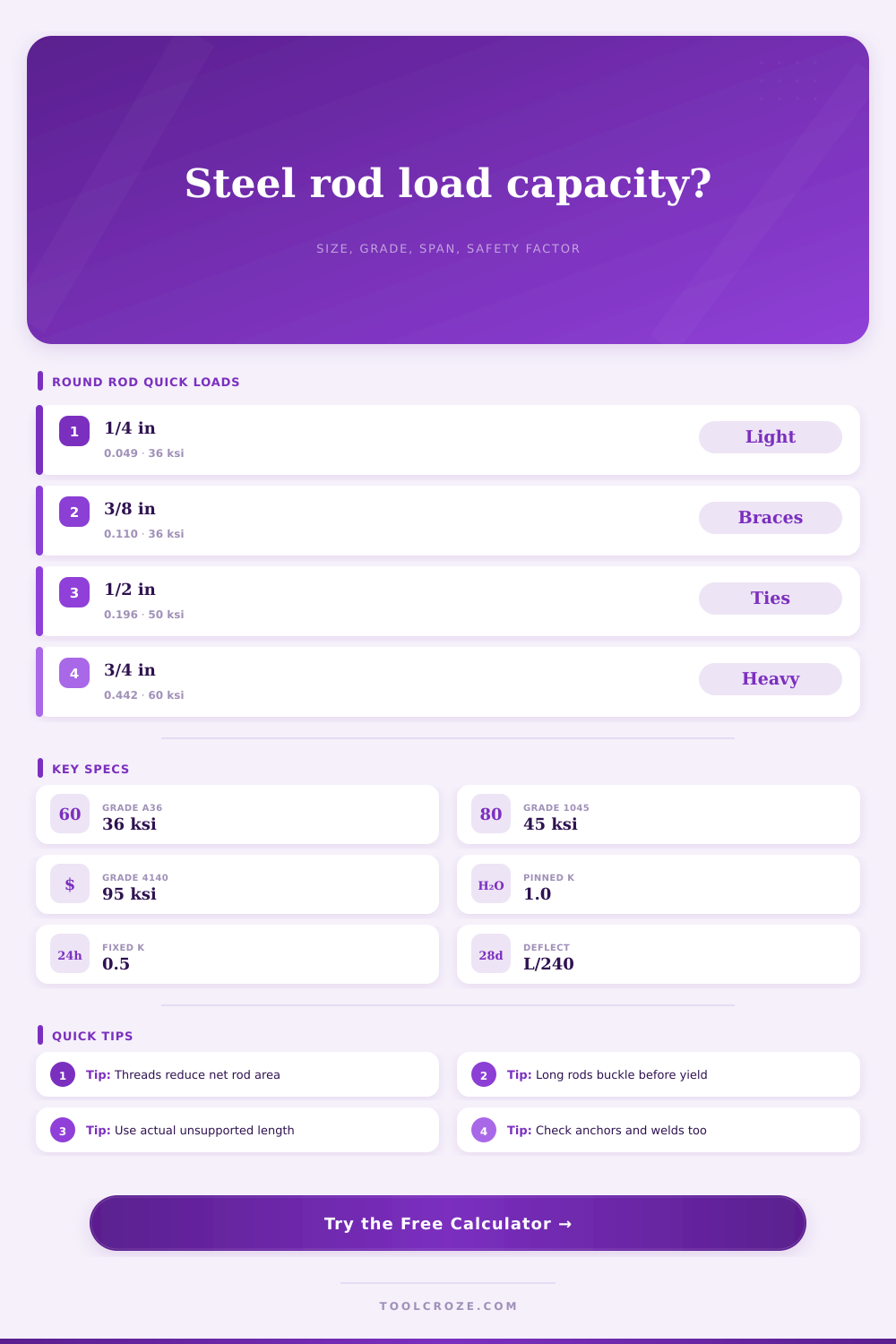
Steel Rod Load Capacity Calculator
Estimate axial tension, compression buckling, bending load, deflection, weight, and utilization for round steel rods using practical engineering formulas.
Steel Rod Capacity Results
Formula Breakdown
| Steel grade | Yield strength used | Elastic modulus used | Typical rod use |
|---|---|---|---|
| ASTM A36 mild steel | 36 ksi | 29,000 ksi | General brackets, tie rods, light frames |
| ASTM A500 Grade B | 46 ksi | 29,000 ksi | Structural posts and bracing assemblies |
| AISI 1018 cold finished | 54 ksi | 29,000 ksi | Shafts, pins, fixture rods, machined parts |
| AISI 1045 hot rolled | 45 ksi | 29,000 ksi | Higher strength dowels, rods, and pins |
| AISI 4140 normalized | 95 ksi | 29,700 ksi | Alloy rods, cantilever pins, high load shafts |
| 304 stainless steel | 30 ksi | 28,000 ksi | Indoor corrosion-resistant rods and guards |
| 316 stainless steel | 30 ksi | 28,000 ksi | Marine and chemical exposure rods |
| ASTM A193 B7 threaded rod | 105 ksi | 29,700 ksi | High strength anchors and bolted assemblies |
| End condition | K factor | Euler length used | Practical note |
|---|---|---|---|
| Pinned - pinned | 1.0 | Full unsupported length | Common for clevises, loose pins, and hinged ends |
| Fixed - pinned | 0.7 | 70% of unsupported length | One restrained end and one rotating end |
| Fixed - fixed | 0.5 | 50% of unsupported length | Requires strong rotational restraint at both ends |
| Fixed - free | 2.0 | Double unsupported length | Conservative for freestanding cantilever rods |
| Rod diameter | Area | Section modulus | Typical capacity sensitivity |
|---|---|---|---|
| 1/4 in or 6 mm | 0.049 sq in | 0.0015 cu in | Useful in tension; weak for bending spans |
| 3/8 in or 10 mm | 0.110 sq in | 0.0052 cu in | Short pins and light brackets |
| 1/2 in or 12 mm | 0.196 sq in | 0.0123 cu in | Common tie rods and guard components |
| 5/8 in or 16 mm | 0.307 sq in | 0.0240 cu in | Large jump in bending stiffness |
| 3/4 in or 20 mm | 0.442 sq in | 0.0414 cu in | Better for compression posts and side loads |
| 1 in or 25 mm | 0.785 sq in | 0.0982 cu in | Strong rod, but end connections often govern |
| Load case | Strength formula | Deflection formula | Best use of result |
|---|---|---|---|
| Axial tension | P = A × Fy / SF | Axial stretch not shown | Tie rods, hangers, bracing rods |
| Axial compression | Lower of yield or Euler buckling | Lateral bowing controls slender rods | Posts, push rods, compression links |
| Simply supported center load | P = 4 × Fy × S / (SF × L) | Δ = P × L³ / (48EI) | Rod spanning between two supports |
| Cantilever end load | P = Fy × S / (SF × L) | Δ = P × L³ / (3EI) | Projecting pins, hooks, or bracket rods |
| Specification | Strength behavior | Connection concern | Best calculator adjustment |
|---|---|---|---|
| Plain round bar | Full gross area usually available | Weld quality or drilled holes may govern | Use 90% to 100% efficiency if ends are full strength |
| Threaded rod | Thread root area is lower than shank area | Nuts, washers, and embedment can limit load | Use 60% to 85% efficiency unless net area is verified |
| Stainless rod | Lower yield than many alloy steels | Galling and thread damage can reduce reliability | Use grade-specific yield and a conservative safety factor |
| Alloy steel rod | High yield strength but same basic stiffness scale | Heat treatment and notch effects matter | Raise strength grade, but still check deflection and buckling |
That’s why you ordered a rod from the hardware store last summer and measured a length that matched the span. You screwed on those hinges and tightened the nuts until they seemed snug. That hinge lasted a year or two then you noticed a slight squeak.
“Most folks think steel is simply strong.” Nope. There are different ways that steel fails. Getting the proper size rod depends as much on geometry as raw strength. Too-thin an alloy can snap like a twig if stretched across a long span. Plugging in your dimensions into calculator does the math for you. It spares you guessing whether your design relies on bending stiffness or tensile strength.
Why Your Steel Rod Might Break
So how much can a rod take? How much can it bend without breaking? Or without pulling apart, or crushing together? Those are three distinct problems. One could cause a piece of metal to fail while another dont even start until later.
When you put tension on a rod, you are testing its yield strength against its cross-sectional area. That’s why a fatter rod is no problem. But when you push the rod against an object such as a scaffold column, then you’ve got a different issue: buckling. If you push hard enough, a long and skinny rod snaps sideways instead of crushing first. That’s why length of unsupported part is important. The calculator takes into account the unsupported length to figure out whether the rod is strong and solid like a post, or weak and flimsy like a drinking straw.
Rod material is significant. I’ve seen guys go for anchor bolts made from high-strength alloys such as B7 and 4140 just because it has a nice long number on it. That sounds like a good deal, right? High yield strength must mean that’s insurance. Nope. It only covers tension. For bending or compression its about the elastic modulus. That remains constant in all steels. A special metal rod may be no more resistant to buckling then some cheap old piece of mild steel with equal cross section. Look at the table of references. Alloy grade increases tensile limits, but it says nothing about how well the rod resists bowing sideways. May end up paying for strength you dont need given your own load case.
But there’s another thing: connections. If your rod isn’t good at the ends then what? Thread cuts through materials and causes stress points. That’s accounted for in tool with a connection efficiency slider. Threaded rod doesn’t behave like its nominal size; in effect, you’re working with a smaller rod than stated. It makes sense but it’s a little thing that adds up.
Shop designs generally use a safety factor of two. Out in the field where loads aren’t known and vibration exists, three and more is common. You design to the weight and then the shock of that initial big one. Then you have to design for the cumulative fatigue of lots of lesser loads. This brings us to deflection and it’s a quiet problem. Sure the rod will not break. But it bends too much so now the mechanism that it’s supporting is wearing out to soon or jamming up. This is where the calculator checks you. This makes sure the rod is stiff enough to be useful.
It gets you to think of the rod as a system. No more looking at price per foot. Now you’re looking at load paths. Better Numbers is just using common sense in engineering. Just because something is true doesn’t mean you have to have a degree to understand it.
A long thin rod pushes and pulls different than a short fat one. Know your failure mode. That’s what the tool takes out of the equations. It’s still your judgement call. Measure twice, check your supports. Steel isn’t generally the weakest part of the chain.