Steel Base Plate Weight Calculator
Calculate column base plate weight from plate length, width, thickness, anchor bolt holes, grout holes, cutouts, washer plates, stiffeners, quantity, allowance, and steel density.
⚙Base Plate Presets
📏Plate Inputs
🔩Holes, Cutouts, Washers, Stiffeners
Base Plate Weight Results
Calculation Breakdown
📋Base Plate Spec Grid
📚Steel Density Reference
| Steel Material | Density g/cm³ | Density lb/in³ | Typical Base Plate Use |
|---|---|---|---|
| A36 carbon steel | 7.85 | 0.2836 | Common column base plates |
| A572 Grade 50 | 7.83 | 0.2829 | Higher strength structural plates |
| A992 structural steel | 7.85 | 0.2836 | Wide flange column assemblies |
| A588 weathering steel | 7.85 | 0.2836 | Exposed outdoor structures |
| 304 stainless steel | 8.00 | 0.2890 | Corrosion resistant bases |
| AR400 wear plate | 7.70 | 0.2781 | Abrasion resistant bases |
🔩Anchor Hole and Grout Opening Guide
| Anchor Rod | Common Hole Diameter | Area Removed | Weight Removed per 1 in Thick |
|---|---|---|---|
| 5/8 in rod | 13/16 in | 0.52 in² | 0.15 lb |
| 3/4 in rod | 15/16 in | 0.69 in² | 0.20 lb |
| 7/8 in rod | 1 1/16 in | 0.89 in² | 0.25 lb |
| 1 in rod | 1 1/4 in | 1.23 in² | 0.35 lb |
| 1 1/4 in rod | 1 1/2 in | 1.77 in² | 0.50 lb |
| Grout hole | 2 to 4 in | 3.14 to 12.57 in² | 0.89 to 3.56 lb |
🏗Common Base Plate Presets
| Preset | Plate Size | Thickness | Openings and Add-ons |
|---|---|---|---|
| Porch column | 10 x 10 in | 1/2 in | 4 anchor holes |
| Canopy post | 12 x 12 in | 5/8 in | 4 holes plus 2 in grout hole |
| Mezzanine base | 14 x 14 in | 3/4 in | 4 holes, light allowance |
| Portal frame | 18 x 18 in | 1 in | 8 holes plus 3 in grout hole |
| Crane base | 24 x 24 in | 1 1/2 in | 8 holes and stiffeners |
| Heavy base | 30 x 30 in | 2 in | 12 holes, washers, stiffeners |
📐Washer Plate and Stiffener Reference
| Component | Typical Size | Weight Method | Modeling Note |
|---|---|---|---|
| Square washer plate | 4 x 4 x 1/2 in | L x W x T x density | Add one per anchor when supplied loose |
| Heavy washer plate | 6 x 6 x 3/4 in | L x W x T x density | Use for large slotted anchor holes |
| Triangular stiffener | Use half area | 0.5 x L x H x T | Enter half the effective length if triangular |
| Rectangular stiffener | 8 x 10 x 1/2 in | L x H x T x density | Enter full web plate dimensions |
| Shear lug | Flat bar or plate | L x H x T x density | Can be entered as stiffener volume |
💡Base Plate Weight Tips
A base plate isn’t something you have to be a structural engineer to know about. But it’s something you should ofnt guess at either.
Weight is more than just length x width x thickness; you also has to account for holes, stiffeners, and steel density. Most folks think that formula applies (that’s half true). The other half are in the grade of steel you bought, the stiffener, and the holes. Overbuy? Underestimate the load your foundation must carry? Either way, you’re paying for getting this wrong.
How to Calculate Base Plate Weight Correctly
Let’s go back to the gross dimensions. What is the length and width of your plate? And how thick is it? These numbers determines the possible max weight.
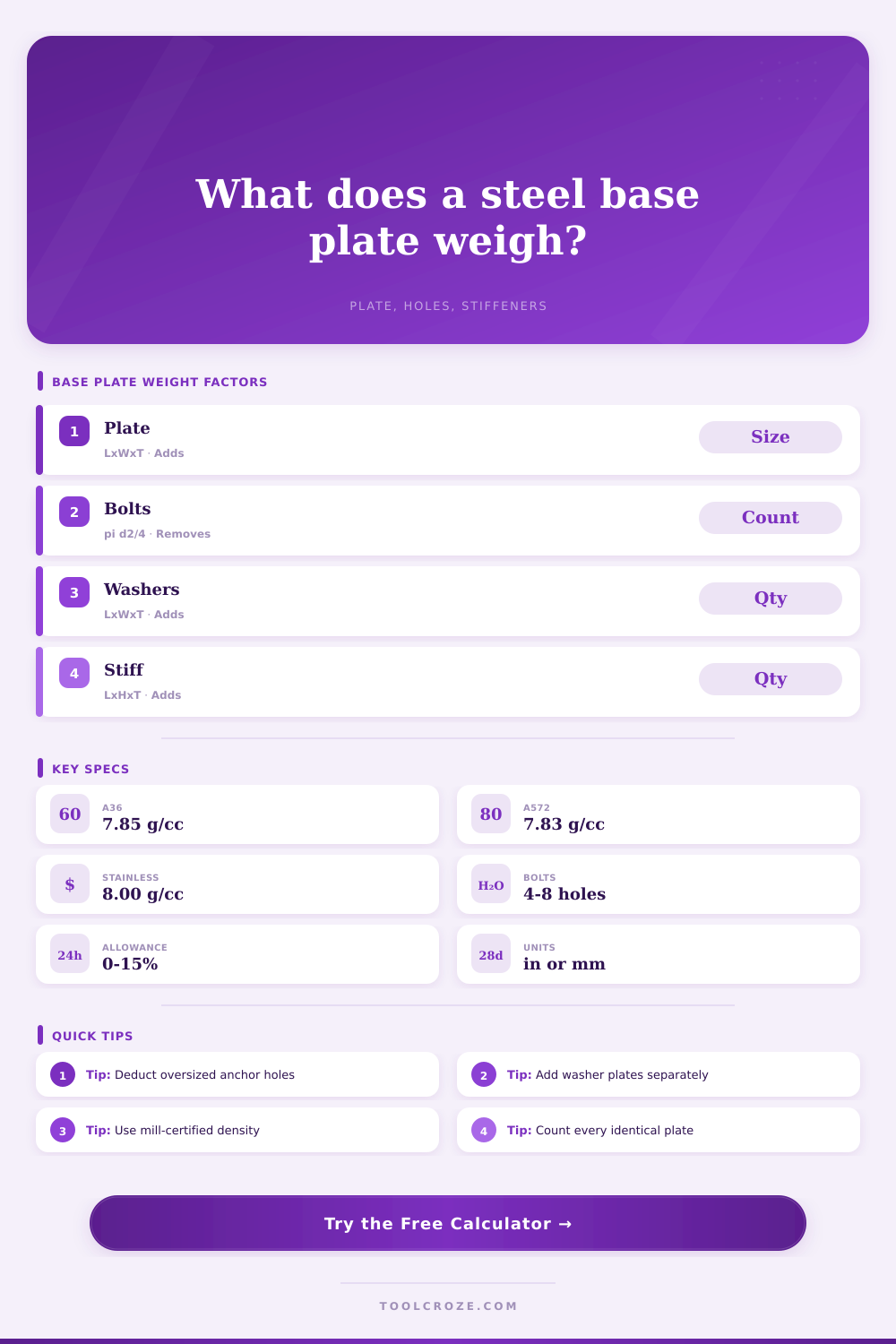
Now what happens when we look at a base plate? Is it a solid block of steel? No way. It’s a sieve. You’ve got anchor bolts going right through it. You’ve got grout holes letting concrete run under there. Every one of those hole subtracts mass. When you enter the number of holes and their diameters into the calculator, it do all the math for you (so you don’t need to do mind numbing circular area calculations by hand).
One note on the diameter field: It’s not the bolt size. It’s the hole diameter that was cut out for the bolt. There is a difference. Don’t ignore that clearance because that’s empty air and not steel. Including it increases your estimated weight but it shouldn’t be there.
But now imagine what is being added with it. Washer plates sits under nuts to spread the load. Column edges are reinforced with stiffener. All of this adds weight and volume. The tool takes into account the geometry of triangle if you have triangles as stiffeners or the total area of the rectangle if you have rectangular plates. But make sure you’re precise on how many there is. Don’t guess that “there are a few.” Count ’em. One extra stiffener omitted from your calculation may appear inconsequential, but they’ll add up over the course of a big project.
The silent variable is density of material. Steel isn’t all the same weight per cubic inch. For instance, A36 (mild steel) are the typical baseline. However, you can spec A572 Grade 50 to get more strength than that. Or, you can go for stainless steel for corrosion resistance, but then the density change. Stainless is heavier. For exactly the same size, it’s going to weigh more. This page has a good reference table where they lay this out, comparing stainless vs weathering steel vs wear plate vs A36.
When you choose the wrong density number, then you throw off your whole total. Small thing, but if you’re hefting big plate around with a crane, it matters.
So why all that precision? It’s about the weight. Bigger plates means more strenuous rigging. Perhaps a heavier plate mean using a different crane. Maybe it shifts the load bearing pressure on the concrete footing. Your rigging plan may not be safe if you misjudge the weight. Also, what happens when you get to the mill and your shipment weigh over their limit for some form of transportation? That will come out of your pocket in an unexpected way. Being exact protects against that kind of surprise.
Finally, don’t forget the waste factor. Plates are cut at steel mills and there is tolerances on those cuts. Minor damage or trimming is handled by allowing certain amounts. Then you add a little more for good measure because this is reality. Five percent is typical. This recognizes that fabricating is a physical business, not a digital one.
The base plate is the handshake between the earth and the steel structure. It moves massive amounts of force. Knowing its weight means knowing what is physically happening at the connection. You aren’t simply moving metal. You’re moving engineered mass.
Look at your total shipping weight compared to the net weight when you complete your calculation. That’s how much you’re really moving different than how much you’re paying to move. Ultimately though, clarity is king. If you want to understand what weight you’re picking up then that’s what matters. If you want to find out what you’re actualy paying for in terms of steel, that’s what matters too.
Stop guessing and stop making rules-of-thumb. Pull out the numbers. Count the holes. Confirm the steel grade. It’s easy math, but the penalty for skipping it is significent. Nail down the weight and everything else falls into place.