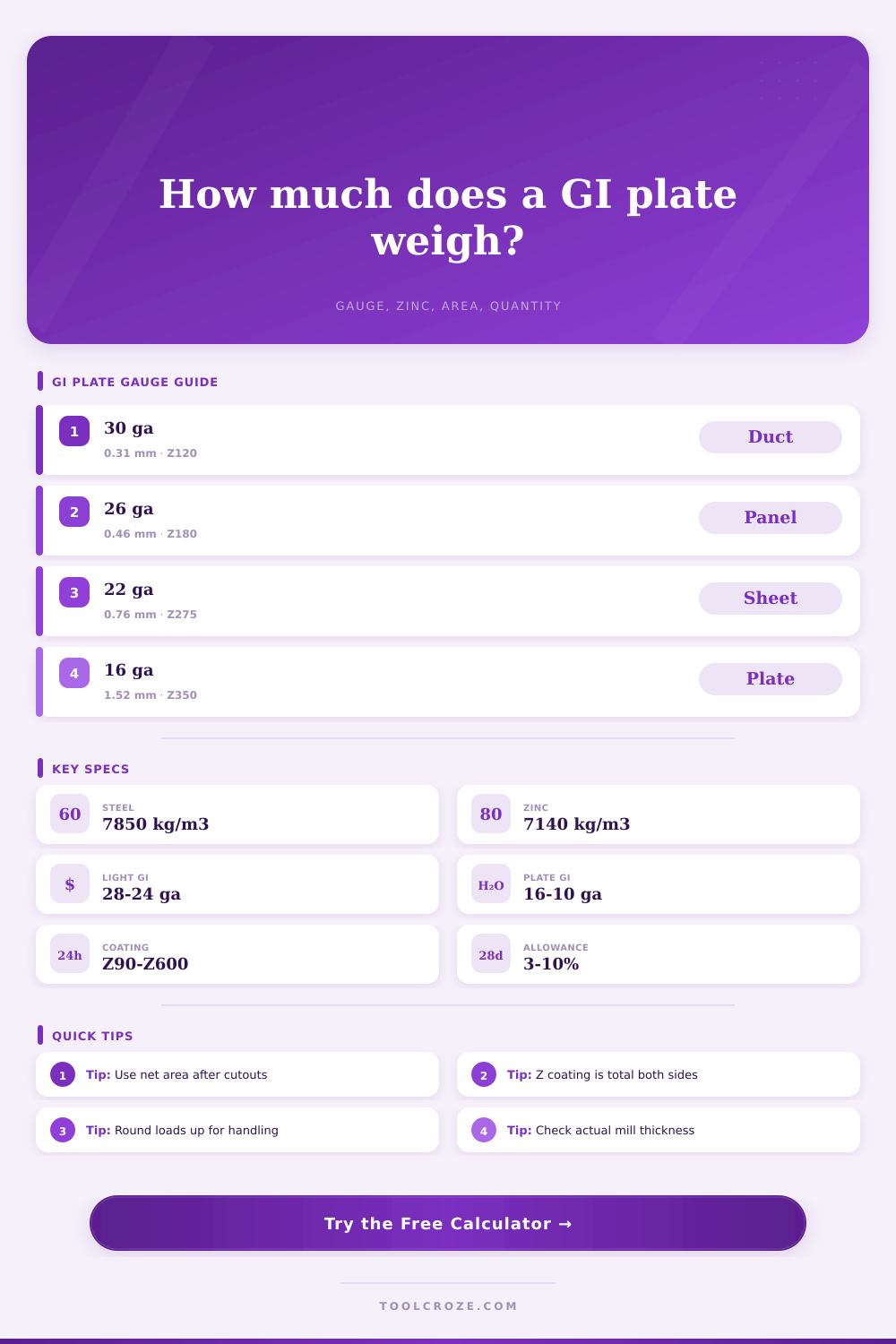
GI Plate Weight Calculator
Estimate galvanized iron sheet or plate weight from length, width, thickness or gauge, zinc coating mass, density, quantity, cutout area, and shop allowance.
⚙Quick GI Sheet Presets
📐Plate Inputs
GI Plate Weight Results
🧮Current Material Snapshot
📊Gauge and Coating Grid
| Gauge | Thickness | Steel kg/m² | Z120 kg/m² | Z275 kg/m² | Z600 kg/m² |
|---|---|---|---|---|---|
| 30 ga | 0.31 mm | 2.43 | 2.55 | 2.71 | 3.03 |
| 28 ga | 0.38 mm | 2.98 | 3.10 | 3.26 | 3.58 |
| 26 ga | 0.46 mm | 3.61 | 3.73 | 3.89 | 4.21 |
| 24 ga | 0.61 mm | 4.79 | 4.91 | 5.06 | 5.39 |
| 22 ga | 0.76 mm | 5.97 | 6.09 | 6.24 | 6.57 |
| 20 ga | 0.91 mm | 7.14 | 7.26 | 7.42 | 7.74 |
| 18 ga | 1.21 mm | 9.50 | 9.62 | 9.77 | 10.10 |
| 16 ga | 1.52 mm | 11.93 | 12.05 | 12.21 | 12.53 |
| 14 ga | 1.90 mm | 14.92 | 15.04 | 15.19 | 15.52 |
| 12 ga | 2.66 mm | 20.88 | 21.00 | 21.16 | 21.48 |
| 10 ga | 3.42 mm | 26.85 | 26.97 | 27.12 | 27.45 |
📏Common GI Sheet and Plate Sizes
| Format | Metric size | Imperial size | Typical gauge | Typical use |
|---|---|---|---|---|
| Small panel | 1000 × 1000 mm | 39.4 × 39.4 in | 24-20 ga | Covers, patches |
| Standard sheet | 1220 × 2440 mm | 4 × 8 ft | 28-16 ga | Duct, panel, tray |
| Wide sheet | 1500 × 3000 mm | 5 × 10 ft | 22-12 ga | Enclosures |
| Long plate | 1500 × 6000 mm | 5 × 20 ft | 16-10 ga | Guarding, base |
| Round blank | 300-1200 mm dia | 12-48 in dia | 24-12 ga | Caps, covers |
🛠Density and Coating Reference
| Material or coating | Density | Weight impact | Calculator note |
|---|---|---|---|
| Mild steel core | 7850 kg/m³ | Main weight driver | Use as default GI base |
| Galvanized coating | Z90-Z600 g/m² | 0.09-0.60 kg/m² | Total both sides |
| Zinc metal | 7140 kg/m³ | Very thin layer | Use coating mass instead |
| High strength steel | 7800-7900 kg/m³ | Small variation | Adjust density if specified |
| Perforated GI | By open area | Reduces net weight | Enter cutout percent |
📝Cutout and Allowance Guide
| Condition | Cutout input | Allowance input | Use when |
|---|---|---|---|
| Full blank | 0% | 2-5% | Simple rectangular plates |
| Slotted panel | 5-15% | 5-8% | Vent slots or service holes |
| Perforated sheet | 20-45% | 3-6% | Known open-area pattern |
| Nested parts | By net open area | 8-12% | Irregular blanks from sheet |
| Round disc | 0-10% | 8-15% | Circle cut from square stock |
💡Practical GI Weight Tips
Pallet or no? Can I fit that in my pick-up? Will I snap an axle? Standing on a yard littered with galvanized steel, you has questions. You think the sheet must be lightweight since it’s thin, but then you remember the zinc coating so now you’re re-planning the load. That’s why we created the calculator so you don’t have to run math yourself. It converts gauges and dimensions to kilograms.
Now what do all these numbers mean? The work lie in understanding them. Most folks think gauge means simply a measure of thickness. Wrong. Gauge is a remnant of how wire was drawn. As the thickness decrease, the number increases. So a sheet labeled as twenty gauge is thicker than one marked twenty-six. It seems backwards but you’ll get used to it. The tool do the conversion for you. It saves you from having to flip through a reference chart each time you want to verify a spec.
How to Calculate Galvanized Steel Weight
For estimators used to dealing with raw steel, the zinc coating can be bit of a headache. Galvanized iron isn’t simply painted steel; galvanized iron is steel that has been dipped into molten zinc. This form a metallurgical bond between the two metal which resists corrosion. That bond also weigh something. The amount of zinc coating (e.g., Z275) refers to grams of zinc per square metre. Total weight is calculated across both sides. It doesn’t sound like much, but multiply it by twenty sheets and suddenly it start to add up. If you forget about it then you’re leaving yourself with a large margin of error. The calculator take all this into account when estimating your total weight. Many simple steel calculators don’t; they’ll provide you with an estimate of the steel alone and expect you to make your best guess at remainder. There’s no need to do so.
Estimates fail when cutouts is used. Here’s an example. You’re making a vented duct panel. Or maybe you’re making a vented machine guard. In either case, the gross area of sheet doesn’t matter. You’re paying for whatever remains. For cutouts like this, the tool subtract some percentage. That makes sense.
Very few projects is exact rectangles. Nest your cuts as closely as possible. Allow a little more space then necessary for handling material. It is not a fudge factor. Rather, it compensate for the scrap created by trimming a circle from a square blank. And it compensates for the slightly heavier weight of those imperfectly stacked bundles arriving on trucks. Five percent is typically prudent. That covers both the edges you trim away and also slight variance in mill thickness from one supplier to another. This is important because ratings and freight pricing has zero tolerance for imprecision.
This isn’t just a matter of lifting sheets with a crane. It also involve computing a truck’s cargo capacity. You need net weight required, not the max possible. Under-estimate and you’re up the proverbial creek. Over-estimate and you’re fine. On table on the page is a reference that explains how this works. That is: Coating class + density = … what? Mild steel is roughly seven thousand eight hundred fifty kilograms per cubic meter. Put a heavy duty Z600 coating on there to stand up to harsh conditions. The density of the assembled sheet change. Maybe you won’t feel a big difference on one sheet. But on a huge order quantity, it affects your bottom line. And that’s why it is useful.
No more guessing. You grab the gauge number based off of a drawing. Pick your coating class. Instantly see how much it weigh. Take the pressure out of material planning. Stop second-guessing yourself if you missed out on weight. Start thinking about job at hand. You get the number right. You pick up the load. You get to work building.
The metal doesn’t give a crap about your estimate. Just that you got it right.