Welding Deposition Calculator
Estimate weld metal deposition from process, filler diameter, wire feed speed, travel speed, efficiency, weld length, fillet size, bead count, density, and operating factor.
📌Welding Process Presets
⚙Deposition Inputs
Welding Deposition Results
📊Process and Filler Grid
🔥Welding Process Deposition Reference
| Process | Common Filler Diameter | Typical Efficiency | Typical Deposition Rate |
|---|---|---|---|
| GMAW short circuit carbon steel | 0.030-0.035 in wire | 88-94% | 2.5-5.5 lb/hr with moderate wire feed |
| GMAW spray transfer | 0.045-0.052 in wire | 90-96% | 6-12 lb/hr on production fillets |
| FCAW gas shielded | 0.045-1/16 in flux-cored wire | 82-90% | 6-14 lb/hr depending on wire class |
| FCAW self shielded | 0.068-5/64 in field wire | 78-86% | 5-12 lb/hr with slag allowance |
| SMAW low hydrogen | 1/8-5/32 in stick electrode | 55-70% | 1.5-5 lb/hr depending on rod size |
| GTAW manual filler | 1/16-3/32 in cut length rod | 88-96% | 0.5-2.5 lb/hr for precision welds |
| Submerged arc welding | 1/16-1/8 in wire | 95-99% | 10-35 lb/hr for long seams |
📏Filler Diameter Weight Reference
| Diameter | Carbon Steel Solid Wire | Stainless Solid Wire | Aluminum Wire |
|---|---|---|---|
| 0.030 in / 0.8 mm | 0.000200 lb/in | 0.000203 lb/in | 0.000069 lb/in |
| 0.035 in / 0.9 mm | 0.000272 lb/in | 0.000276 lb/in | 0.000093 lb/in |
| 0.045 in / 1.2 mm | 0.000450 lb/in | 0.000455 lb/in | 0.000154 lb/in |
| 0.052 in / 1.3 mm | 0.000600 lb/in | 0.000608 lb/in | 0.000206 lb/in |
| 1/16 in / 1.6 mm | 0.000868 lb/in | 0.000879 lb/in | 0.000298 lb/in |
| 3/32 in / 2.4 mm | 0.001953 lb/in | 0.001978 lb/in | 0.000670 lb/in |
| 1/8 in / 3.2 mm | 0.003472 lb/in | 0.003517 lb/in | 0.001191 lb/in |
△Fillet Weld Volume Reference
| Fillet Leg Size | Theoretical Area | Carbon Steel Weight | Notes |
|---|---|---|---|
| 1/8 in | 0.0078 in² | 0.0265 lb/ft | Light sheet or small bracket fillet |
| 3/16 in | 0.0176 in² | 0.0597 lb/ft | Common light structural fillet |
| 1/4 in | 0.0313 in² | 0.1061 lb/ft | Frequent shop fabrication size |
| 5/16 in | 0.0488 in² | 0.1658 lb/ft | Often multiple passes in position |
| 3/8 in | 0.0703 in² | 0.2388 lb/ft | Higher heat input and distortion risk |
| 1/2 in | 0.1250 in² | 0.4245 lb/ft | Usually planned as multi-pass work |
🛠Process Preset Details
| Preset | Wire Speed | Travel Speed | Best Fit |
|---|---|---|---|
| GMAW short arc .035 | 300 in/min | 10 in/min | Small carbon steel fillets and short welds |
| GMAW spray .045 | 430 in/min | 16 in/min | Flat or horizontal production fillet welds |
| FCAW-G .052 structural | 320 in/min | 12 in/min | Structural steel with shielding gas |
| FCAW-S 1/16 field | 230 in/min | 9 in/min | Outdoor field welds with slag loss |
| SMAW 1/8 7018 | 55 in/min | 5 in/min | Repair welds and positional work |
| SAW 3/32 seam | 180 in/min | 24 in/min | Long straight submerged arc seams |
💡Deposition Tips
The welder assume the time to complete the work based off the seam length. A structural beam requires a day’s worth of effort while a 20 foot fillet is a snap. That make sense for straightforward seams. Adding variables complicate the mental math. You can add more passes, change wire diameters or switch transfer modes. Now the math get tough.
How does one determine the deposition rate? Deposition Rate; the actual amount of metal that ends up in the joint versus what you feed into the machine. This number get determined by you setting the parameters in the tool. It will use your travel speed, filler diameter and process choice to estimate how many pound of weld metal are being deposited each hour. But it only works if assumptions are correct.
How to Plan Welding Time
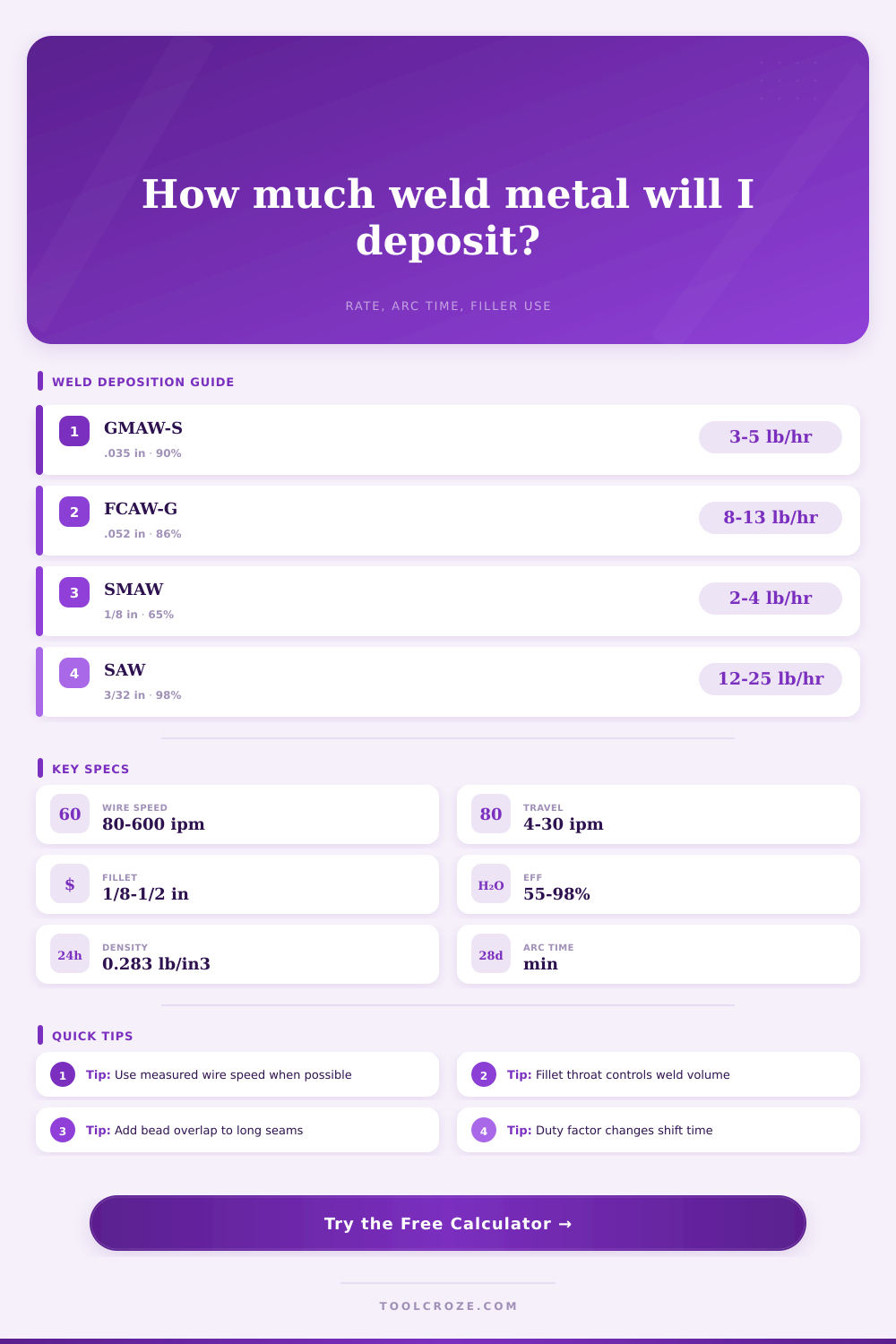
One thing that throws people off is deposition efficiency. Even though you’re feeding wire at a steady rate, not everything end up as part of the weld. Some gets lost due to arc loss, some gets spattered off and some falls into slag. If you protect the pool with flux, like submerged arc welding, then most (around 98%) of the wire end up on the plate. If you lose the coating like stick welding, then it’s more like 65% efficient. This loss is accounted for in the calculation. What it’s showing you isn’t what comes off the spool; it’s what goes onto the plate.
Speed is another consideration. Cap height and bead width depends on the speed of travel. Too fast will result in poor fusion. Too slow and you have added too much heat. This melt the thin material, which causes distortion and wasted filler. The reference table show typical rates for each process. Stick welding is slower then GMAW spray transfer. For production shops, wire carry more metal per minute and thus is preferred for high volume work. Faster does not necessarily mean better; good control at high speed become necessary for good quality. If your travel speed varies, then so will your deposition rate. Therefore, your schedule estimate are incorrect.
Fewer things have more of an effect on fillet size than most believe. Fillet welds scales based off the square of the leg size. So doubling the leg size quadruples the amount of metal needed. A quarter inch fillet is not twice as expensive than an eighth inch fillet; it is four times as expensive in terms of material and time. This is where many estimates go wrong. Change a leg size from three sixteenths to a half-inch, and think that it will just take you slightly longer to do the job. That is not the math.
Look at the arc time change when adjusting the leg size. It get bigger. Use the calculator. Adjust the leg size. See the arc time go up. Recognize that big fillets requires multiple passes. Also, recognize that heat buildup is real. Rushing a big fillet can create problems.
The operating factor is where things get real. In a controlled lab environment, you can hold an arc on metal every second of the hour. Out on the shop floor, you’ll break for lunch, clean up slag, move your clamps, wait for operators, etc. A general rule of thumb for most shops is a 35% operating factor. That means you’re only realy welding for 21 minutes out of every hour. Everything else is overhead. If you don’t account for this your schedules will appear tighter then they really are. By adjusting the % here you can plan your shift times more accuratey. You begin planning around real world interruptions instead of guessing when you’ll complete the job.
The balance between accessibility and speed is selecting the proper wire diameter. Larger diameter wires carries more current, depositing more metal. But they has a harder time on verticals and other tight corners. Smaller diameter wire are easier to manage, but takes more passes to deliver the same amount of metal.
The pre-sets in the calculator load standard values for common situations. Think of these as starting points; not rules. Adjust according to your conditions and equipment. Maybe your travel speed is faster than average or your wire feeder runs slow. This can be customized in the tool.
Planning is half of welding; just as important as performing it. If you know how much metal you need to deposit, you can calculate how much filler to order. How long will the welder have the arc turned on? Schedule them accordingly. Make a concrete plan based off an estimate. Stop hoping for the best. Make estimates based on reality. When you see a joint, think about what will leave and what will remain. What’s the difference? That’s your efficiency.