Asphalt Grinding Calculator
Estimate pavement milling quantity, tons removed, loose swelled volume, milling passes, truck loads, hourly production, and shift duration from area, depth, density, cutter width, overlap, and machine speed.
📌Pavement Milling Presets
⚙Grinding Inputs
Asphalt Milling Estimate
Full Breakdown
⚖Equipment and Material Grid
📏Milling Depth and Quantity Reference
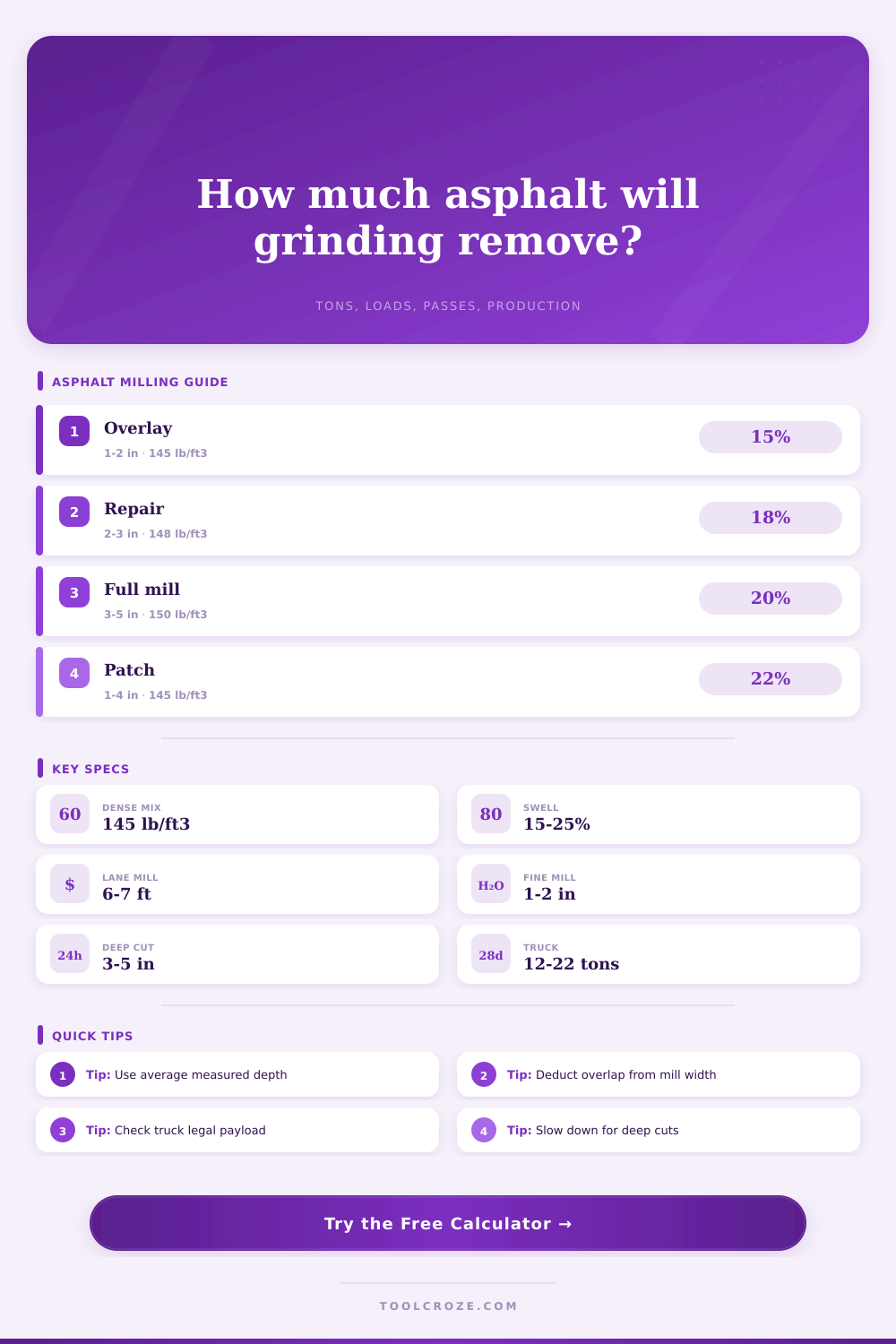
| Milling Scope | Typical Depth | Approx Tons per 1,000 sq ft | Planning Note |
|---|---|---|---|
| Surface correction or profile grind | 0.5 to 1 in | 3.0 to 6.0 tons | Quantity is sensitive to high spots and variable cross slope. |
| Overlay preparation mill | 1 to 2 in | 6.0 to 12.1 tons | Common for parking lots, lanes, and pavement surface renewal. |
| Structural lane removal | 2 to 3 in | 12.1 to 18.1 tons | Watch truck cycle time because production creates RAP quickly. |
| Deep repair or binder removal | 3 to 5 in | 18.1 to 30.2 tons | Machine speed usually drops as depth and aggregate size increase. |
| Butt joint or taper grind | 0.75 to 2 in average | 4.5 to 12.1 tons | Use average depth across the tapered width, not maximum edge depth. |
🛣Asphalt Density and Swell Reference
| Asphalt or RAP Condition | In-Place Density | Loose Swell Factor | Use in Calculator |
|---|---|---|---|
| Older parking lot mix | 140 to 145 lb/ft³ | 18% to 25% | Good default when the pavement is weathered or variable. |
| Dense-graded roadway asphalt | 145 to 150 lb/ft³ | 15% to 20% | Use for typical HMA surface and binder courses. |
| High-stone asphalt layer | 150 to 155 lb/ft³ | 15% to 18% | Useful for tight, aggregate-rich roadway sections. |
| Patch excavation and mixed millings | 140 to 150 lb/ft³ | 20% to 30% | Use higher swell when chunks, edges, or sweepings enter the load. |
| Bridge deck or thin surface grind | 140 to 148 lb/ft³ | 18% to 25% | Small changes in measured depth can move the total noticeably. |
🏭Machine Width and Production Reference
| Machine Class | Common Drum Width | Typical Speed Range | Best Fit |
|---|---|---|---|
| Skid steer planer attachment | 12 to 40 in | 5 to 25 ft/min | Utility patches, tie-ins, and tight access cuts. |
| Compact cold planer | 3 to 4 ft | 15 to 45 ft/min | Small lots, trench repair, and short urban runs. |
| Half-lane milling machine | 5 to 7 ft | 30 to 80 ft/min | Parking lots, lane work, shoulders, and resurfacing prep. |
| Full-lane milling machine | 7 to 12.5 ft | 40 to 100 ft/min | Roadway lanes where trucks can cycle continuously. |
| Deep cut production mill | 6 to 12.5 ft | 15 to 45 ft/min | Thick asphalt removal where depth limits forward speed. |
🚚Truck Loading and Haul Planning Reference
| Truck Type | Typical Legal Payload | Loose Volume at 145 lb/ft³ | Planning Use |
|---|---|---|---|
| Small dump truck | 5 to 8 tons | About 4 to 7 yd³ | Patch milling and short site hauls. |
| Single-axle dump | 7 to 10 tons | About 6 to 9 yd³ | Municipal work and smaller grinder support. |
| Tandem dump | 12 to 16 tons | About 10 to 14 yd³ | Parking lots and routine road resurfacing. |
| Tri-axle dump | 16 to 22 tons | About 14 to 19 yd³ | High-production milling where load timing matters. |
| End dump or transfer | 20 to 28 tons | About 17 to 24 yd³ | Longer hauls where access and regulations allow. |
💡Asphalt Grinding Tips
Many times a pavement failure starts out looking just fine until it fails. Maybe you drove on an unevenly compacted lot, then when you put the new overlay on it crack up. The problem wasn’t fixed in the underlying profile.
Milling resets the pavement. Removing the old worn out surface leave a blank slate for new material.
Why Milling Is Good for Pavement
Planning involves more than just guessing how many truckloads is needed. There is physics to removing the material in place. There is also physics to what happens to it once its out of the ground. But how do we start? With density. Time and binders has compacted asphalt in the ground. The material are compacted tight. Milling breaks that structure down. As it becomes loose reclaimed asphalt pavement, it swells up and increases its volume. What you’re going to put in your dump truck will take up more space than the hole it leaves in the road. If you plan your haul based off the in-ground volume, you will not plan for enough loads.
The calculator above does that for you. It assumes a swell factor that adjusts for all extra air gaps in your loose material. It multiplies your area times your depth, then multiplies that by the in-place density and then inflates that number to account for what you’re actualy hauling away.
The variable that causes the majority of estimates to go wrong is depth. Most people look at the deepest section of rut and apply it to the whole job. This is a mistake. A milling drum will cut a consistent depth from end to end. So if your job involves correcting a crown or tapering an edge, you want the average depth, not the maximum. The mill itself helps you consider weighted averages. You may only be removing one to two inches consistently for simple overlay prep, but on a full-depth repair, you could be cutting three to five inches. Tons differ greatly. An additional inch over a large parking lot add dozens of additional truck cycles. It also adds hundreds of ton to the bill.
Then there’s speed, both for the man and the machine. Yes, a milling drum is heavy duty stuff. But it isn’t infinitely speedy. How many feet of pavement per minute the drum traverses determine how quickly it can removes the old material. Wider drums covers area faster. Narrower ones get into tighter spots. Lighter equipment is nimble. Heavier equipment makes fewer passes. Time out doesn’t show up on the spec sheet, so we included an efficiency factor in the calculator to account for those stops. Trucks need to turn. The operator will stop to confirm grade. Someone has to spray water to dampen the dust. Each break adds up. Overlook these factors and you’ll get overly optimistic timelines that always slide.
This is about logistics. This is where the bottleneck is. How many truck loads? How far are you hauling? What is payload capacity of your trucks? Dump trucks can vary in capacity, with a tri-axle dump truck being able to carry eighteen tons while smaller units manages much less. How long will it take you to drive there? If the trip is long, then every minute the truck is gone mean one fewer minute of milling. You may discover you have to wait for a truck before putting the grinder back to work. People mess this up. They look at how fast their grinder works but ignore the logistics of getting material to it.
Where does all that stuff go? Well most milled asphalt gets recycled. It is crushed up, sized, mixed with new hot mix asphalt, and used as aggregate and whatnot. You can get a better deal on your contract with recycling plants if you know exactly how many tons. Cause they charge per ton and knowing more saves you money. If you overestimate you’re wasting space on their disposal site. If you underestimate, you would of have to pay them for additional runs to catch up.
It’s a noisy business and messy, but that’s what’s required. Poor pavement leads to poor driveability, and anything laid overtop will have a shorter lifespan because of it. Milling removes some of the uncertainty, but it still takes more than just guessing. It reveals the true nature of the underlayment and gives you a flat starting point. While the technology out there makes the math simpler nothing takes away from the requirement for local knowledge. Still have to walk the job, check the spots, know the traffic pattern. What goes in is only as good as what comes out. Get the depth correct, factor in the swell, and everything else seems to fall into place. A smooth, even, ready-for-the-next-chapter surface is the result… Like it oughta be.