I Joist Weight Calculator
Estimate engineered I-joist handling weight from depth, flange size, web thickness, length, manufacturer series approximation, quantity, moisture, bundle size, and hardware allowance.
📌Engineered I-Joist Presets
⚙Joist and Bundle Inputs
I-Joist Handling Weight Estimate
Full Breakdown
⚖Weight Factors Grid
📋Series and Spec Approximation Grid
| Series Preset | Manufacturer | Typical Flange and Depths | Handling Weight Approximation |
|---|---|---|---|
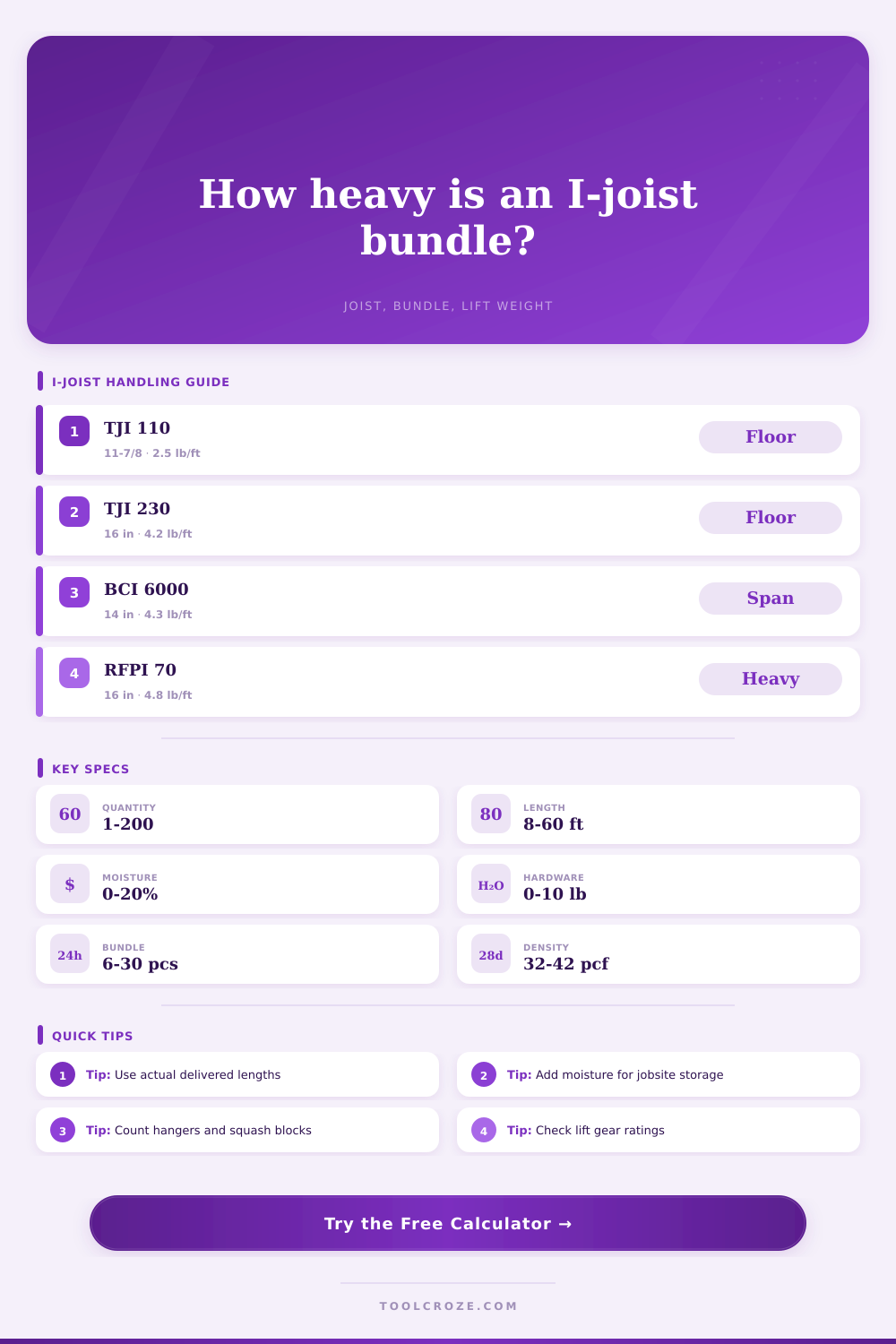
| TJI 110 | Weyerhaeuser Trus Joist | 1.75 in flange, common 9.5 to 16 in depths | Light residential floor joist, about 2.2 to 3.0 lb/ft |
| TJI 210 | Weyerhaeuser Trus Joist | 2.06 in flange, common 9.5 to 16 in depths | Moderate floor joist, about 2.8 to 3.6 lb/ft |
| TJI 230 | Weyerhaeuser Trus Joist | 2.31 in flange, common 11.875 to 16 in depths | Stiffer residential joist, about 3.4 to 4.5 lb/ft |
| TJI 360 | Weyerhaeuser Trus Joist | 2.31 in flange, common 11.875 to 18 in depths | Longer span floor member, about 4.0 to 5.3 lb/ft |
| TJI 560 | Weyerhaeuser Trus Joist | 3.5 in flange, common 14 to 24 in depths | Deep heavy series, about 5.6 to 7.6 lb/ft |
| BCI 5000 | Boise Cascade | 1.75 in flange, common 9.5 to 16 in depths | Residential floor joist, about 2.4 to 3.3 lb/ft |
| BCI 6000 | Boise Cascade | 2.31 in flange, common 11.875 to 20 in depths | Heavier floor joist, about 3.7 to 5.6 lb/ft |
| LPI 20Plus | LP SolidStart | 2.5 in solid-sawn flange, common 9.5 to 16 in depths | Light to medium joist, about 2.6 to 3.3 lb/ft |
| LPI 32Plus | LP SolidStart | 2.5 in solid-sawn flange, common 9.5 to 16 in depths | Stiffer floor joist, about 3.0 to 4.3 lb/ft |
| RFPI 70 | Roseburg | 2.31 in flange, common 11.875 to 20 in depths | Heavy I-joist, about 4.2 to 5.9 lb/ft |
📐Depth, Length, and Bundle Reference
| Joist Group | Common Depths | Common Length Range | Handling Note |
|---|---|---|---|
| Shallow floor framing | 9.5 in and 11.875 in | 12 to 28 ft | Often staged by hand in small packs; watch bundle straps and blocking |
| Standard floor framing | 11.875 in and 14 in | 18 to 36 ft | Bundle weight rises quickly with quantity and damp storage |
| Deep floor or roof framing | 16 in and 18 in | 24 to 44 ft | Use fewer pieces per pick when access is tight or wind is present |
| Long-span engineered framing | 20 in to 24 in | 30 to 60 ft | Check manufacturer handling guidance and equipment limits before lifting |
| Mixed package delivery | Multiple depths | Cut list dependent | Calculate each series group separately, then add the totals for staging |
💧Moisture and Hardware Allowance Table
| Condition | Moisture Factor | Hardware Allowance | When to Use |
|---|---|---|---|
| Fresh indoor stock | 0% to 3% | 0 to 0.5 lb per joist | Clean joists moved directly from covered storage to layout |
| Covered jobsite bundle | 4% to 8% | 0.5 to 1.5 lb per joist | Typical delivery staging with labels, straps, and some hangers |
| Damp site storage | 8% to 15% | 1 to 3 lb per joist | Packages exposed to rain, wet decking, mud, or long outdoor staging |
| Hardware bundled with joists | 5% to 12% | 3 to 10 lb per joist | Hangers, blocking, clips, rim board pieces, or squash blocks strapped in |
| Conservative lift planning | 12% to 20% | 5 to 15 lb per joist | Use for crane picks, long hoist reaches, or uncertain package contents |
🚚Handling Weight Planning Table
| Result to Check | Calculator Output | Practical Use | Planning Caution |
|---|---|---|---|
| Weight per joist | Length x adjusted lb/ft plus hardware | Useful for hand staging and crew size planning | Long joists are awkward even when the weight looks manageable |
| Bundle weight | Total weight divided by bundles or picks | Useful for forklift, boom, telehandler, or crane pick checks | Use actual bundle count if the supplier banded packages unevenly |
| Linear weight | Blend of series lb/ft and geometry density check | Useful when the exact published joist weight is not on the cut sheet | Replace approximation with manufacturer data when available |
| Lift percentage | Average bundle weight divided by entered lift limit | Quickly flags whether the selected bundle size is too large | Rigging angle, reach, wind, and terrain can reduce safe capacity |
| Total handling weight | Dry joist package plus moisture and hardware | Useful for staging zones, temporary platforms, and delivery planning | Do not use this estimate as a substitute for engineered load checks |
💡I-Joist Weight Tips
A pallet of engineered lumber looks manageable on a jobsite until you try to lift it. To span large spaces with relatively little material, I-joists does their job efficienty in terms of structure, but not in terms of physical handling. They seem light because the wood is not distributed evenly like a solid beam, which gives an inaccurate impression of weight until you consider both the bundle size and its overall length. Add water weight (which adds significant pounds to every piece, depending on ambient humidity), and most framers tend to under-estimate how much a long span weigh, or simply forget about it entirely.
Enter your bundle count and your joist dimensions into calculator, and let it do the math for you… Then determine whether your crew can stage the load by hand, or if you’ll require a telehandler.
How to Plan Safe Lifts for Engineered Lumber
Keep in mind that an I-joist isn’t solid wood. It is made up of three things: the vertical web between the flanges, the flanges themselves, and whatever holds them together, like glue or fasteners. The web resist shear forces. The flanges resists bending stress. So adjusting thickness or width of the flange adjusts heaviest part of the member right there.
For example, a TJI 110 series joist might weigh around two and a half pounds per foot, but a deeper one like a 24-inch TJI 560 can weighs six or even seven pounds per foot. On a short wall, that’s not a big difference, but when lifting forty-foot spans, that make a huge difference. Knowing exactly what your package weigh matters for making your lift plan.
A lot of folks forget about moisture till the forklift is struggling. Wood take on moisture from air. And those bundles sitting outside exposed to dew or even just under a tarp pick up their weight quick. The tool allows you to enter a moisture factor, a smart move if your site is damp. A modest eight percent increase in moisture doesn’t sound like much, but on a fifty-bundle order, it add hundreds of pounds. That additional weight doesn’t change structural capacity of the floor, but it will change safety margin for your lifting equipment. Is it dry stock you’re lifting out of a warehouse? Or is it wet bundles you’re lifting off a muddy area?
Another aspect of framing that is easy to forget is hardware. You don’t get joists as bare sticks of wood. They’re delivered strapped together in bundles, labeled, and sometimes accompanied by metal clips or hangers. A few ounces of steel per joist begins to add up fast, multiply it by two-hundred pieces. There’s a line on the calculator for allowing for hardware. This “dead” weight will allow you to factor into the equation what total weight of each package is, not merely the theoretical weight of the dry lumber. When you are pushing the capacity of your equipment, even forgetting the hardware can cause an overload.
On the page there is a reference table that lists average weights per series. But beauty is knowing what this means in terms of actual weight of the individual lift for your application. This applies to everything from a single joist for a repair job to an entire bundle for new construction.
Know that longer members will have greater leverage. A 24 foot joist may not be heavy but lifted at one end it is going to swing wildly. People pay attention to weight but miss the dynamic of the swing. Estimating weights is a realistic way to plan for actual conditions. By estimating weights, you want to come to the scene knowing how many trips your gear will require. Will the weight of your bundle stress your ground? How many people do you need on your crew to control the load?
The math provides comfort, but experience teaches caution. If in doubt, weigh it as if it weighs more then its appearance would suggest. Having excess lifting strength is preferable to having a heavy load that could of not been lifted. That approach makes job go smoothly and keeps everybody safe.