Type 1 Aggregate Calculator
Estimate MOT Type 1 sub-base for patios, driveways, paths, shed bases, and hardstanding areas using area, compacted depth, loose factor, density, subgrade correction, geotextile allowance, tonnes, and bulk bags.
⚙Unit System
📌Real Project Presets
📐Sub-Base Inputs
MOT Type 1 Estimate
📊Live Material Summary
🛣Type 1 Spec Grid
| Sieve Size | Overall Passing Range | Practical Meaning | Estimator Note |
|---|---|---|---|
| 63 mm | 100% passing | All particles pass the top sieve | Often sold as 40 mm to dust for domestic work |
| 31.5 mm | 75% to 99% passing | Large angular stone forms the skeleton | Rake and compact in even layers |
| 16 mm | 43% to 81% passing | Mid-size stone locks voids | Good grading helps reduce settlement |
| 8 mm | 23% to 66% passing | Smaller aggregate tightens the matrix | Use moisture and a plate compactor |
| 4 mm | 12% to 53% passing | Fine aggregate improves interlock | Do not substitute open clean stone |
| 0.063 mm | 0% to 9% passing | Dust content is limited | Excess fines can hold water and pump |
📏Patio, Driveway, and Base Depth Guide
| Application | Typical Compacted Depth | Subgrade Correction | Loose Factor |
|---|---|---|---|
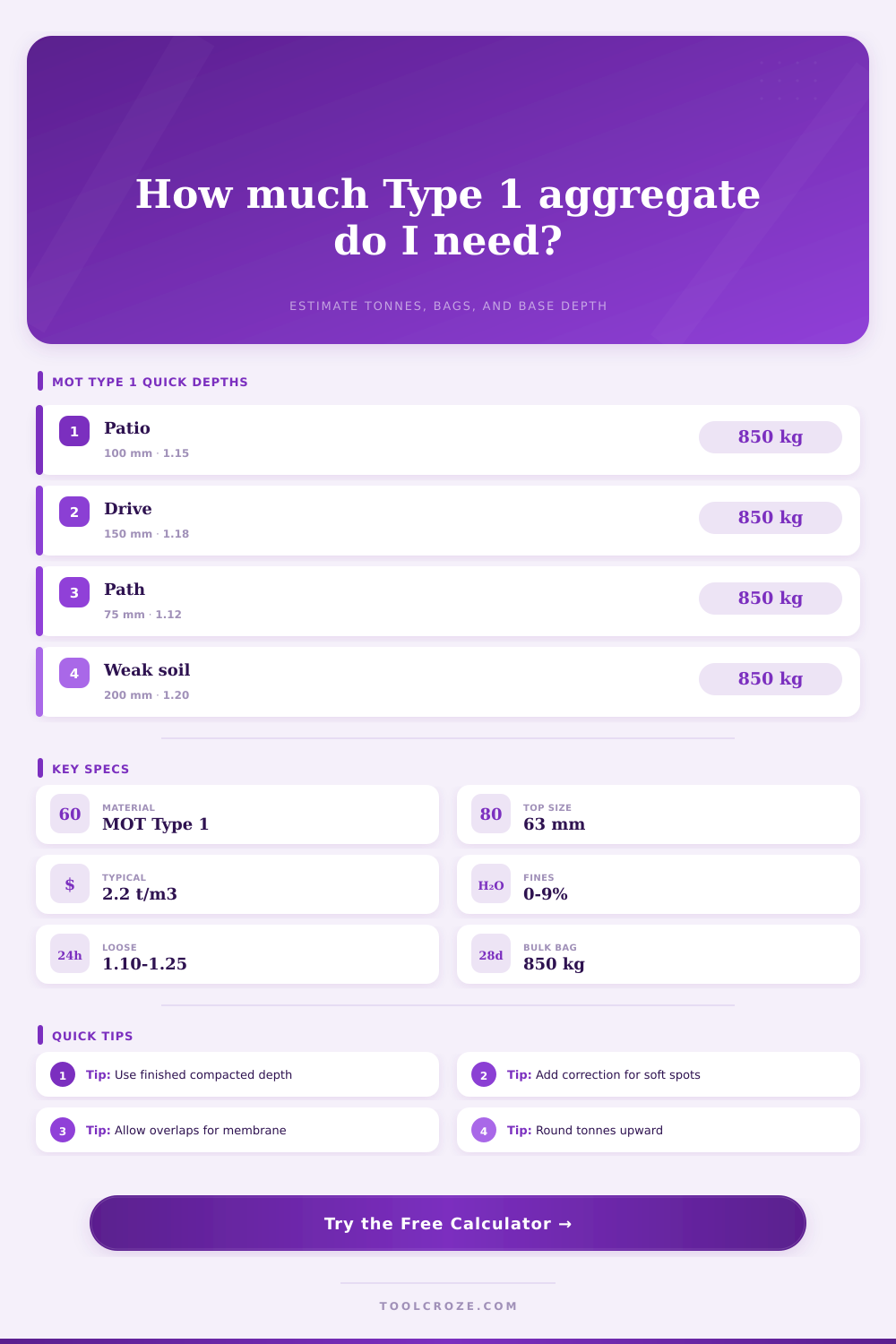
| Garden path under slabs or gravel | 75 to 100 mm | 0 to 10 mm | 1.10 to 1.15 |
| Patio or terrace sub-base | 100 to 150 mm | 10 to 25 mm | 1.12 to 1.18 |
| Block paving driveway | 150 to 200 mm | 15 to 40 mm | 1.15 to 1.20 |
| Domestic hardstanding area | 150 to 225 mm | 25 to 50 mm | 1.18 to 1.25 |
| Shed or greenhouse pad | 100 to 150 mm | 10 to 25 mm | 1.12 to 1.18 |
| Soft spot repair beneath paving | 150 to 250 mm | 40 to 100 mm | 1.20 to 1.25 |
⚖Density and Bulk Bag Reference
| Material Condition | Estimator Density | Tonnes Per 850 kg Bag | Best Use In Calculator |
|---|---|---|---|
| Dry recycled Type 1 | 2000 kg per m³ | 0.85 tonnes | Light paths and non-critical fill |
| Limestone MOT Type 1 | 2100 kg per m³ | 0.85 tonnes | Typical patios and slab bases |
| Mixed MOT Type 1 allowance | 2200 kg per m³ | 0.85 tonnes | Default domestic estimating |
| Dense granite Type 1 | 2300 kg per m³ | 0.85 tonnes | Driveways and harder stone areas |
| Wet dense-graded sub-base | 2400 kg per m³ | 0.85 tonnes | Heavy side estimate for wet stock |
🧵Geotextile and Ordering Allowances
| Allowance | Use When | Calculation Effect | Planning Note |
|---|---|---|---|
| 5% membrane allowance | One rectangular sheet with clean edges | Area x 1.05 | Works for simple patios |
| 10% membrane allowance | Overlaps, laps up edges, and one joint | Area x 1.10 | Good default for domestic bases |
| 15% membrane allowance | Curves, drains, or several fabric joins | Area x 1.15 | Useful around paths and planting edges |
| 5% aggregate allowance | Straight edges and reliable formation | Order volume x 1.05 | Least spare material |
| 10% aggregate allowance | Small level changes and normal spreading | Order volume x 1.10 | Common practical takeoff |
| 15% aggregate allowance | Irregular excavation or soft ground | Order volume x 1.15 | Use with deeper correction inputs |
💡Calculator Tips
You don’t know what the ground beneath your feet is like, and you need to pave a driveway or patio. Meet your new best friend, Type 1 aggregate. It is the structural skeleton that everything else sit on top of. No good without this as a solid base; your gravel will sink, your paving slabs will crack. Stone is heavy and expensive to deliver, but if you don’t have a solid base, your hardstanding will look like a bowl after first heavy rain.
You can’t return it when it’s in a skip, so getting the volume right matter. This is a calculator to fill the gap between a rough sketch and a delivery order. The calculator manages the dirty work: the conversion from loose material into compacted reality. Most folks miss this bit.
Why a Good Base Matters for Your Driveway
Stone spreads out in a pile. Roll that same stuff down, and it’s not enough. Yup, there’s shrinkage. For a standard patio base, this value usually hovers around 1.15. This value shows the voids that is crushed out by weight of a plate compactor. Miss this one, and you’re going to be scrambling for more mid-job. It’s a low multiplier but, boy, does it make all the difference between a weekend project that ends when planned and an emergency delivery call on a Tuesday morning.
Then there is what lies beneath the stone. That’s no technicality; it’s a reminder that your garden isn’t exactly flat. Some areas might feel spongy underfoot. There are low spot. Is it clay soil? Then you need more depth to compensate… To build in some padding over the lumps and bumps. The calculator includes this into the target depth, so that whatever you order will provide you with a level surface, not just fill holes.
That’s where the difference between total fill and compacted depth comes in. You’re not making a sandcastle here; you’re constructing a foundation. There’s also the issue of density, although it sounds like abstract math. Most Type 1 has a density of about 2200 kilograms per cubic meter. But then there’s your local stone. Granite is heavy; limestone is light. Depending on whether or not you’re getting some dense material from a local quarry, your weight might be more/less than the expected estimate.
You can alter this in the tool, good as the merchants bill based off tonnes (not cubic metres). So the denser the stone the less cubic metres you’ll have per tonne. This impacts number of loads you require. It is all too easy to underestimate the weight, especially if your trailer has an axle weight limit.
There is one other item I want to mention: geotextile fabric. This is used as a separator between the clean stone and the soil beneath it. The estimator’s fabric calculation include cutting waste and overlapping the fabric. Since you don’t want the fabric to move (and in addition need some turn-up on the edges), you’ll use more fabric than just the surface area of the patio. The stuff is thin and will save your butt come mudding time.
After that it calculates the result into loose loads, bulk bags and tonnes. And here’s where you take action. If access is difficult, or the job is relatively small then you will want bulk bags; they’re easy to use but a bit of a faff. For bigger jobs where speed is important, go for a loose delivery… Just make sure your gate is wide enough and there is a solid surface for the tipper to stand on.
The calculator rounds the results up, which is sensible. Half a tonne shortage is not good if the lorry driver has gone home, whereas having some spare stone is no problem. The most difficult aspect of the preparation work is getting the depth right. Seventy-five millimeters of crushed stone will suffice for a garden path; a hundred-and-fifty-millimeter layer of compacted stone are the bare minimum for a driveway suitable for a moddern car. These guidelines are spelled out in the tool’s reference tables; don’t expect to guesstimate. Follow them (and then adjust for local conditions).
And the secret? Don’t think about the fancy slabs. Just think about the base. Make the base rock-solid, and the rest will follow for decades. Do it wrong, and in five years you’ll dig it all back out. The calculator at top will do the numbers for you, but always double-check visually: use your eyeballs to read the ground. Order with a bit of buffer; measure twice; get that first layer solid. Your work won’t stand on its own, only on a good base, which is invisible to everyone else but truly supports your work.