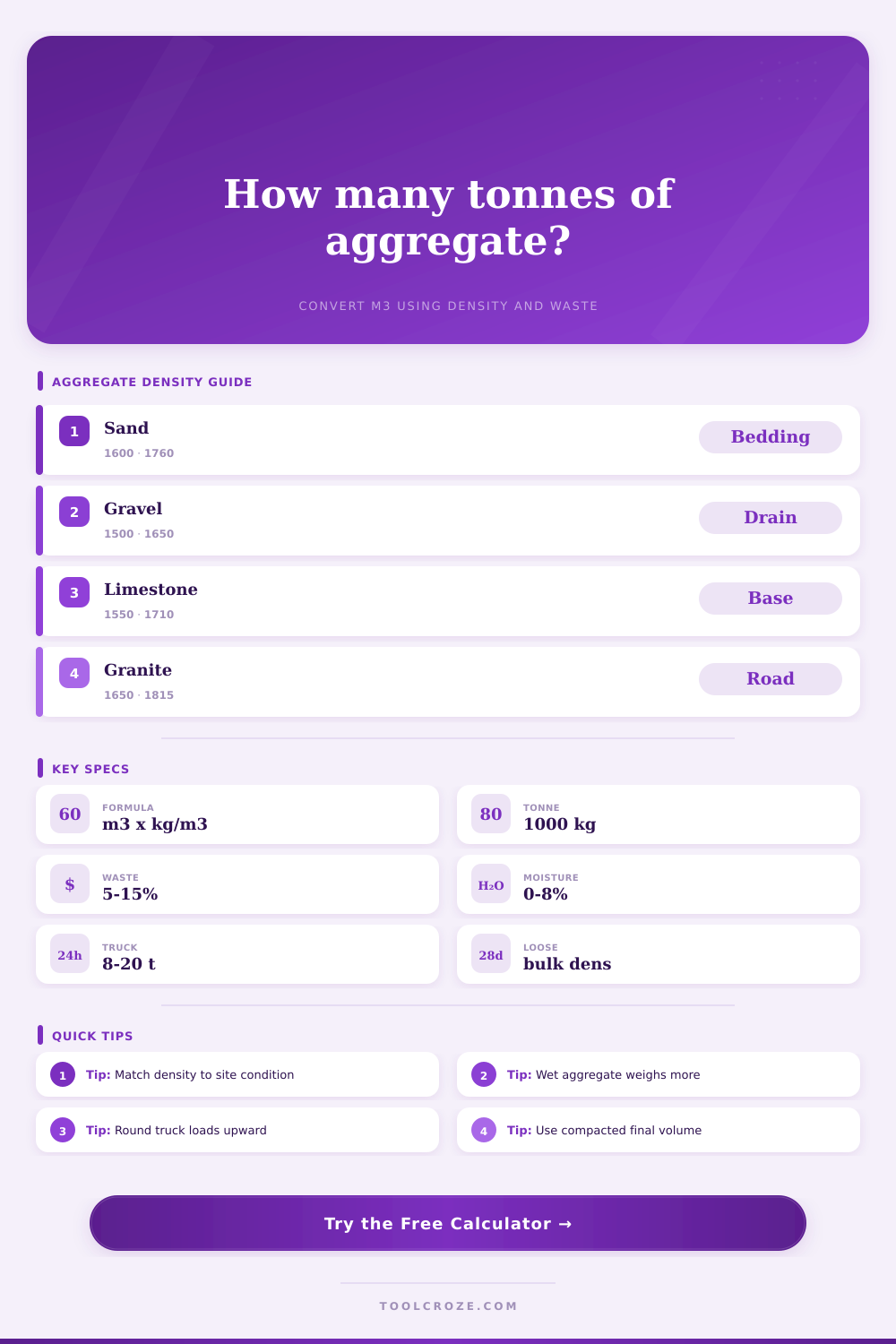
Convert M3 to Tonnes Aggregate Calculator
Convert aggregate volume in cubic meters to dry tonnes, wet tonnes, loose bulk volume, wastage allowance, and truck payload split using real aggregate density presets.
📌Aggregate Presets
⚙Volume, Density, and Delivery Inputs
Aggregate Conversion Result
Calculation Breakdown
⚖Density and Spec Grid
📋Aggregate Density Reference
| Aggregate Type | Loose Density | Compacted Bulk Density | Typical Use |
|---|---|---|---|
| Sharp sand | 1500 to 1650 kg/m³ | 1650 to 1820 kg/m³ | Bedding layers, screeds, paver work |
| Pea gravel | 1400 to 1520 kg/m³ | 1470 to 1600 kg/m³ | Drainage, pipe bedding, decorative fill |
| Washed river gravel | 1450 to 1580 kg/m³ | 1520 to 1660 kg/m³ | Paths, drains, exposed landscaping |
| 20 mm crushed stone | 1500 to 1600 kg/m³ | 1650 to 1760 kg/m³ | Subbase, backfill, drainage aggregate |
| MOT Type 1 limestone | 1600 to 1700 kg/m³ | 1760 to 1870 kg/m³ | Driveway, patio, pavement subbase |
| Crushed granite | 1620 to 1720 kg/m³ | 1780 to 1890 kg/m³ | Road base, hardstanding, rail works |
| Recycled concrete aggregate | 1350 to 1550 kg/m³ | 1490 to 1710 kg/m³ | General fill, capping, subbase |
| Concrete ballast blend | 1680 to 1800 kg/m³ | 1800 to 1950 kg/m³ | Concrete mixing and heavy fill |
| Slate chips | 1250 to 1450 kg/m³ | 1320 to 1530 kg/m³ | Decorative landscaping and beds |
| Gabion rock | 1600 to 1800 kg/m³ | 1680 to 1890 kg/m³ | Retaining baskets and erosion control |
📐Conversion Formula Table
| Step | Formula | What It Means | When It Matters |
|---|---|---|---|
| Loose volume | Compacted m³ x (1 + compaction %) | Adds volume needed before material is compacted | Road base, slabs, patios, driveway layers |
| Dry tonnes | Loose m³ x kg/m³ / 1000 | Converts aggregate volume to dry metric tonnes | Core m3 to tonnes aggregate conversion |
| Wet tonnes | Dry tonnes x (1 + moisture %) | Adds water weight carried in damp aggregate | Truck payload checks and weighbridge tickets |
| Order tonnes | Wet tonnes x (1 + waste %) | Adds loss from spreading, grading, edges, and handling | Final supplier order quantity |
| Truck loads | Order tonnes / payload tonnes | Splits the order across delivery trucks | Scheduling deliveries and avoiding overloads |
🚚Truck Payload Split Reference
| Truck Type | Typical Payload | Best For | Planning Note |
|---|---|---|---|
| Small tipper | 3 to 5 tonnes | Garden beds, short paths, small drainage jobs | Good access on tight residential sites |
| Single axle tipper | 6 to 9 tonnes | Small driveways and moderate subbase loads | Often easier to place near homes |
| Rigid truck | 12 to 18 tonnes | Patios, lanes, hardstanding, larger fill areas | Check access width and ground bearing |
| Articulated tipper | 24 to 29 tonnes | Commercial roads, bulk fill, long site roads | Needs strong access and turning room |
| Bulk bag delivery | 0.75 to 1 tonne | Small jobs where loose tipping is awkward | Bag density varies by moisture and material |
💧Moisture and Compaction Reference
| Condition | Typical Allowance | Effect on Tonnes | Field Check |
|---|---|---|---|
| Dry screened aggregate | 0% to 1% moisture | Close to dry density calculation | Dusty surface, little clumping |
| Damp stockpile | 2% to 5% moisture | Adds modest payload weight | Holds shape lightly when squeezed |
| Wet sand or fines | 6% to 12% moisture | Can raise delivered tonnes noticeably | Visible water sheen or heavy clumping |
| Light tamping | 5% compaction allowance | Needs a little extra loose volume | Foot traffic, rake, hand tamper |
| Plate compaction | 10% to 15% allowance | Order more loose material for same final volume | Vibrating plate or roller passes |
💡Aggregate Conversion Tips
When you’re planning any construction project, you need to know the relationship between weight and volume. Volume is amount of space that something takes up. Weight is how much something costs to move. The gap between those two measurements is where most projects stumble.
For example, you can order what feels like enough sand by pile height, only to find it’s not enough once it compacts. Once you lay it on the ground, however, it all compacts. When you come back to put down last layer, it’s not as high as planned.
Why Volume and Weight Matter in Construction
Or maybe you schedule one truck to bring in some stone because it’s “light”. But the truck driver won’t take the load because it’s too heavy!
The calculator above figures this out for you. You input your site conditions. The tool handles conversions. You are trying to convert from volume to weight. Weight depend on density. Aggregate material has variable density. Particle shape affect it. Moisture content can change it. Compacted aggregate will weigh more then the same amount of loose aggregate.
Consider that when ordering material. For example, if you want a certain thickness as base for your patio, you need to order more material because some of it will settle into ground. The calculator allow you to enter a compaction percentage. That closes the loop between the pile of material delivered and what ends up on the ground.
Water does not add structural value but it adds weight. Water has mass. If you are picking up aggregate that’s slightly damp after mist or rain then it will be heavier. The water costs you money. When you’re paying by weight this is important because there will be limits to how much weight you can take on a truck. For example, your tipper truck may be legally limited to carrying up to eighteen tonnes. Because wet aggregate is heavier than dry aggregate, you won’t get as much into the truck. Consequently, you’ll either have to make another trip or accept that you’ve paid for something that isn’t going to do any structural good. That loses you both time and money.
You should also consider wastage. There are no ideal rectangles on any site. When it’s unloaded, there will be spillage. When workers grade, they’ll kick some of that material out of the way. Add ten to fifteen percent to what you order. Is this being pessimistic? Hardly. It’s smart planning. With the buffer, you won’t run out of material. This means you don’t have to patch the job in later with a second batch that may not act or look the same.
In addition to total weight, the tool breaks the order into number of bulk bags and the number of truck loads. That make it easier for logistics. For example, if you require three and a half truck loads then plan for four deliveries. And that helps with planning access, too. Big trucks requires firm ground and wide turns. Maybe your property has limited space. Maybe smaller trucks are needed. There will be more trips. But total tonnage remains unchanged.
The reference table also compares the various materials. Limestone weighs less than granite does. Sand is lighter still. Set the correct density and match the material. Avoid over-ordering.
But converting volume to weight, you see, lets you set realistic expectations. It turns an abstract space requirement into a concrete plan. Lets you schedule rather than guess. The math adds up. The trucks roll in on time. The base levels off. Because it uses accurate data, the process works.