Aggregate Coverage Calculator
Estimate aggregate coverage from length, width, depth, material density, compaction factor, waste allowance, bag weight, tons, cubic yards, and delivery loads.
📌Driveway, Path, and Base Presets
⚙Coverage Inputs
Aggregate Coverage Estimate
Full Breakdown
⚖Aggregate Density Grid
📏Project Depth and Coverage Presets
| Project Use | Typical Finished Depth | Common Aggregate | Planning Allowance |
|---|---|---|---|
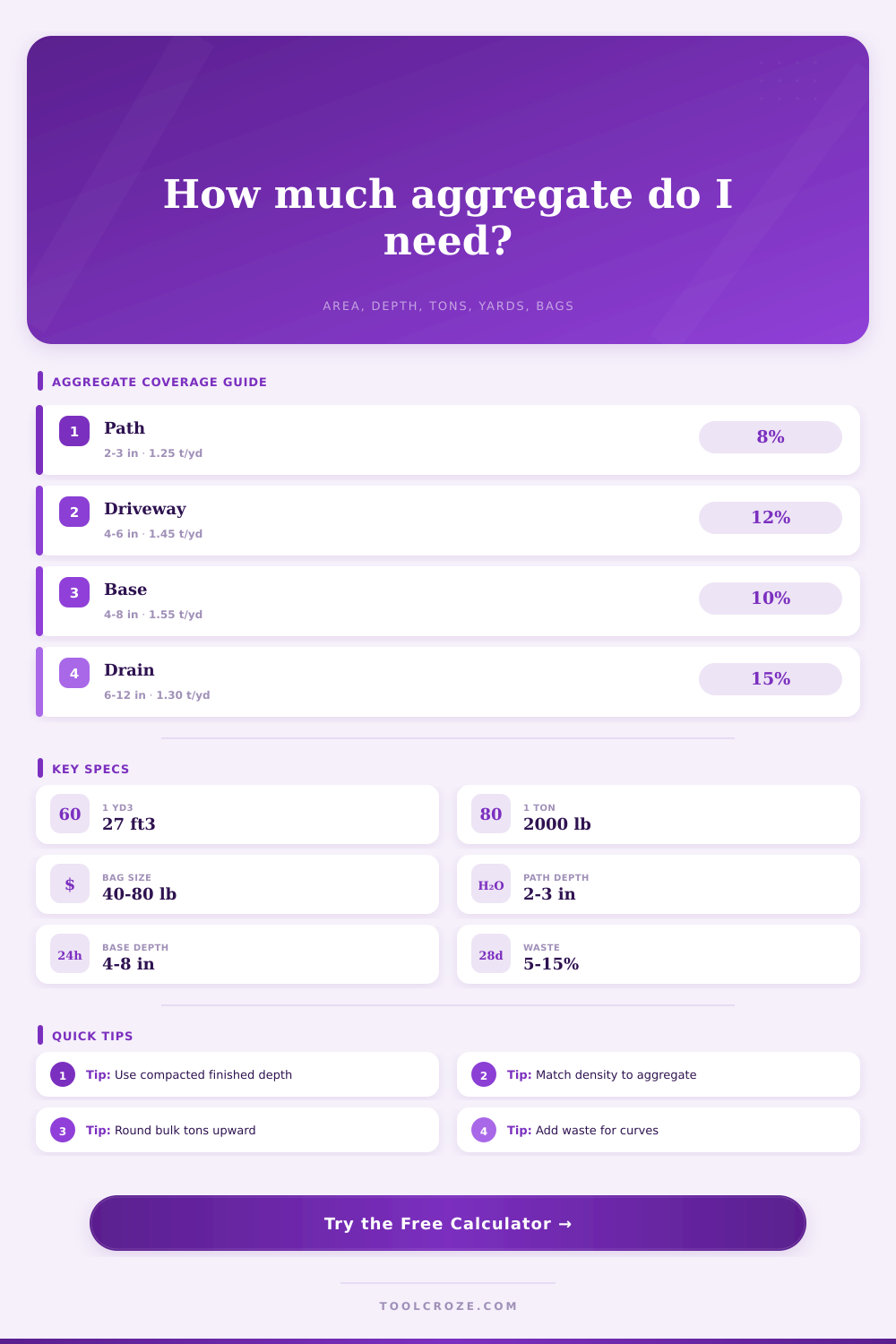
| Garden path or walkway | 2 to 3 in compacted | Pea gravel or clean crushed stone | 5% to 10% for edging and rake-out |
| Residential driveway topping | 4 to 6 in compacted | Crushed stone with fines | 10% to 15% for rut correction |
| Paver or slab sub-base | 4 to 8 in compacted | Road base or MOT Type 1 | 8% to 12% after plate compaction |
| Drainage trench envelope | 6 to 12 in around pipe | Clean washed stone | 12% to 18% for trench overbreak |
| Shed or equipment pad | 4 to 6 in compacted | Limestone, crusher run, or recycled concrete | 10% for low spots and leveling |
🪨Bulk Density Reference
| Aggregate Type | Bulk Density | Compaction Behavior | Best Fit |
|---|---|---|---|
| Washed pea gravel | 1.15 to 1.25 tons per yd³ | Settles lightly and stays free-draining | Paths, dog runs, and decorative cover |
| Clean crushed stone | 1.30 to 1.40 tons per yd³ | Angular stone locks moderately with open voids | Drainage layers and firm walkways |
| Crushed stone with fines | 1.40 to 1.50 tons per yd³ | Fines fill voids and compact into a tight surface | Driveway surfaces and base repair |
| Crusher run or road base | 1.50 to 1.60 tons per yd³ | Dense-graded material needs a higher compaction factor | Sub-base, lanes, and parking pads |
| Decomposed granite | 1.35 to 1.50 tons per yd³ | Compacts into a firm surface when fines are present | Patios, paths, and seating areas |
| Recycled concrete aggregate | 1.40 to 1.60 tons per yd³ | Variable density, so supplier data is helpful | Base layers and utility access areas |
📦Bag and Ton Conversion Reference
| Order Unit | Weight or Volume | Coverage at 3 in | Use in Calculator |
|---|---|---|---|
| 40 lb bag | 0.020 ton before moisture | About 2 to 3 sq ft | Small patches and edging |
| 50 lb bag | 0.025 ton before moisture | About 3 sq ft | Common bagged gravel size |
| 80 lb bag | 0.040 ton before moisture | About 5 sq ft | Small pads and repairs |
| 1 cubic yard | 27 ft³ loose volume | 108 sq ft before allowances | Bulk volume order comparison |
| 1 short ton | 2,000 lb | Varies by density | Supplier scale or truck quote |
🚚Compaction and Waste Factors
| Condition | Compaction Factor | Waste Factor | When to Use |
|---|---|---|---|
| Loose decorative cover | 0% to 5% | 5% to 8% | Straight beds, shallow paths, and light rake-out |
| Hand tamped walkway | 5% to 10% | 8% to 10% | Edged paths and small patio areas |
| Plate compacted base | 10% to 15% | 8% to 12% | Pavers, shed pads, and firm driveway lifts |
| Heavy driveway rebuild | 15% to 25% | 10% to 15% | Ruts, soft subgrade, and dense road base |
| Irregular trench work | 5% to 10% | 12% to 20% | Overbreak, pipe bedding, and uneven excavation |
💡Aggregate Coverage Tips
When most homeowners stare at their gravel, all they see is volume. So they measure the space, divide by target thickness, and calculate how many cubic yard they need. And then they sit in front of truck while it unloads and discover that there isn’t nearly as much stone as expected. Usually, the arithmetic was correct. People make mistakes because they fail to consider what happens to aggregate under weight of a truck. Aggregate isn’t solid like concrete; aggregate is a bunch of rocks sitting loosely on top of one another, shifting around and settling in when you put a truck on them or tamp them down. Before you call in the truck, take into account how much aggregate will dissapears when that happens.
That’s where the calculator (above) comes in. It will convert depth, area and weight into each other. So now you don’t need to guess if your material is heavy or light. The actual density of stone depends upon what type of stone you purchase. For example, road base has fine dust that fills in spaces between bigger pieces of rock; thus it is heavier then clean crushed stone. Pea gravel is still lighter than both of those. So it weigh less, but covers a greater area.
How to Calculate How Much Gravel You Need
So if you assume the wrong density, you may have enough volume, but not enough mass to hold up a vehicle. This is why the tool allows you to adjust the bulk density yourself. Your local quarry should of be able to tell you exactly how many tons per cubic yard they are selling. That way the load won’t be underweight for the road.
There’s also the matter of compaction. When you look at a pile of loose rock, there is spaces between all those stones (air pockets). Compacting the rock shakes it around until it’s packed more tightly together, which lowers its volume while raising its density. In other words: Order based off the thickness of your loose rock, but be sure you have enough for half as much again if you’re going to pack it down. (Because remember, when you order, this is based on “loose” material, not compacted.)
The waste factor works in a similar way, though for a different reason. No driveway is perfectly square or rectangular. It features curves and corners where the stone spills over. It also have depressions that require additional filling. A waste factor adds an extra percentage to cover these types of inefficiencies, so you don’t end up with patches here and there.
On small jobs, bagged gravel can be tempting, but it won’t serve well for large areas. At a decent thickness, a typical 50-pound bag will cover an area roughly three square feet in size. That means if you want to use bags to do a hundred-square-foot path, you’ll be lugging more than thirty heavy load from the car into place. The task is backbreaking, and tends to result in patches where the gravel has been spread haphazardly, in a hurry. For larger areas, bulk delivery is less expensive and time-saving, but planning is required. First you’ll need some kind of equipment to transport it, and a spot to deposit it.
On a garden path, the bother of bags may be worthwhile. On a driveway re-do, the numbers adds up on the side of the truckload. How much of what? And which aggregate? For example, crusher run with fines will lock into place nicely and hold up well under heavy loads. Clean stone allows water to seep through readily (great for drain trenches), but won’t stay in place as well. A decomposed granite can be smoothed out nicely; great for patios but may not drain well unless well graded. To give you an idea of what to expect, below is a reference table from the page outlining typical waste and depth recommendations for each material. Use this as a starting point when estimating quantities.
Begin with the depth you want the finished surface to be. Include a waste factor based on your skill level at spreading the stone, and the shape of the area. Include a compaction factor if you plan to roll or tamp the stone in place. Let the tool do all the math: it will tell you how many tons you need, how many cubic yards that equals, and whether you should be buying by the bag or the load.
It’s not about filling-in a hole, but building a sturdy, stable surface that won’t shift during the next rainstorm. If you get it right the first time you avoid digging out the same spot a month later.