Lime Mortar Calculator
Estimate lime mortar for heritage repointing from joint length, masonry area, joint width, repointing depth, NHL binder, lime-to-sand ratio, shrinkage, density, waste, bucket yields, and bag counts.
⚙Heritage Repointing Presets
📏Units and Takeoff Inputs
Lime Mortar Estimate
Detailed Breakdown
⚖Lime and Mix Spec Grid
🏛Heritage Repointing Preset Table
| Preset | Masonry and joint style | Typical binder | Starting joint size | Allowance |
|---|---|---|---|---|
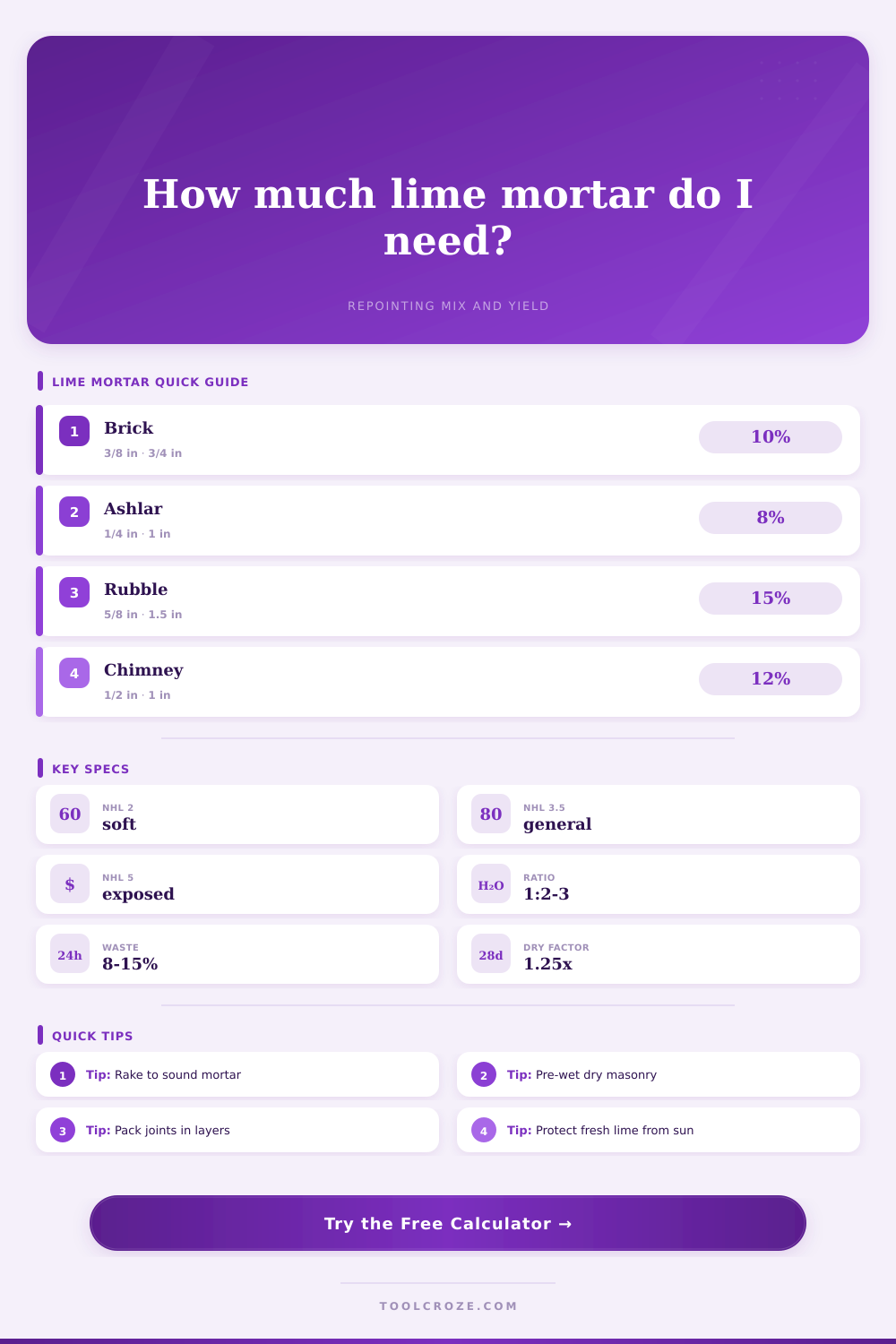
| Georgian soft brick | Low-fired brick with narrow weathered bed joints | Lime putty or NHL 2 | 3/8 in wide, 5/8 to 3/4 in deep | 10% waste for arrises and voids |
| Victorian brick facade | Solid brick elevation with regular running bond | NHL 2 or NHL 3.5 | 3/8 in wide, 3/4 to 1 in deep | 10% to 12% waste for variable rake-out |
| Limestone ashlar | Fine dressed stone with tight horizontal joints | NHL 2, often with fine sand | 1/4 in wide, 3/4 to 1 in deep | 8% waste when joints are consistent |
| Rubble stone barn | Irregular joints around large and small stones | NHL 3.5 for exposed farm walls | 5/8 in wide, 1-1/2 in deep | 15% waste for deep pockets and pinning |
| Chimney stack | Weather-exposed brickwork above roofline | NHL 3.5 or NHL 5 by exposure | 1/2 in wide, 1 in deep | 12% waste for crowns and shoulders |
🧪NHL Type and Exposure Reference
| Lime binder | Common repointing use | Relative set | Masonry match | Calculator density |
|---|---|---|---|---|
| Lime putty | Sheltered historic brick, interior stone, soft joints | Slow carbonation | Very soft masonry needing high vapor openness | 35 lb/ft³ default bulk lime |
| NHL 2 | Soft brick, sheltered external walls, gentle exposure | Slow hydraulic set | Low strength historic units and friable mortar | 36 lb/ft³ default bulk lime |
| NHL 3.5 | General exterior repointing and many stone walls | Moderate hydraulic set | Medium-strength brick or stone in normal exposure | 40 lb/ft³ default bulk lime |
| NHL 5 | Severe exposure, copings, chimneys, dense stone | Faster hydraulic set | Durable dense masonry where stronger mortar is suitable | 44 lb/ft³ default bulk lime |
📐Joint Depth, Ratio, and Waste Guide
| Condition | Repointing depth | Mix by volume | Waste range | Estimator note |
|---|---|---|---|---|
| Tight brick joints | 2 to 2.5 times joint width | 1:2.5 or 1:3 lime:sand | 8% to 10% | Fine sand keeps narrow joints packable |
| Open soft brick | 3/4 to 1 in common | 1:2.5 lime:sand | 10% to 12% | Extra mortar fills broken arrises and old voids |
| Random stone | 1 to 1-1/2 in common | 1:2.5 or 1:3 lime:sand | 12% to 18% | Irregular stones raise joint length and depth variation |
| Deep rubble pockets | 1-1/2 to 2 in or more | 1:3 with coarse graded sand | 15% to 20% | Pack in lifts so shrinkage is controlled |
📦Bucket, Bag, and Yield Reference
| Planning item | Common value | Calculator use | Rounding practice |
|---|---|---|---|
| 5 gallon site bucket | 0.67 ft³ level-full volume | Converts lime, sand, and mixed mortar to bucket batches | Round up to whole buckets for staging |
| 25 kg lime bag | About 55 lb bag weight | Converts calculated lime binder weight to bag count | Round up and keep unopened surplus dry |
| Dry ingredient factor | 1.25 times finished mortar volume | Allows for voids between dry sand grains and mixing loss | Adjust when trial mixes prove local yield |
| Premix yield bag | 0.45 to 0.75 ft³ typical | Compares finished mortar volume to bagged mortar yield | Use the yield printed on the bag |
💡Calculator Tips
There you are with a trowel in your hand, faced by a crumbling Victorian garden wall, and wondering if there’s enough mortar left for the job. Sound familiar? You prepare a batch. But then it sinks into the cavernous old-brickwork joints. Getting the right amount of mortar can be the determining factor between success…and another supply trip halfway through the project. It’s not about bag size. It’s about knowing how much material will actualy go into filling those gaps, with neither waste nor delay.
Here’s a tip: Homeowners greatly under-estimate the amount of mortar needed for a repointing project. When figuring out how much is needed for their project, they only look at the joints along face of wall… Where they look like thin lines. What they don’t realize is that the joint runs deep into the wall. That’s why the calculator does the conversion from joint size to bags of mortar for you. You just input the numbers and get on with the work, leaving calculations up to computer.
How to Use the Mortar Calculator
But to really use this calculator, first know what each input represents in reality. Joint depth. This one’s easy, or so it appears. Half an inch? An inch, tops, if you’re raking out old mortar and exposing solid material beneath. That depth triples the volume compared to a superficial skim coat. Triple it again, since depth increase volume threefold. Which is why the tool asks for it: Depth matters. A bucket is fine for a shallow scrape, but you will need multiple bags when doing a proper rake-out. Be honest about how deep you go. Yes, leaving crumbling mortar in place might save some lime today, but will compromise the breathability of the wall tomorrow.
Finally, there is the binder. Not all lime are created equal. You’ll be presented with a choice of NHL types from the interface… Corresponding to different levels of exposure and therefore strength. For instance, NHL 2 is soft and slow setting, which is perfect for sheltered soft brick. NHL 5 is faster and harder, making it appropriate for a chimney stack or dense stone exposed to harsh weather. Using the wrong kind can harm historic masonry. Too-strong a mortar holds moisture in the brick, which then cracks and spalls when it freezes and thaws. This chart on the page makes things clear by matching binder strength to masonry durability. It creates a sort of safety net to prevent a common, expensive mistake: using concrete mortar on soft historic brick.
Another seemingly abstract idea turns concrete: waste. Yes, you’ll drop stuff, and yes, you will spill some. Joints aren’t always consistent. To allow for this, the calculator has a waste factor built into it, which is typically about ten to fifteen percent. For really inconsistent rubble stone (which might have very deep or very shallow joints), go to the high end of that range. That’s your allowance for the little pockets that are huge behind the face stone, yet seem tiny from out front. Don’t try to save money by ordering too little; if you order too little, you will have mismatches when you mix in a new batch a few days later.
The sand is graded. Coarse, sharp sand will allow for better moisture evaporation (water vapor) while fine sand makes the mixture denser and less permeable. You can play with these variables on the tool, which will impact your yield. More sand in the mix mean you’ll need more binder to keep it all bound up together, but it will also replicate the nature of a more porous, traditional lime mortar. New pointing should be ever so slightly softer than the surrounding bricks, no harder. This protects the integrity of the wall and ensures the mortar do most of the work by taking abuse and cracking before the bricks do.
Look at the bucket yields, look at the bag count, run the numbers. This is going to tell you exactly what to haul. Don’t mix more than you can use in a day. Lime mortar will carbonate over time and stay workable for a while, but freshly mixed mortar will ensure the texture and color stay the same. A five gallon bucket may well be your unit of measure if you’re doing a small section. You’ll be looking at pallet for a whole wall.
A lot of this also involves preparation rather than application. Pre-wetting the wall prevents the dry brick from sucking moisture out of the lime too quickly, which stops premature cracking. Raking the mortar to soundness provides a good mechanical key. Shielding the new mortar from wind & direct sun helps it not dry out before setting up. The lime:sand mix matters but these other details is equally important.
Finally, repointing is a conversation with the building itself. You’re paying attention to the way it was built and answering back in a language of appreciation for its past: the language of materials. And the calculator provides you the words to begin that conversation with authority. You have your numbers, your volumes, your binder, your waste. All that’s left now is to grab the trowel. One joint at a time, the wall will tell you whether or not you’ve got it right.