Bricklaying Mortar Calculator
Estimate brick count, net wall volume, wet mortar, dry mortar materials, cement bags, lime bags, sand volume, openings, bond allowance, joint thickness, and waste.
📌Real Wall Presets
⚙Wall and Mortar Inputs
Bricklaying Mortar Estimate
Full Quantity Breakdown
🧱Brick and Mix Spec Grid
📐Brick Size Reference
| Brick type | Actual size | With 10 mm joint | Approx face rate | Use in calculator |
|---|---|---|---|---|
| US modular | 194 x 92 x 57 mm | 204 x 67 mm face module | 73 per m² per wythe | Veneer, residential brickwork |
| US standard | 203 x 92 x 57 mm | 213 x 67 mm face module | 70 per m² per wythe | General stretcher bond walls |
| Engineer modular | 194 x 92 x 70 mm | 204 x 80 mm face module | 61 per m² per wythe | Taller units and utility work |
| UK metric | 215 x 102.5 x 65 mm | 225 x 75 mm face module | 59 per m² per wythe | Metric housing and garden walls |
| AU metric | 230 x 110 x 76 mm | 240 x 86 mm face module | 48 per m² per wythe | Australian metric brickwork |
📊Mortar Mix Ratio Reference
| Mix style | Volume ratio | Sand share | Workability | Common planning use |
|---|---|---|---|---|
| Type M style | 1 cement : 0 lime : 3 sand | 75% | Strong, less forgiving | Below-grade or high load masonry checks |
| Type S style | 1 cement : 0.5 lime : 4.5 sand | 75% | Good bond and strength balance | Exterior walls and structural brickwork |
| Type N style | 1 cement : 1 lime : 6 sand | 75% | Workable general-purpose mix | Veneer, partitions, and normal brickwork |
| Type O style | 1 cement : 2 lime : 9 sand | 75% | Softer and highly workable | Low-load repair and historic-style planning |
| Cement-sand 1:4 | 1 cement : 0 lime : 4 sand | 80% | Lean lime-free option | Utility masonry where lime is not specified |
📏Wall Thickness and Bond Reference
| Wall layout | Typical thickness | Wythe factor | Bond allowance | Quantity note |
|---|---|---|---|---|
| Single veneer leaf | 90-110 mm | 1.0 | Running bond 1.00 | Use net face area after openings |
| Half-brick wall | 102.5 mm | 1.0 | Stack or running bond | Standard garden and cavity leaf work |
| One-brick wall | 215 mm | About 2.1 | English bond 1.03 | More headers and cross joints |
| Double wythe wall | 200-230 mm | About 2.0 | Flemish bond 1.05 | Count both leaves and cavity ties separately |
| Feature soldier course | Project-specific | Set by thickness | Soldier bond 1.08 | Higher cut and joint allowance |
🗂Preset Wall Examples
| Preset | Net wall area | Brick size | Mix and waste | Best use |
|---|---|---|---|---|
| House Veneer | About 22.9 m² | US modular | 1:1:6 with 10% | Single leaf exterior brickwork |
| Garden Wall | About 7.4 m² | US standard | 1:0:4 with 12% | Short freestanding wall planning |
| Metric Partition | About 10.1 m² | UK metric | 1:1:6 with 8% | Internal non-load wall estimates |
| Double Wythe | About 6.7 m² | US modular | 1:0.5:4.5 with 12% | Thicker patio and pier panels |
| Soldier Panel | About 3.7 m² | Engineer modular | 1:1:6 with 15% | Feature bond with more cuts |
💡Bricklaying Quantity Tips
The easy stuff is building a brick wall. The hard stuff starts when you stand in middle of the hardware store’s aisle. There is piles of sand and bags of cement. How many bag do you buy? How much do you need? Too few, and you’ll have to make multiple trips (in the rain). Too many, and you’re lugging it all back for a refund. Maybe they doesn’t give refunds.
With this calculator, that math is done for you. All you do is enter your brick type and wall dimensions. That eliminate the guesswork on conversions and coefficients. It also converts your project into a shopping list, yours.
How to Calculate Brick and Mortar Needs
Mortar: Many believe this means wet cement. Nope. Mortar is a recipe, and ratio matter. Frost heave require some flex in a garden wall. You want more lime. A more limey mix are easier to work with, but it also gives you more room for error. Pouring a foundation? That’s taking a pile of load. You want the strong stuff, so use more cement.
The tool offer selections for commonly used mixes. You can pick a Type N (more flexible) or a Type S (stronger). This determine the amount of binder and sand to use. You don’t do the math. That’s what most people fail at. They assumes one size fits all when it comes to mortar. But masonry is a balance, between strength vs. Flexibility.
It’s all about the rhythm of the job. The rhythm is imposed by the brick itself. A typical modular brick are designed to work with a ten millimeter joint. So there is a repeating pattern. For a thicker joint, the bricks will align better. But you need much more mortar. And although that extra amount sounds small on paper it adds up fast when you’ve got a big wall. The calculator takes that into account. You can enter actual joint thickness. Your estimate matches reality. It doesn’t match some perfect textbook scenario.
You are paying for the space between the bricks. You’re paying for it every bit as much than you’re paying for the bricks themselves.
The silent quantity killer is openings. The more windows/doors/vents, the less brick required. And they alters the edge condition as well. Opening up doors and windows and cutting bricks around them creates additional waste. Filling in these odd spaces take slightly more mortar. Before long, you’ve forgotten about the openings in your estimation. By the time you get to the third window, you’re running short. You are short on bricks and short on mortar. That little thing could of make all the difference.
Deduct the area of each opening, and you have yourself a baseline. It is a baseline of something you can actualy achieve.
A plan can’t eliminate everything. Failure is a part of the trade. Bricks break. Cement bags gets a hole poked in them. Mortar spills. Failure is a characteristic of the trade. Bricks break. Cement bags get a hole poked in them. Mortar spills.
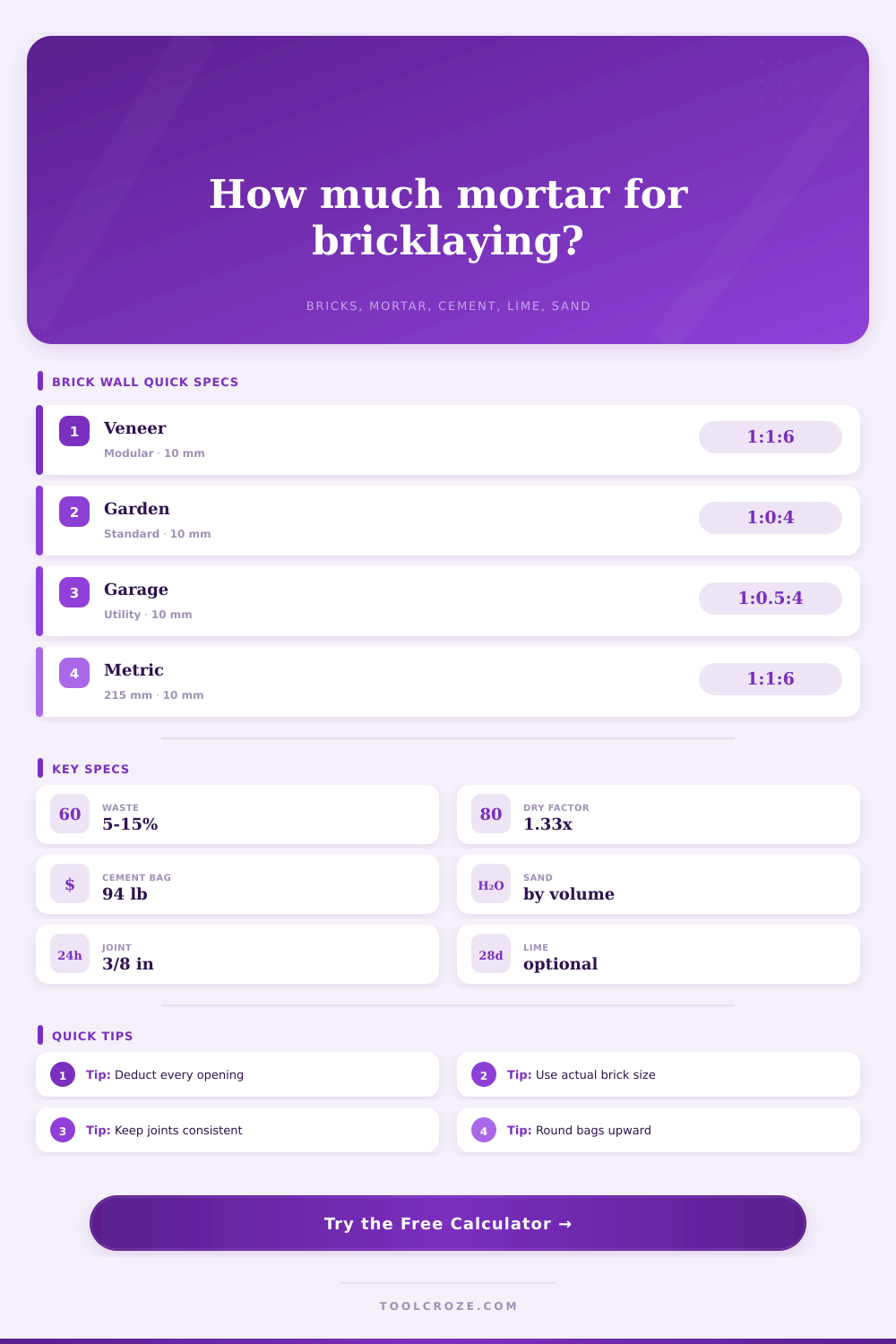
There is a waste factor in the calculator. Typically, that waste factor are between ten and fifteen percent. That’s why you don’t find yourself half-way up the wall without any more materials. That is your insurance policy; that is your buffer against the chaos of a job site. It is better to have an extra bag of sand sitting there. It is better than having to call the supplier when your hands are covered in slurry.
It comes with a set of reference tables that list typical brick size. It shows different bond patterns as well. That’s helpful in case you don’t know what you’re dealing with. For instance, running bond is easy and efficient. English bond has that nice old-fashioned look. But those headers uses more bricks. Total count depends on your choice. Add in a decorative soldier course and the waste skyrockets. You end up cutting each and every brick.
The tool takes all this into account. No need to memorize the masonry standards. So yes, it’s about controlling the variables. And you can control the variables. Size? Mix? Joint? Math? (The calculator.) Weather? How skilled are the hands that lay the brick? Is it the quality of the sand that gets dropped on your driveway?
Nope. Don’t worry about it to much, because there’s a tool to help you get as close as the right amount as possible. Then throw a little extra on top just for good measure. Once you have a good estimate, you won’t panic. And if you avoid panic, you are halfway through winning the battle of construction. Walk in the store with a plan. Fill up the truck with the right amounts. Go home with a wall. It is not a mess.