Rapid Set Mortar Mix Calculator
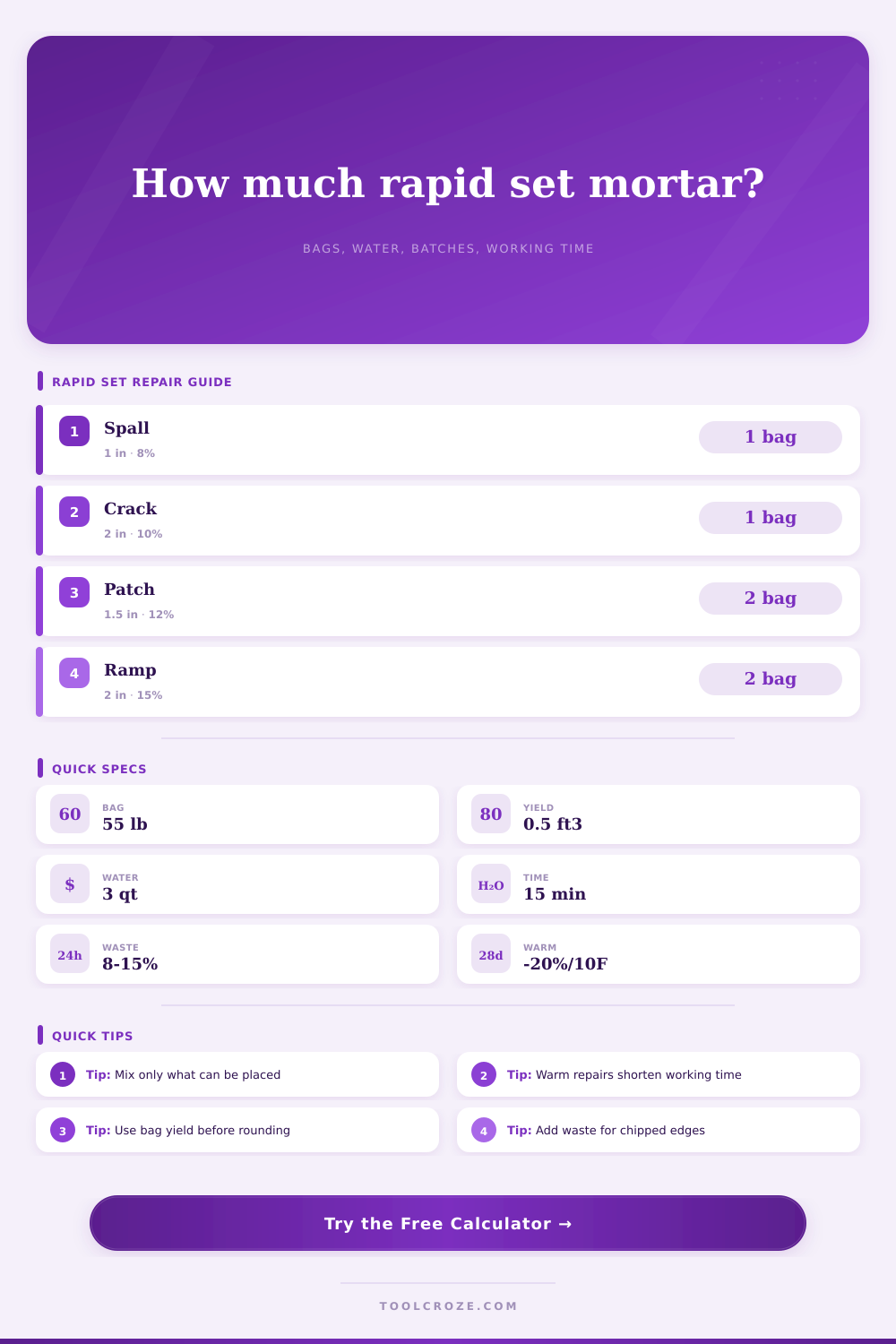
Size rapid-setting mortar repair batches by repair volume, layer thickness, yield per bag, water ratio, waste factor, working time, crew pace, and temperature-adjusted set window.
⚙Unit System
📌Repair Presets
📐Batch Sizing Inputs
Rapid Set Mortar Batch Plan
🧪Current Mix And Spec Grid
📏Rapid Repair Preset Reference
| Repair Preset | Typical Layer | Waste Factor | Batch Planning Note |
|---|---|---|---|
| Garage spall patch | 3/4 to 1-1/2 in | 8 to 12% | Usually one or two small batches |
| Broken stair nosing | 1 to 2 in face build | 10 to 15% | Keep stiff and place quickly |
| Anchor pocket fill | 2 to 6 in cavity | 5 to 10% | Flowable mix may need more water |
| Curb face repair | 1 to 3 in vertical | 12 to 15% | Limit batch size for hand packing |
| Threshold ramp | 1/2 to 2 in taper | 12 to 15% | Use average thickness for volume |
| Pipe sleeve patch | 1 to 4 in annular fill | 8 to 12% | Round pocket shape works best |
💧Yield And Water Reference
| Common Bag Size | Typical Yield | Water Range | Use In Calculator |
|---|---|---|---|
| 25 lb rapid mortar | 0.22 to 0.24 ft³ | 1.3 to 1.6 qt | Small spalls and edge chips |
| 40 lb rapid mortar | 0.34 to 0.38 ft³ | 2.0 to 2.4 qt | One-person patch batches |
| 50 lb repair mortar | 0.42 to 0.46 ft³ | 2.5 to 3.0 qt | Stair, curb, and ramp repairs |
| 55 lb rapid mortar | 0.48 to 0.52 ft³ | 2.8 to 3.3 qt | Default batch sizing basis |
| 60 lb high-build bag | 0.50 to 0.55 ft³ | 3.0 to 3.5 qt | Vertical and overhead-friendly work |
| 70 lb anchoring bag | 0.58 to 0.65 ft³ | 3.6 to 4.4 qt | Deep pockets and flowable fills |
⏱Working Time And Temperature Reference
| Material Temperature | Approx. Time Effect | Batch Strategy | Practical Warning |
|---|---|---|---|
| 40 to 50 F | Slower set | Batch by normal bag limit | Protect from freezing |
| 50 to 70 F | Near normal | Use listed working time | Keep tools ready before mixing |
| 70 to 85 F | Noticeably faster | Reduce bags per batch | Warm substrate pulls time down |
| 85 to 95 F | Fast set window | Mix half batches if needed | Shade material and mixing water |
| Over 95 F | Very short window | Use smallest practical batches | Confirm product hot-weather limits |
🧰Rapid Mortar Mix Spec Reference
| Mix Specification | Typical Lift Range | Placement Character | Batching Note |
|---|---|---|---|
| Standard rapid repair mortar | 1/2 to 3 in | Trowelable patch mix | Good default for slabs and steps |
| High-build vertical mortar | 1/4 to 2 in | Stiffer, low slump | Use less water and smaller batches |
| Flowable anchoring mortar | 2 to 8 in | Pourable pocket fill | Watch leakage and form pressure |
| Polymer-modified patch | 1/4 to 2 in | Bond-focused repair | Measure water tightly |
| Rapid floor underlayment | 1/8 to 1 in | Loose, spreadable mix | Use average thickness carefully |
| Hot-weather retarded mortar | 1/2 to 3 in | Extended open time | Still batch by adjusted time |
💡Batch Planning Tips
Rapid set mortar does have that “panic” element. When you add water to powder, the clock begins ticking and it goes by much quicker then you think. So there is a race between you and chemistry with your trowel and you lose if you don’t follow timeline. Then you’re left with a rock in bucket.
People mostly fail this test because they didn’t plan out correct amount before starting. It’s not for a lack of ability or strength.
How to Plan Your Quick Set Mortar Job
This section compare time and volume. What does that mean? How much fill will go into hole, and what’s the waste factor? How much do I put in before it all set up? The more exact this number, the better. It is better than guessing.
This is where calculator helps. Enter your repair details and it figure out math for you: how many bags should you purchase? How many do you need to mix at one time? And… Critically, how many can your guys applies before mortar gets too stiff to work with?
This is where math comes into play and also why temperature is a big part of it. As the temperature increases so does speed of chemical reaction that cures cement. Your workable time decrease when air gets warmer. A mix will provide you with a fifteen minute window if it’s 70 degrees out and a ten minute window if it’s 90.
The tool use your entered temp to adjust time window for how long the batch should of been worked. For every degree it’s hotter, it reduces target. So you plan shorter batches. Ignoring this adjustment is by far the quickest way to blow through some costly material.
Waste also adds up fast. Pockets aren’t regular shapes, concrete chips at edge, and there’s always some mixture remaining in bucket. Buying precisely calculated volume doesn’t work out because it’s not quite right. Open a new bag with limited time before it sets? Overestimating just a bit is safer. There’s also a waste factor in the calculator. Adjust up or down depending on whether your demolition pocket were rough, or if you had nice clean cuts with a saw. Rougher pockets requires more volume to fill all those voids. It is just a simple buffer against unpredictable nature of broken concrete.
The last variable for success is amount of water. Mortar made with too little water will be both weak and unworkable. Mortar made with too much water will have increased shrinkage and lower strength. The water ratio is referenced in the calculator along with bag yield. It also reminds you that what’s written on bag is a baseline, not a suggestion.
You may require a bit more water in hot weather to keep mortar workable but you want to be careful here. Look for a mix that holds its shape but trowels well.
And then you get batch plan. It divides up the overall volume into something you can handle in your modified workday. Don’t attempt to make more than what it tells you. It’s math. And the chemistry doesn’t care about your feelings.
Think of it like this: you’re constructing a mini-construction job that needs to be finished in 15 minutes or less. Take it seriously. Have all your tools out. Pre-measure your water. Get the area cleaned up beforehand. Rushing the prep phase will ruin batch.
For quick set mortar, preparation is more important than speed. Plan on chemistry of the set to be faster than what you might think. Don’t try to outwork a chemical set because you can’t. Size your batch based off how much time remains, consider how temperature affect the mix, and know your volume. Turn a race into a controlled process.
There will be no more hardened mortar in the pail. The mix gets used and the hole gets filled. Plan on the work and the work won’t plan on you.