Rebar Tie Wire Calculator
Estimate tie wire quantity from slab mat or cage dimensions, bar spacing, intersections, tie pattern, gauge, wrap length, spool weight, and waste.
📌Real Tying Presets
⚙Inputs
Tie Wire Estimate
🧵Wire Gauge Spec Grid
📊Gauge and Spool Reference
| Wire size | Approx diameter | Approx unit weight | 3.5 lb spool coverage |
|---|---|---|---|
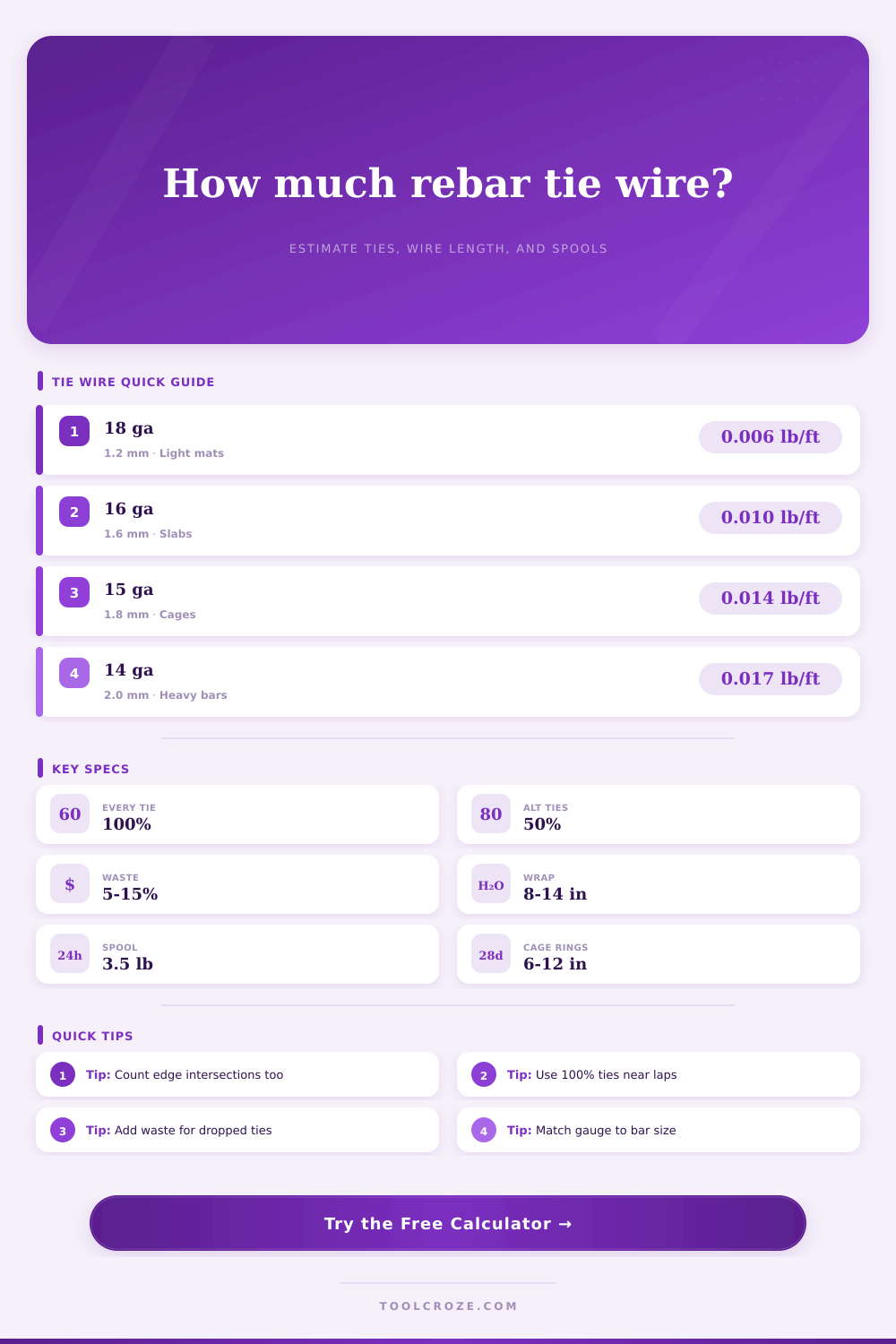
| 18 ga annealed | 0.0475 in / 1.2 mm | 0.0060 lb/ft / 0.0089 kg/m | About 583 ft |
| 16 ga annealed | 0.0625 in / 1.6 mm | 0.0104 lb/ft / 0.0158 kg/m | About 337 ft |
| 15 ga heavy tie | 0.0720 in / 1.8 mm | 0.0138 lb/ft / 0.0200 kg/m | About 254 ft |
| 14 ga heavy cage | 0.0800 in / 2.0 mm | 0.0171 lb/ft / 0.0247 kg/m | About 205 ft |
🔗Tie Pattern Reference
| Pattern | Calculator percent | Typical use | Quantity effect |
|---|---|---|---|
| Every intersection | 100% | Edges, laps, mats needing full restraint | All crossings tied |
| Alternating checkerboard | 50% | Common slab mats with stable chairs | Half of crossings tied |
| Two of three | 67% | Congested mats or moderate vibration risk | Two thirds tied |
| Perimeter heavy | 60% to 80% | Mats tied dense at edges and laps | Use blended percent |
📐Assembly Formula Table
| Assembly | Bars across | Bars along | Intersections basis |
|---|---|---|---|
| Single mat | floor(width / spacing) + 1 | floor(length / spacing) + 1 | Across x along x layers |
| Double mat | floor(width / spacing) + 1 | floor(length / spacing) + 1 | Single mat x faces |
| Rectangular cage | ceil(perimeter / bar spacing) | floor(length / ring spacing) + 1 | Long bars x rings |
| Round cage | ceil(circumference / bar spacing) | floor(length / ring spacing) + 1 | Long bars x rings |
🏗Common Slab and Cage Setups
| Setup | Typical dimensions | Tie spacing basis | Common wire |
|---|---|---|---|
| Patio slab mat | 10 ft x 10 ft | 12 in each way, 100% | 16 or 18 ga |
| Driveway slab mat | 20 ft x 30 ft | 18 in each way, 50% | 16 ga |
| Column cage | 18 in x 18 in x 10 ft | 6 in rings, 100% | 16 or 15 ga |
| Drilled shaft cage | 1200 mm dia x 12 m | 150 mm rings, 100% | 1.6 or 2.0 mm |
💡Field Tips
Problem: You’re standing over a fresh concrete pour and realize you didn’t quite get the math right on the tie wire. Crew’s waiting on another spool. What do you do?
We often think of rebar tying as purely manual labor, but it’s actualy a geometry problem wrapped in a logistics puzzle. It’s a logistics puzzle inside a geometry problem. There is waste. Forget intersections. You buy more than necessary. Stop the pour, run to the supply house. You guess wrong.
How to Plan Your Tie Wire
A piece of software make it a plan instead of a guess. Order precisely what you need. No more panic moments.
How many do you count? It’s an intersection problem. Bars that define the edges matter. If you have a twenty foot long wall with bars every 12 inches, then it’s twenty one bar lines. Not twenty. Once you enter your measurements into the calculator, it does all the math for you. It figures out length and width and the spacing, front to back, and back to front. And if you’re hanging something like a wall curtain or a double mat, it will multiply the total by the number of layers. The number one cause of short orders are missing the edge counts.
Next, you choose the tie pattern. Do you make a checker board alternating pattern? Or do you tie each individual intersection? If it’s just a simple slab mat on top of some chairs, fifty percent is often good enough. If you’re making a column cage that you need to lift and lower into a hole, you tie each and every point. This percentage can be changed with the tool based off the risk of how it will be handled and what it must structurally withstand. It models real world behavior of the steel itself under stress and movement.
What about the gauge of wire? Typically you’ll find that the industry use 16 gauge soft wire. Why? Because it’s pliable enough to twist together by hand (without breaking) and stiff enough to hang on many slabs. If your cage has a lot of bars in a concentrated space, perhaps you’d go with 14 or 15 gauge wire. The table of references show the differences between wire diameters; greater gauge equals less feet/lb. Even though the actual linear footage of wire needed may remain constant, you will need more spools.
Then it adds a waste factor. Ties break, cut short, or get dropped, twisted too tightly. Ten to fifteen percent isn’t unreasonable. It’s added at the end by the calculator. From there, you have a final number of spools accounting for that messy job site reality.
And it figures out your wire length per tie from both tail allowance and wraps. That lets you see how much material each tie use.
You must respect the little details by getting estimate of the tie wire correct. Yes, the wire doesn’t cost much; no, waiting for it isn’t free. Run the numbers before cutting the first piece. If concrete sets as planned, the crew stays moving. What could of been a disaster becomes just another normal day on the site.