Bigfoot Footing Concrete Calculator
Estimate concrete for Bigfoot-style flared footing forms, round pier tubes, waste allowance, bags, cubic yards, and frost-depth clearance.
⚙Bigfoot Form Presets
📏Units And Dimensions
Concrete Estimate
Breakdown
🧱Current Form Reference
📋Bigfoot Form / Tube Spec Grid
| Model | Base Diameter | Accepted Tube Diameters | Listed Form Volume | Typical Use Class |
|---|---|---|---|---|
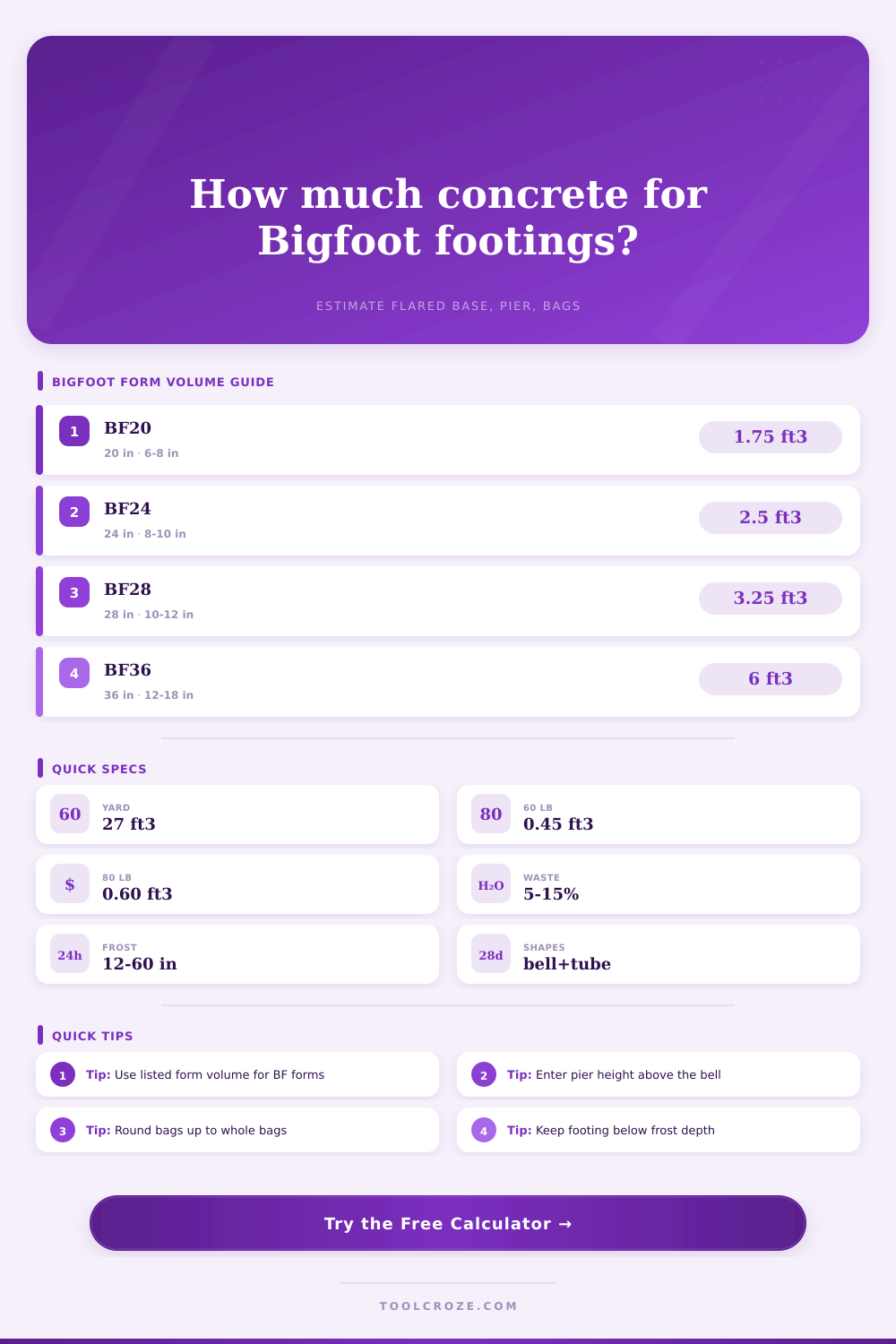
| BF20 | 20 in | 6 in or 8 in | 1.75 ft³ | Residential decks and light piers |
| BF24 | 24 in | 8 in or 10 in | 2.50 ft³ | Residential porches and cabins |
| BF28 | 28 in | 10 in or 12 in | 3.25 ft³ | Residential or light commercial |
| BF36 | 36 in | 12 in, 14 in, 16 in, or 18 in | 6.00 ft³ | Commercial or industrial footing forms |
🔢Pier Tube Concrete Volume Table
| Tube Diameter | Volume Per Foot | 4 ft Pier | 6 ft Pier | 8 ft Pier |
|---|---|---|---|---|
| 6 in | 0.196 ft³/ft | 0.79 ft³ | 1.18 ft³ | 1.57 ft³ |
| 8 in | 0.349 ft³/ft | 1.40 ft³ | 2.09 ft³ | 2.79 ft³ |
| 10 in | 0.545 ft³/ft | 2.18 ft³ | 3.27 ft³ | 4.36 ft³ |
| 12 in | 0.785 ft³/ft | 3.14 ft³ | 4.71 ft³ | 6.28 ft³ |
| 14 in | 1.069 ft³/ft | 4.28 ft³ | 6.41 ft³ | 8.55 ft³ |
| 16 in | 1.396 ft³/ft | 5.59 ft³ | 8.38 ft³ | 11.17 ft³ |
| 18 in | 1.767 ft³/ft | 7.07 ft³ | 10.60 ft³ | 14.14 ft³ |
🛍Bag And Yard Conversion Table
| Concrete Unit | Approx Yield | Bags Per 10 ft³ | Bags Per 1 yd³ | Best Use In Calculator |
|---|---|---|---|---|
| 40 lb bag | 0.375 ft³ | 27 bags | 72 bags | Small repair batch estimates |
| 60 lb bag | 0.45 ft³ | 23 bags | 60 bags | Short residential pier batches |
| 80 lb bag | 0.60 ft³ | 17 bags | 45 bags | Common footing bag estimate |
| 90 lb bag | 0.675 ft³ | 15 bags | 40 bags | Fewer bags for larger piers |
| Ready-mix yard | 27 ft³ | 0.37 yd³ | 1 yd³ | Multiple footings in one pour |
❄Frost Depth Planning Reference
| Climate Zone | Common Frost Depth | Suggested Bottom Depth | Calculator Check | Note |
|---|---|---|---|---|
| Mild coastal | 0 to 12 in | 12 to 18 in | Embed depth greater than frost | Local code still controls |
| Moderate winter | 24 to 36 in | 30 to 42 in | Positive frost clearance | Common deck pier range |
| Cold northern | 42 to 60 in | 48 to 66 in | Check bottom of form | Deep tubes add concrete fast |
| Severe frost | 60 in plus | Code or engineer value | Use exact local depth | Soil and exposure matter |
📚Worked Volume Reference
| Preset Scenario | Form + Tube | Per Footing Before Waste | Six Footings With 10% | 80 lb Bags |
|---|---|---|---|---|
| BF20 short deck pier | BF20 + 6 in x 3 ft | 2.34 ft³ | 15.43 ft³ | 26 bags |
| BF24 frost porch pier | BF24 + 8 in x 4 ft | 3.90 ft³ | 25.73 ft³ | 43 bags |
| BF28 beam support pier | BF28 + 10 in x 5 ft | 5.98 ft³ | 39.45 ft³ | 66 bags |
| BF36 heavy column pier | BF36 + 14 in x 6 ft | 12.41 ft³ | 81.90 ft³ | 137 bags |
💡Concrete Estimating Tips
The first error is thinking that a footing is nothing more than a hole in ground. Dig out, pour concrete and pray to St. Frost that he doesn’t shift it. Fine for a bench in the garden, but forget about enduring a full-on winter with this kind of structure.
Bigfoot forms change the shape of the pour by adding a flared bottom section, which creates a larger base at the bottom. More surface area equals better bearing area against soil, and also less chance that the pier will punch right through or slide sideways over time.
How to Calculate Concrete for Your Footings
Again, the calculator figures out math for you; all you need to do is enter your tube size and the exact Bigfoot form used. You do not need to visualize a frustum volume. So what are the inputs? Understanding them is half the battle.
One common mistake: We see people measure how tall the whole tube is based off the ground. For our purposes, you just input height of the pier above the bell form. Whether you have a BF36 on a heavy post, or a BF20 on a small deck, you know the volume of the bell form that is mounted below the tube, so you don’t need to include it. The calculator separates out that molded plastic base from the cylindrically shaped tube going upwards. If you add that twice, you’ll order more concrete than needed, and find yourself scraping setting slurry off your wheelbarrow. It’s a small thing, but it’s one less thing you have to do, and it saves you money in the end.
Another variable is frost depth. In cold northern climates your local code may call for footings to be six feet below grade. That is a bunch of concrete to carry around. The tool provides you with a clearance figure based on comparing your embed depth to that frost line. If that figure is negative, you’ll either have to adjust your design or go digging a little deeper.
Failure to take frost depth into account results in heaving which breaks fasteners and twists deck frame. Frost does not care how deep the concrete is buried, but when it freezes and expands, the soil beneath certainly does.
At what point does ready-mix make sense? That depends on how big the job is. If you’re building just a couple of piers, you can mix in bags; even at 80 pounds each, you’ll have plenty of control and precision. On the other end of the spectrum, if you’re pouring a commercial building or something as big as a pergola, the only reasonable solution are a mixer truck.
The calculator will tell you both how many bags and cubic yards of concrete you need. It also rounds up to account for waste. And no, this isn’t some additional “overhead.” This accounts for the extra concrete that will stick to the sides of hole. It also includes uneven bottom surfaces in the hole and other factors such as spillage. Generally speaking, adding another ten to fifteen percent to your estimation is good practice. You don’t want to be scrambling for another bag because you came up a couple inches short.
One more thing to think about is reinforcement. While the calculator takes into account volume, it doesn’t take into account that the rebar provides the footing with tensile strength. Concrete is good at withstanding compression loads but does not do so well when placed under tension. Some stirrups and a few vertical bars keep the whole assembly working together as the structure settles. Just because your volume is sufficient according to the math, don’t skimp out on the rebar. It’s what keeps the footing in place after it’s gotten there.
Site access can make or break the pour. If you order three cubic yards of concrete to fill your backyard, but have to navigate a steep slope and a narrow gate to reach it, you’re taking a risk. Will the truck even get through? It is smarter to break up the job into smaller batch pours delivered via bags, although this will take longer.
Volume scales exponentially according to the size of the tube used. Double the diameter and you quadruple the cross-sectional area. That’s a bigger tube that adds concrete much more quickly. People gets surprised by this when they assume linear scaling. Refer to the reference table below to see how volume scales with the height and diameter of a tube.
Plan, don’t wing it. Know what volume each form will take (accounting for waste), measure the depth of the frost, and make the initial phone call based off those measurements, not just a wild guess. The tables and tools here will help you see how big a project this really is, but remember: The real facts are in the dirt. Fill those spaces under the frost line, use the correct mix, and keep your structure level long-term. Last thing you should of needed is to be the homeowner who calls the contractor in March because your deck is leaning toward the street.