Polyurethane Weight Calculator
Estimate cured polyurethane weight, mixed liquid volume, Part A and Part B amounts, skin allowance, expansion effect, and waste for foam, elastomer, coating, and casting work.
Calculation Breakdown
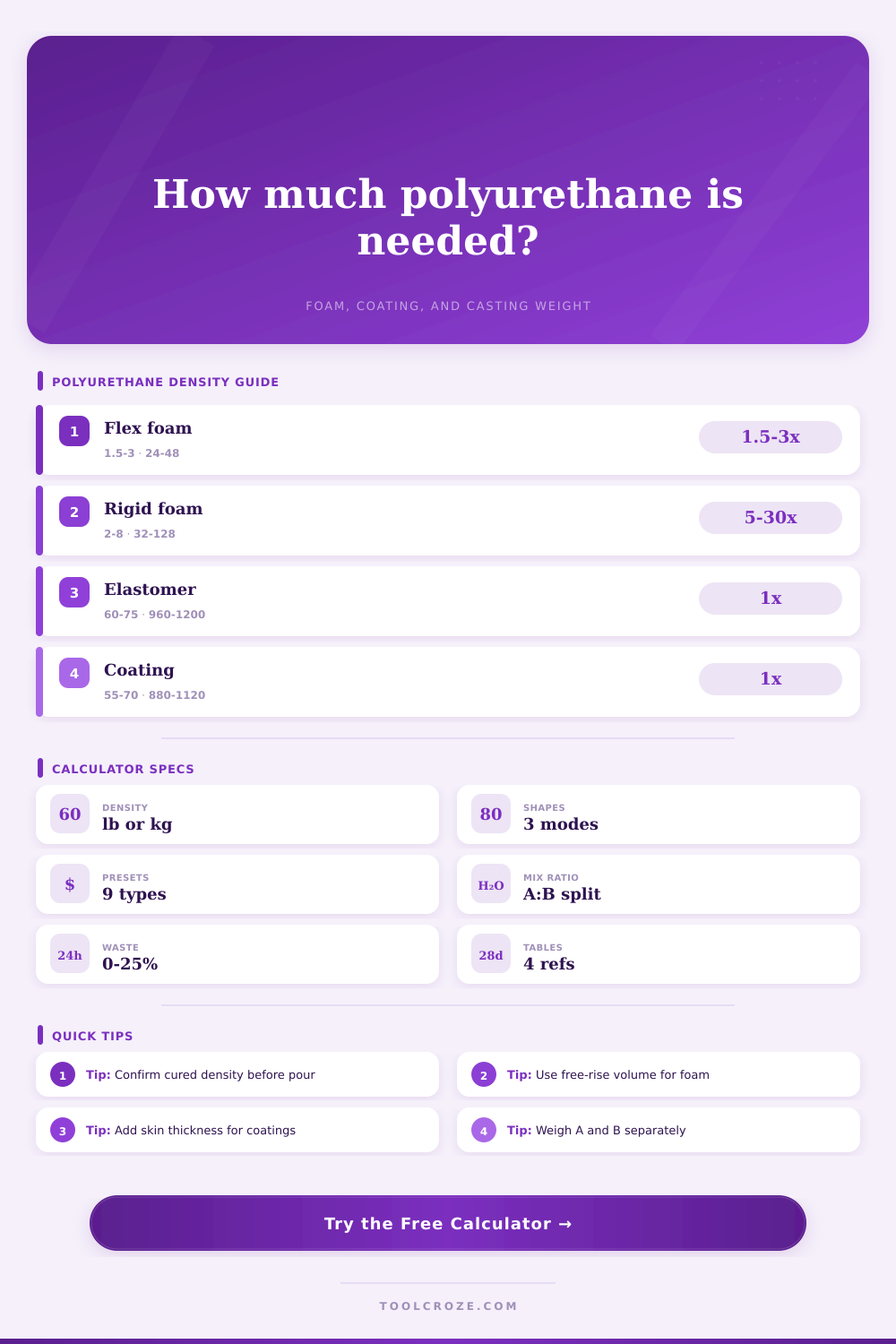
| Polyurethane material | Typical density | Metric density | Common use |
|---|---|---|---|
| Open-cell flexible foam | 1.0-3.5 lb/ft³ | 16-56 kg/m³ | Upholstery, sound pads, packaging |
| Closed-cell rigid pour foam | 2.0-8.0 lb/ft³ | 32-128 kg/m³ | Flotation, insulation, cavity fill |
| Integral skin foam | 12-30 lb/ft³ | 192-480 kg/m³ | Arm rests, grips, molded pads |
| Solid polyurethane elastomer | 60-75 lb/ft³ | 960-1200 kg/m³ | Wheels, bumpers, rollers, wear pads |
| Polyurethane coating film | 55-70 lb/ft³ | 880-1120 kg/m³ | Membranes, bed liners, protective skins |
| System type | Expansion factor | Weight behavior | Calculator setting |
|---|---|---|---|
| Solid casting elastomer | 1.0x | No foam expansion | Use actual liquid or cured density |
| Integral skin foam | 1.2-3.0x | Dense outside, lighter core | Add skin allowance if trimmed |
| Rigid two-part pour foam | 5-30x | Low finished density | Use cured free-rise density |
| Spray polyurethane foam | 10-30x | Yield varies with pass thickness | Use installed density and waste |
| Thin polyurethane coating | 1.0x | Film weight follows solids | Use sheet mode and film thickness |
| Shape mode | Base volume formula | Skin area used | Best for |
|---|---|---|---|
| Slab or block | L × W × T | All six faces | Foam blocks, pads, panels, molded blanks |
| Cylinder or round mold | π × r² × H | Side wall plus two ends | Rollers, wheels, plugs, pipe insulation |
| Sheet or coating | L × W × film T | Top face only | Coatings, membranes, skins, poured films |
| Waste factor | Weight × (1 + waste) | Applied after skin | Mix cup loss, trimming, overspray, test shots |
| Allowance item | Typical range | Use in calculator | Notes |
|---|---|---|---|
| Skin allowance | 0-0.125 in | Adds cured volume by surface area | Useful for dense skins, coatings, and trimming stock |
| Waste factor | 5-15% | Raises total mixed amount | Use more for spray foam or small batches |
| Part A:B by weight | 1:1 to 2:1 | Splits final batch mass | Always follow the system data sheet when known |
| Target fill | 90-105% | Scales the cavity volume | Lower fill leaves headspace; higher fill overpacks |
That is where this calculator comes in. No more panicking that you won’t have enough polyurethane to fill your mold. No more guessing about how many ounces or grams of material you will require. No more trying to figure out waste, expansion, volume and density. Let the calculator do all the work. You can just concentrate on mixing two parts together.
The tricky part are knowing which numbers to input. Cured weight isn’t the same as liquid weight. The key to all this is density. Most folks confuses the weight of the cured foam with the weight of the liquid in the bucket. Liquid polyurethane is dense and heavy. When it cures and expands, it take up a lot more space but still has the same mass. That is why there is a way to input the cured density and the expansion factor into the calculator.
How to Use the Calculator
In the case of solid elastomer wheels, they expand at a one to one ratio. Pour a pound out and you have a pound. With rigid insulation foam it expands 15-30 times. This is where many folks fail to consider this fact. They order based off liquid volume not the cured volume. Flexible foam, rigid foam, and solid coatings each behaves differently as shown in reference table.
Consider what you’re going to fill as well. It’s not hard to picture a rectangular slab. But a complex mold or a cylinder adds surface area considerations. The tool allow you to choose among sheets, cylinders and even slabs. This change how the skin allowance is applied.
And the skin allowance is important because the outside of the part will frequently cure more dense than the inner core. This is especially true when using integrated skin or other closed mold methods. So now your arm rest has some added weight in the form of that dense outer shell. A straight up volume calculation doesn’t take that into account. Add a bit for skin allowance, like fraction of an inch. This ensures you have enough material without worrying about it drying out before you cover the surface.
A casting project has a budget and every ounce that’s wasted takes away from it. How much? There is side-wastes in the mixing cup, there are spill-wastes, and then there are test shot-wastes. Adding a waste amount to the total allows you to calculate how many more pounds or ounces you need. Typically it’s somewhere between 5 and 15 percent. To have excess material on hand is always preferable. A couple-ounces-short batch would of kill a project. That little cushion prevents it from becoming scrap.
Knowing exact weights of both Part A and Part B helps you know what you have. In most systems you has to get precise with the weights. Knowing this upfront avoids frustration and time lost.
Safety is non-negotiable: it’s all about safety. Isocyanates are major respiratory dangers. Ventilation and personal protection equipment is not optional; you can’t skip them because you “got it right” using this tool. This tool help you get the logistics down. It’s up to you to control the environment.
When you do, the process feel more like a craft than an exercise in making sure you don’t run out of anything. Running the numbers eliminates worry about running out. Focus shifts to getting the finish correct. That change in focus is worth the time (less than five minutes) that running the numbers requires.