Firewood BTU Calculator
Estimate gross cord heat, moisture penalty, seasoning loss, stove efficiency, usable BTU, and heating-day coverage from a measured firewood stack.
Firewood Heat Output Results
Calculation Breakdown
| Species | Seasoned BTU / Cord | Relative Heat | Burn Character |
|---|---|---|---|
| Black locust | 27.9 million | Very high | Dense, long, strong coals |
| Hickory | 27.7 million | Very high | Hot fire and long coal bed |
| White oak | 24.0 million | High | Long burn after full seasoning |
| Sugar maple | 24.0 million | High | Reliable heat and steady coals |
| Ash | 22.6 million | Medium high | Splits easily and seasons well |
| Yellow birch | 20.8 million | Medium | Good shoulder season heat |
| Black cherry | 20.0 million | Medium | Moderate heat with easy starts |
| Douglas fir | 20.7 million | Medium | Good softwood heat when dry |
| Eastern white pine | 15.9 million | Lower | Fast burn, best when very dry |
| Moisture Content | Calculator Factor | Practical Meaning | Heating Note |
|---|---|---|---|
| 12 percent | 1.016 | Kiln dry or very dry storage | Fast ignition, high usable heat |
| 18 percent | 1.004 | Well-seasoned firewood | Good target for wood stoves |
| 20 percent | 1.000 | Baseline seasoned cord rating | Common reference point |
| 25 percent | 0.940 | Slightly wet firewood | More steam loss and slower starts |
| 35 percent | 0.820 | Fresh or under-seasoned stack | Large heat loss to moisture |
| 45 percent | 0.700 | Green wood range | Poor heating fuel until seasoned |
| Firewood Volume | Dimensions | Stacked Cubic Feet | Cord Equivalent |
|---|---|---|---|
| Full cord | 4 ft x 4 ft x 8 ft | 128 | 1.00 cord |
| Half cord | 4 ft x 4 ft x 4 ft | 64 | 0.50 cord |
| Face cord, 16 in | 4 ft x 8 ft x 16 in | 42.7 | 0.33 cord |
| Face cord, 18 in | 4 ft x 8 ft x 18 in | 48.0 | 0.38 cord |
| Porch rack | 4 ft x 4 ft x 16 in | 21.3 | 0.17 cord |
| Loose pickup load | 6 ft x 4 ft x 2 ft | 48 loose | 0.24 to 0.26 cord |
| Appliance Type | Typical Efficiency | Best Use In Calculator | Result Impact |
|---|---|---|---|
| Open fireplace | 10 to 25 percent | Ambience or short burns | Most heat leaves with flue gas |
| Older airtight stove | 35 to 55 percent | Legacy stove estimate | Moderate usable BTU indoors |
| Modern non-catalytic stove | 60 to 75 percent | Typical home heat estimate | Good transfer with dry fuel |
| Catalytic wood stove | 70 to 82 percent | Long heating cycles | High usable heat and coaling |
| Indoor wood boiler | 65 to 85 percent | Hydronic heat load planning | High daily BTU delivery |
| Outdoor boiler | 45 to 75 percent | Variable transfer losses | Check real stack and water losses |
You can’t buy firewood without trusting someone at some point: before you load that wood onto your truck or stack it up against your home. There it sits, a nice neat pile of split logs, the price tag match what you’d agreed to pay, and off you go, ready to hunker down through winter.
But not all cords of wood are the same. From three feet away, a face cord of black locust looks like a face cord of white pine, but energy locked within those two piles differs by almost half. And that make a difference when it’s colder than zero outside and your only warm spot is next to fire in the corner.
How to Buy Firewood the Right Way
This page’s calculator will help you graduate from guessing based off appearances to an actual count of how much heat you’re buying, in other words, how long it lasts.
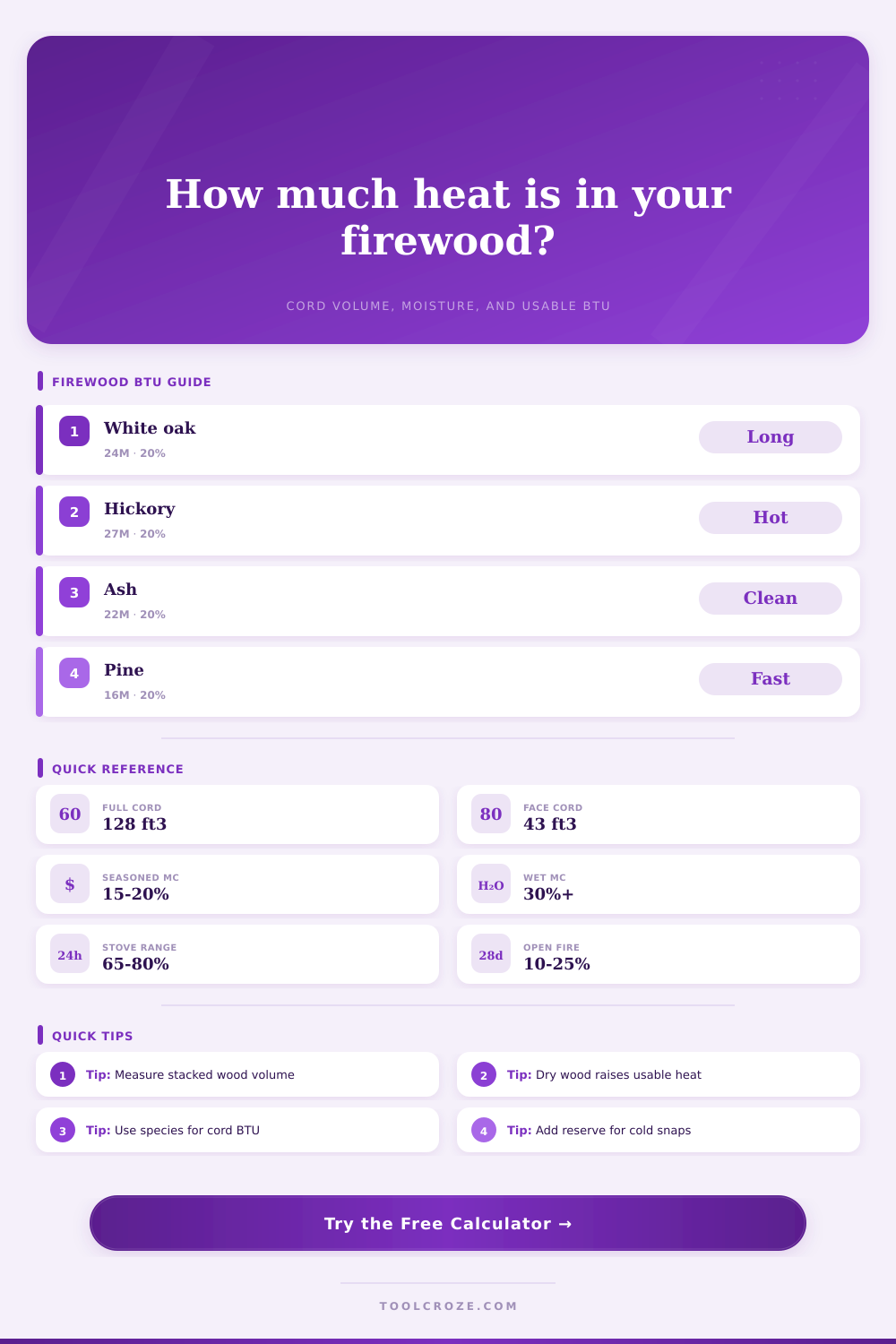
Start with species, since wood with higher density stores more heat. Eastern white pine comes in around sixteen million BTU’s per cord; hickory and black locust are dense woods that produce more then double that number (over twenty-seven). That’s quite a gap; too bad most of us don’t check the label before buying what supplier happened to have in stock.
Compare BTUs to cash value. How much heat do you have for every log? Do you get a silver dollar, or a copper penny, when you pay by load? The tables on the page explains in clear detail which woods burns fast but cool and which woods burn long but not as hot.
Armed with this knowledge you can carefully blend your stash. You might choose pine for summertime, when you want something casual and bright for those hot summer nights, but use oak or maple for wintertime because you will of need serious heat then. Species mixups aren’t just personal taste. They’re part of the art and science of juggling your seasonal heat needs.
The second trap is volume. A full cord of firewood measures 128 cubic feet, four by four by eight. Less is a fraction. Sometimes suppliers will sell what they call face cords (only sixteen inches high). Sounds reasonable … until you learn that’s only a third of a full cord. Unless you measure the stack yourself, you’re relying on somebody else to do math for you.
The tool lets you input your own dimensions. No more ambiguity here. Enter precisely how much you want delivered; exactly the length and height and depth.
That matters. Stacked cords aren’t the same as a loose truckload. You will need different adjustments depending on whether your firewood comes stacked or loose. The waste from that air space means there’s less actual wood. Adjusting the packing factor in the calculator account for that wasted volume. This helps you calculate heat produced per unit of wood, not empty air.
It is less efficient when wet. By weight, green wood can contains half its mass as water. Burning wet wood means most of your fuel is being used to boil that water off into steam. That steam rises straight up out of the chimney, carrying your heat with it. Wood containing less than 20% moisture (seasoned) burns well because it gives most of its heat to the room, not the sky.
The calculator takes this into account and estimates what your heat output will look like after additional drying. This is helpful if you purchase a pile in the early spring and need some time for it to cure. It tells you how much of a hit you’re taking now versus the reward of waiting.
And last is efficiency. Most of the heat from an old open fireplace goes up the chimney. Moddern EPA-certified stoves capture nearly all of it. Enter your appliance type and adjust it to suit your stove. You’ll be given a realistic usable BTU estimate. This is the number that actualy warms your house. That includes stove efficiency (vs. Burning it up the chimney), how completely it burns, and even a margin of safety so you don’t freeze during a cold snap.
Plug in how much heat your building needs and how many hours you use your stove each day and it tells you how long you’re covered in days. Suddenly that vague pile of wood becomes a concrete plan for surviving winter.
No longer do you guess whether or not you’ve got enough, now you know, and that peace of mind is priceless.