Log Dovetail Calculator
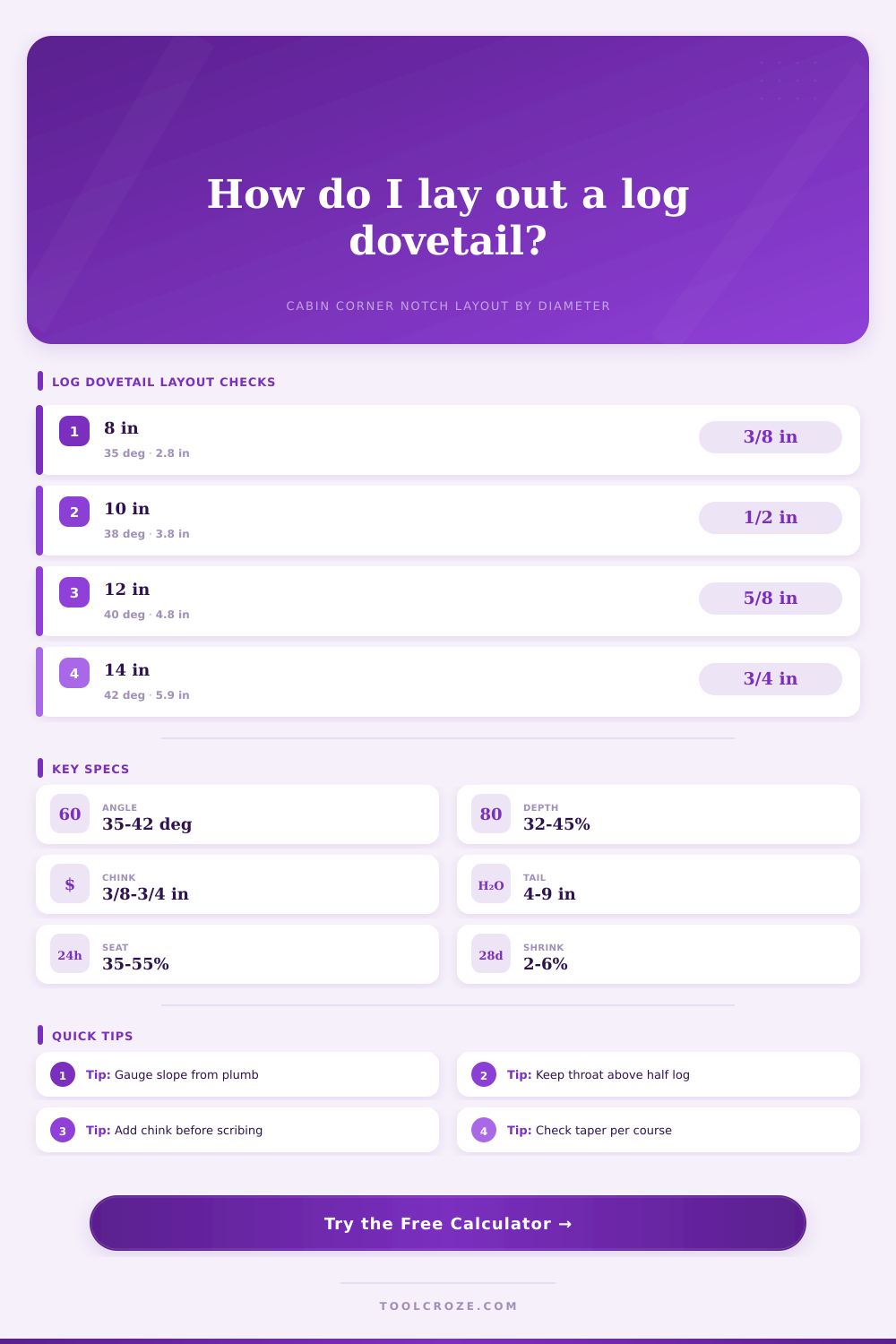
Lay out a cabin corner notch from real log diameter, taper, dovetail wall angle, bearing seat, tail projection, shrinkage, and chinking allowance.
⚒ Cabin Corner Presets
📏 Notch Layout Inputs
🪵 Dovetail Notch Results
🧰 Material And Spec Comparison
📚 Log Dovetail Reference Tables
| Corner style | Best use | Usual angle | Layout note |
|---|---|---|---|
| Full dovetail | Weather-tight cabin corners | 36°-42° from plumb | Both faces flare and lock the crossing log |
| Half dovetail | Sheds and faster utility walls | 30°-38° from plumb | One sloped wall, one straighter bearing shoulder |
| Blind dovetail | Clean exterior face or porch post tie-in | 34°-40° from plumb | Keep the hidden pocket wider than the exposed throat |
| Repair course | Replacing one damaged wall log | Match existing angle | Use measured corner pocket, not a fresh nominal size |
| Species or profile | Layout behavior | Settlement factor | Chinking start point |
|---|---|---|---|
| White pine round log | Easy to scribe, moderate crush | 4.2% green | 1/2 in for 8-12 in logs |
| Red cedar round log | Stable, softer shoulders | 3.1% green | 3/8 in to 1/2 in |
| Oak hand hewn log | Hard bearing, slower compression | 5.0% green | 5/8 in to 3/4 in |
| Douglas fir cabin log | Strong, checks along grain | 4.6% green | 1/2 in to 5/8 in |
| Local log diameter | Conservative depth | Common seat | Tail projection |
|---|---|---|---|
| 6-8 in practice or shed log | 30%-35% | 2-3.5 in | 3-5 in |
| 9-11 in small cabin log | 34%-40% | 3.5-5.5 in | 4.5-6.5 in |
| 12-14 in lodge wall log | 38%-44% | 5-7 in | 6-8 in |
| 15-18 in large round log | 40%-46% | 6.5-9 in | 7-10 in |
| Chinking allowance | Where it fits | Layout effect | Check before cutting |
|---|---|---|---|
| 1/4 in | Milled or very dry logs | Tight throat, little visual joint | Confirm seasoning and straightness |
| 3/8 in | Small cedar and pine walls | Allows light bedding compression | Test with actual backing rod |
| 1/2 in | Most 8-12 in round logs | Balanced seal and adjustment space | Keep gap continuous around corner |
| 3/4 in | Large or uneven hand-peeled logs | More room for taper and settling | Avoid weakening the throat too far |
💡 Layout Tips
You start to panic when a ten-inch log won’t fit into the corner. Too wide. Seat is too narrow. You didn’t notice the taper so now you has to cut right through the bearing wall.
Building a log cabin isn’t simply stacking wood. It’s a balance between geometry and gravity.
Why Accurate Measurements Matter
The tool takes care of the math for you if you tell it what species and what local diameter. That spares you having to guess at conversions and coefficients. But the tool is only as useful as your knowledge of the inputs. What do the numbers mean? Why should you know them?
The first thing to consider is the diameter at the exact location of the notch. Logs taper, often significanly. It is seven inches at the tip end and eight inches at the butt end. That alters the ratio of your notch completly. Measure incorrectly and you’ve got a notch that’s loose on one end and tight on the other. Now you’ve created a racking point which weaken the integrity of the whole structure. So the lesson is about being precise. Remember, this is a puzzle piece that fits into a puzzle that’s morphing in shape each time you add another piece.
One other common focus point where people get hung up is on the dovetail wall angle. Making the angle steeper (e.g., 40 deg from plumb) mean more horizontal bearing area on the bottom which helps distribute the load. But it also means more stock needs to be removed off of the top. Which results in less wood left at the tail end to resist pulling apart when winds blow boat sideways. Shallower angles maintains a strong tail but sacrifice the contact patch. The calculator takes all this into account and will scale back the mouth width and the side flare according to your desired angle so you don’t inadvertantly carve out the structural strength of the log. Small thing, big difference over time.
Theory meets reality with chinking allowance. Green logs shrink. And they shrink a lot. You cut a notch to snugly accept freshly harvested log. Come back six months later, and there’s that two-inch gap. That’s why the tool factors settlement into its allowance based off the moisture condition option you select. It depends on whether the timber is air dried or green.
It’s not just about cutting wood. It’s about anticipating what the wood will be when it dries out. That’s what folks miss. They think wood should act like steel, rather than like living organic matter.
This is the part that tells you what portion of the log will be sitting atop another. A wide seat spreads out the load from the higher courses. It lessens the chance of crushing the heartwood beneath. But getting a wide seat mean cutting deep grooves in the crossing piece. Cut too deeply and you may weaken this important component. The calculator looks at the amount of throat still available and calculates where the sweet spot is so that enough wood remains to secure the joint.
It’s a delicate balance because when your bearing surface crushes, it settle unevenly. Uneven settling sends ripples throughout the whole wall system.
It’s interesting that species selection is important, as each type of wood has its own unique characteristics in regards to drying and compression. Oak compresses slowly and is very tight grained. White pine is forgiving and soft. The tool includes this in their settlement prediction. That way they can predict what your corner will do with time. Not only does it fit today, but it fits tomorrow.
In the end though, a well made dovetail joint goes unnoticed. It doesn’t attract attention. It isn’t creaking in the breeze. It’s not letting rain into the cabin.
Respect the material. Respect the geometry. Measure twice. Account for the taper. Follow the math on your cuts. What you have is a corner that stays put. The structure holds firm. It gives you a sense of doing it right and a quiet satisfaction.