Green Lumber Weight Calculator
Estimate board feet, wet species density, piece weight, bundle weight, hauling margin, and drying shrinkage for freshly sawn or high-moisture lumber.
Green Lumber Load Results
| Species preset | Baseline MC | Green density | Dry mass density | Typical green use |
|---|---|---|---|---|
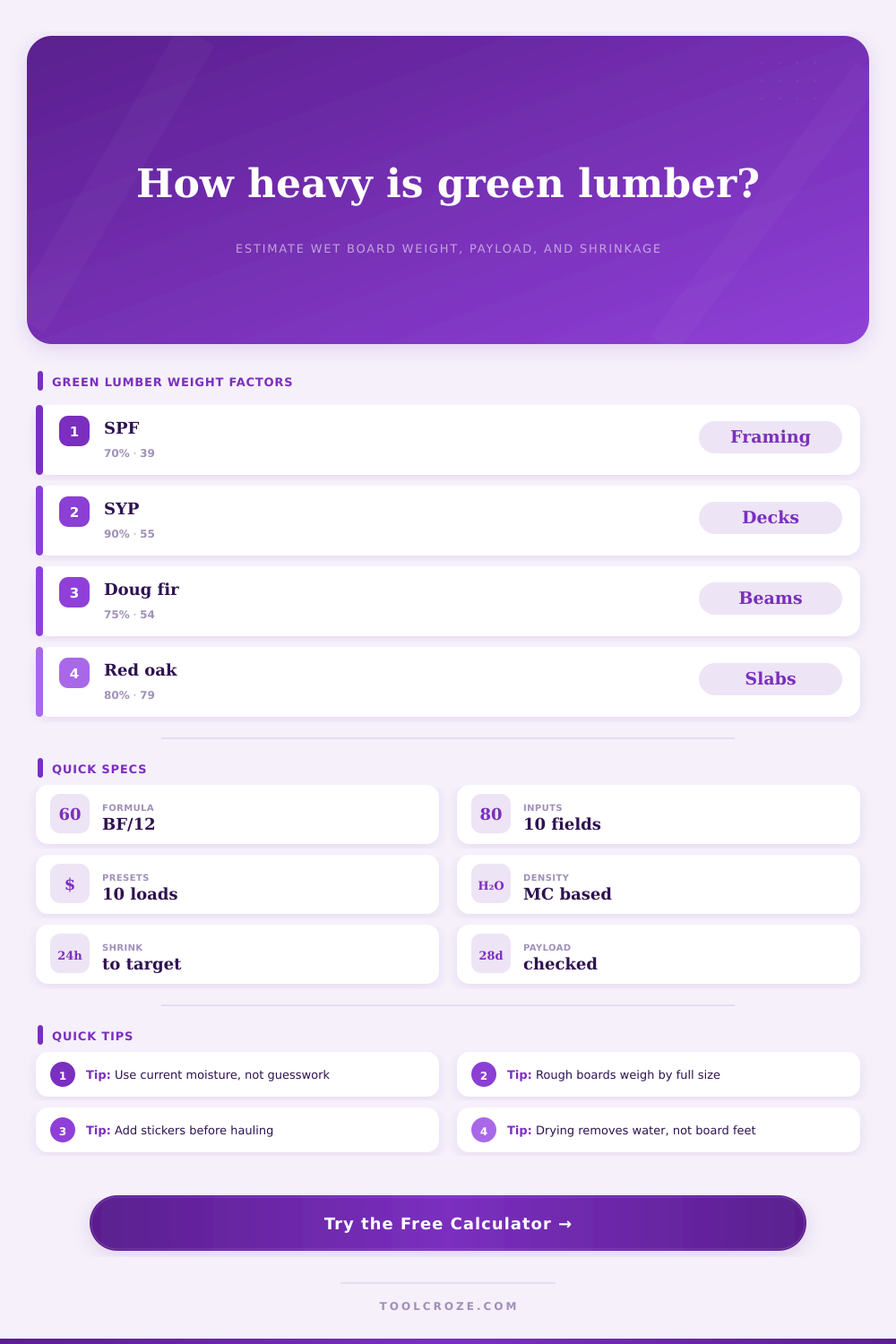
| Spruce-pine-fir | 70% | 39 lb/ft³ | 22.9 lb/ft³ | Fresh framing lifts |
| Southern yellow pine | 90% | 55 lb/ft³ | 28.9 lb/ft³ | Decking and treated stock before drying |
| Douglas fir | 75% | 54 lb/ft³ | 30.9 lb/ft³ | Beams, posts, structural timbers |
| Western red cedar | 60% | 31 lb/ft³ | 19.4 lb/ft³ | Fence boards and outdoor trim |
| Hem-fir | 75% | 47 lb/ft³ | 26.9 lb/ft³ | Joists and studs |
| Ponderosa pine | 85% | 44 lb/ft³ | 23.8 lb/ft³ | Mill-run boards and shop stock |
| Red oak | 80% | 79 lb/ft³ | 43.9 lb/ft³ | Slabs, mantels, dense hardwood loads |
| White oak | 75% | 82 lb/ft³ | 46.9 lb/ft³ | Wet timbers and trailer-heavy loads |
| Hard maple | 65% | 68 lb/ft³ | 41.2 lb/ft³ | Turning blanks and thick shop stock |
| Yellow poplar | 80% | 50 lb/ft³ | 27.8 lb/ft³ | Wide rough boards and sticker stacks |
| Nominal size | Surfaced actual | Rough-sawn basis | BF per 8 ft piece | Weight effect |
|---|---|---|---|---|
| 1 x 6 | 0.75 x 5.5 in | 1.00 x 6.00 in | 2.75 surfaced, 4.00 rough | Rough adds about 45% volume |
| 2 x 4 | 1.50 x 3.5 in | 2.00 x 4.00 in | 3.50 surfaced, 5.33 rough | Rough adds about 52% volume |
| 2 x 8 | 1.50 x 7.25 in | 2.00 x 8.00 in | 7.25 surfaced, 10.67 rough | Rough adds about 47% volume |
| 4 x 6 | 3.50 x 5.5 in | 4.00 x 6.00 in | 12.83 surfaced, 16.00 rough | Rough adds about 25% volume |
| 6 x 6 | 5.50 x 5.5 in | 6.00 x 6.00 in | 20.17 surfaced, 24.00 rough | Rough adds about 19% volume |
| Moisture condition | Typical MC | Weight multiplier | Handling note | Drying note |
|---|---|---|---|---|
| Fresh from saw | 60-120% | 1.60-2.20 x dry mass | Plan for wet faces and sap | Sticker quickly for airflow |
| Air-dried but not kiln-dried | 18-30% | 1.18-1.30 x dry mass | Still heavier than finish stock | Shrinkage mostly slows near 20% |
| Shop acclimated | 8-12% | 1.08-1.12 x dry mass | Usually hand-carried easier | Stable enough for many interiors |
| Outdoor equilibrium | 12-19% | 1.12-1.19 x dry mass | Season and climate matter | Expect seasonal movement |
| Load handling check | Typical range | Use this allowance | Calculator field | Why it matters |
|---|---|---|---|---|
| Lumber only on forks | Clean, banded unit | 0-5% | Handling allowance | Good for shop rack planning |
| Stickered green stack | Wood stickers plus gaps | 5-10% | Handling allowance | Stickers add weight but improve drying |
| Wet yard pickup | Mud, straps, wrap, forks | 10-15% | Handling allowance | Prevents payload from being too tight |
| Unknown sawmill bundle | Irregular rough load | 15-20% | Handling allowance | Best for conservative trailer planning |
“Freshly milled lumber feels like it weighs as much as lead until you’ve lifted it enough times to have confidence in your calculations. Remembering that wood is a solid object with an equal amount of water inside which acts like a sponge, you get that jolt when the forks hit the bundle. Your load will damage equipment if you don’t know its weight first. With moisture readings plus the dimensions you input, the calculator gives you an exact estimate of your total payload. That’s better then having to guess if that final bundle is too heavy to fit underneath your trailer’s maximum capacity.”
The density of green lumber depend upon its species. Softwoods like spruce-pine-fir or hemlock might seem light enough to ignore, but red oak or white oak behaves more like stone. A timber made off a hardwood weighs about 80 pounds per cubic foot while one made of soft framing lumber weigh 39 pounds. That can make a big difference when it comes to keeping your equipment intact.
Why Lumber Weight Matters
People tend to think all wood weighs the same per board foot. Wrong. Match up the actual moisture content with the species. Don’t just go off of the nominal size. Adding water into the equation makes it a little harder. Water increases mass. The same board with a 12 percent moisture level will weigh less than that same board with a 70 percent moisture level. But the board foot volume doesn’t change. So it’s adding mass to something else.
When lumber dries out, it doesn’t shrink to reduce the board foot number; it sheds weight. This matter when you sell or ship it if you are getting paid in board feet. You still have the same volume but less weight on your truck. The calculation accounts for the water being lost separately so you can see how much of what you’re carrying will evaporate.
Another mistake people make is using the wrong size basis. A two by four is actualy 1.5 by 3.5 inches when dressed. If it comes off a sawmill as rough stock, it has the nominal dimension. This makes it heavier. Rough stock contain almost half again as much volume as dressed stock. So calculating a rough load based off dressed dimension will underestimate your weight. You can turn on rough or surfaced bases with the tool and that will adjust for that volume. It keeps you from getting too far off base on your load calculation.
The provided text doesn’t mention the law. If you’re over, it’s your own fault. But having handling allowances in place protect you. What you don’t see is all that extra weight added to the wood. There is debris, straps, stickers and plastic wrap. A 10 to 15 percent margin can be assumed. This stuff adds weight. Without an allowance, you might think you’re good, but then when the scale hits, you realize all those accessories put you over. Plan on more than what you see so there’s no issue with getting fined at the weigh station.
If you intend to let it dry, remember that you’ll get slightly less in the end. The wood will be shorter along the grain then long, but it will retain its length as it shrinks. So if you’re cutting flooring or mantles, or whatever, you won’t have short pieces. I know the shrinkage now so I could of account for it when deciding on the finished size of my project.
Lumber is lumpy and weighs in all sorts of ways that make it a challenging product to deal with if treated like a static object. Actual dimensions, moisture, and even species makes it guesswork, which becomes a logistics plan. There’s no way around it; there’ll be some time where the water comes out, but for now… it’s heavy!
So know what it weighs, understand how much your vehicle can carry, and believe the math. Unloading the heavy bundle won’t hurt your truck or your back.