Roof Shingle Coverage Calculator
Estimate field shingle bundles from actual bundle coverage, roof pitch, roof planes, waste, starter strips, ridge caps, valley allowance, underlayment, and nails.
⚙Coverage Presets
📐Roof Plane Inputs
📦Selected Material Snapshot
📊Shingle Coverage Reference
| Shingle Type | Typical Bundle Coverage | Typical Exposure | Field Bundles Per Square |
|---|---|---|---|
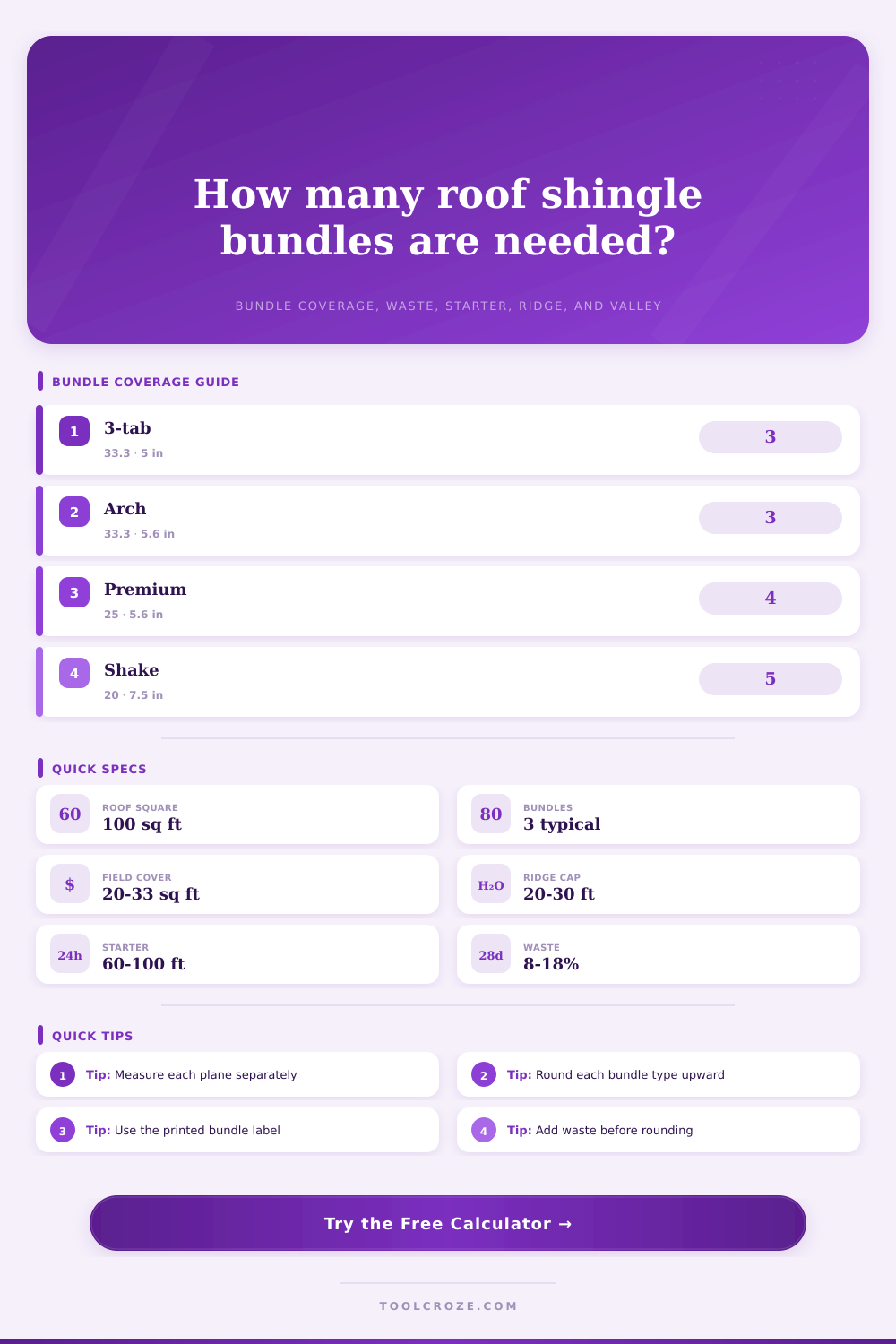
| 3-tab asphalt | 33.3 sq ft | 5 in | 3 bundles |
| Architectural laminate | 33.3 sq ft | 5.625 in | 3 bundles |
| Premium laminate | 25 sq ft | 5.625 in | 4 bundles |
| Metric laminated | 32.8 sq ft | 5.625 in | 3.05 bundles |
| Wood shake style | 20 sq ft | 7.5 in | 5 bundles |
| Slate-look shingle | 25 sq ft | 6 in | 4 bundles |
⌂Roof Plane And Pitch Factors
| Pitch | Area Multiplier | Best Use | Planning Note |
|---|---|---|---|
| 2/12 to 3/12 | 1.014 to 1.031 | Low slope | Confirm shingle rating |
| 4/12 to 5/12 | 1.054 to 1.083 | Walkable roof | Typical layout waste |
| 6/12 to 8/12 | 1.118 to 1.202 | Medium pitch | Measure ridge lines |
| 9/12 to 12/12 | 1.250 to 1.414 | Steep roof | Add handling allowance |
| 14/12 plus | 1.537 plus | Very steep | Verify access method |
🧱Accessory Coverage Reference
| Accessory | Common Coverage | Measured From | Calculator Treatment |
|---|---|---|---|
| Starter strip bundle | 60 to 100 lin ft | Eaves plus rakes | Rounded separately |
| Ridge cap bundle | 20 to 30 lin ft | Ridges plus hips | Rounded separately |
| Valley shingle allowance | 0.4 to 0.8 sq ft per lin ft | Valley centerline | Added to field area |
| Underlayment roll | 216 to 432 sq ft | Total pitched area | Rounded by roll |
| Roofing nails | 320 to 480 per square | Adjusted roof squares | Rounded to boxes of 720 |
🗂Layout Preset Data
| Preset | Plane Pattern | Main Focus | Waste Range |
|---|---|---|---|
| Small gable | 2 similar planes | Basic field bundles | 8% to 10% |
| Hip roof | 4 planes | More ridge cap length | 12% to 15% |
| Complex valley | 6 to 8 planes | Valley allowance | 15% to 22% |
| Premium laminate | Any plane count | Lower bundle coverage | 10% to 18% |
| Wood shake style | Wide exposure | More bundles per square | 12% to 18% |
💡Coverage Tips
How many bundles do I think will be needed? How many bundles? It’s hard to tell until you break the roof down into its true form. A roof consist of sloped surfaces meeting at ridges and valleys. At each intersection is waste, and each cut is scrap. Estimating that scrap before purchasing materials can save you from running short when your crew starts on the roof. This is where an accurate calculation become important.
When you enter in your size, calculator does the math for you. No more guessing with coverage coefficients. First thing you do is select which shingle you’ll be using. There’s a big difference between standard three tab and architectural laminate. Architectural laminates are thicker and heavier then standard three-tab shingles, which means they cover less area per bundle. On average an architectural bundle will provide thirty-three square feet of coverage. However some of the premium heavy duty products may only give you twenty-five. This is a big difference when you have a large roof, as it affects how many bundles you need. It is a small detail but it determines your overall volume.
How to Count Your Shingles
The math gets trickier when considering the roof pitch. If you have a home whose roof has more surface area than its own footprint (a typical scenario), then your shingle length increase as it goes down from eave to the ridge. This means you’ll use more material and must incorporate this slope multiplier into your calculations. When you choose your rise over run, the tool adjust accordingly. It will also include waste allowances based off the roof’s complexity. You may only waste ten percent if you have a simple gable roof. However, multiply that number by three or four if you are dealing with a hip roof with numerous dormers, where waste can reach up to fifteen or even eighteen percent. This difference should of not been overlooked when budgeting.
Don’t overlook the framing elements that surround the main field. Eave starter strips block both water infiltration and wind uplift under the roof. Plane-to-plane peak caps closes off the highest points of structure. These elements are also measured in linear feet; each must be accounted for separately. Don’t cut your field shingles into little bits because you thought about these things afterward. Order special bundles of ridge cap and starters up front: it’s easier and neater. The chart shows how it break down by standard coverage rates.
Shingle underlayment goes under your shingles and helps protect the deck from rain that could be blown up under the shingles while you’re installing them. Make sure you have enough rolls for the whole roof (including overhang) on the pitched part. Nails are also important but often overlooked. Hundreds of nail go into one square of roofing. If you run out of a box in the middle of the job, you have to stop. You can buy a few extra boxes as cheap insurance.
That’s where I’m going to take you. You will go from guessing to knowing and from a hunch to precision. You know exactly how many bundles will go on the peaks, on the edges and in the field. You know you have enough without having to store too much and without wondering if you’ll be two bundles short when it comes down to it. The result is that you’re confident about what you do. You plan well. You cover the roof right the first time. Then you can sit back and enjoy your house. And that’s the value of getting the numbers right before picking up the first bundle.