Round Slab Concrete Calculator
Estimate concrete volume for circular slabs with thickened edges, shallow center depressions, waste allowance, bags, cubic yards, and a practical ring-and-radial rebar layout.
◎Round Slab Presets
⚙Slab Inputs
Round Slab Estimate
📊Current Material Grid
📐Concrete Reference Tables
| Round Slab Use | Typical Diameter | Main Thickness | Edge Detail | Waste Range |
|---|---|---|---|---|
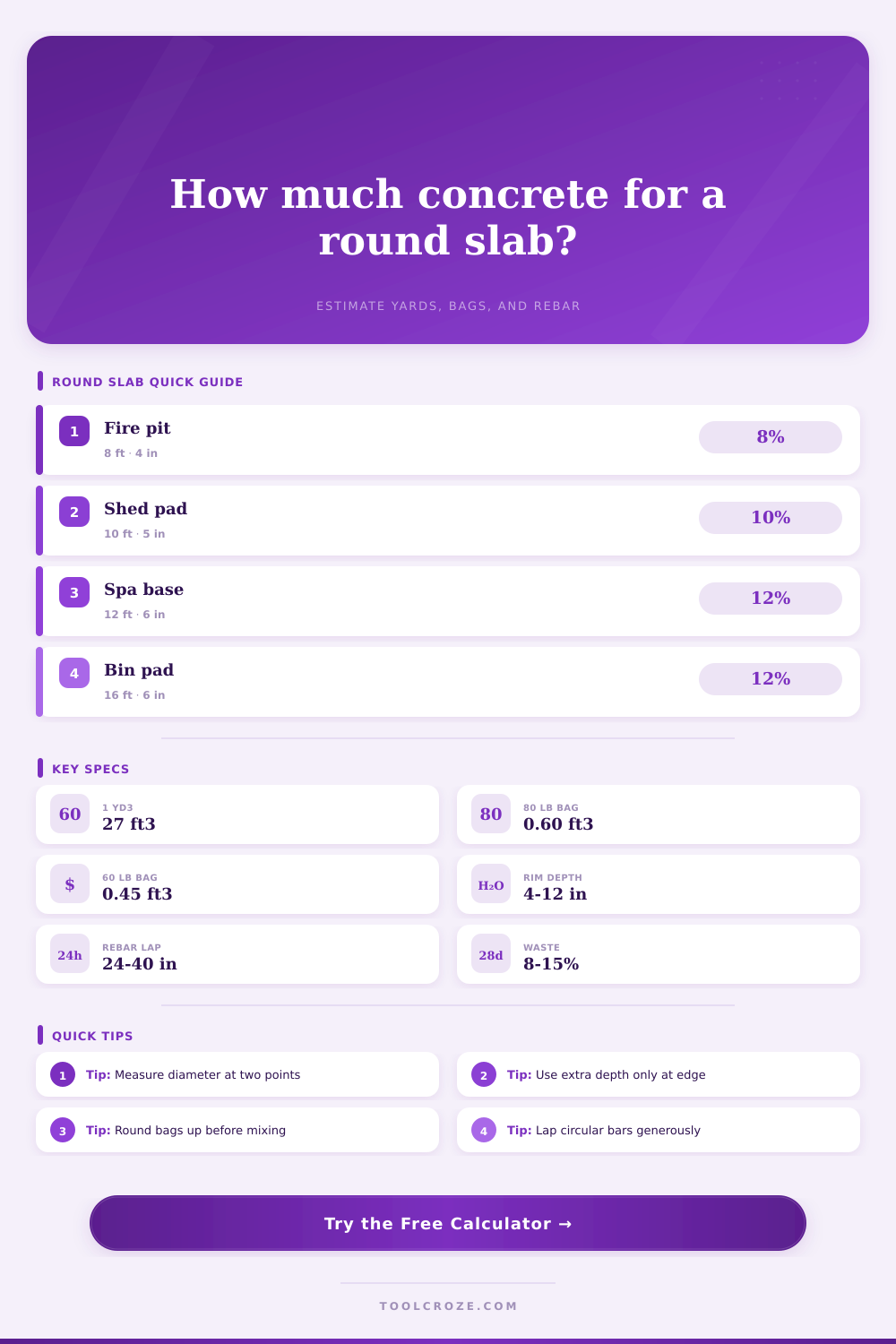
| Fire pit seating pad | 8 to 12 ft | 4 in | None or 8 in rim | 5% to 10% |
| Small shed base | 8 to 12 ft | 4 to 5 in | 8 to 12 in rim | 8% to 12% |
| Hot tub or spa base | 10 to 14 ft | 5 to 6 in | 12 in thickened rim | 10% to 12% |
| Gazebo foundation | 12 to 18 ft | 5 to 6 in | 12 to 18 in rim | 10% to 15% |
| Tank or bin pad | 14 to 24 ft | 6 to 8 in | 18 to 24 in rim | 10% to 15% |
| Bag Size | Approx Yield | Bags Per yd³ | Best Use |
|---|---|---|---|
| 40 lb bag | 0.30 ft³ | 90 bags | Small patches and posts |
| 60 lb bag | 0.45 ft³ | 60 bags | Short walks and small pads |
| 80 lb bag | 0.60 ft³ | 45 bags | Common DIY slab work |
| 90 lb bag | 0.75 ft³ | 36 bags | Fewer bags where lifting is okay |
| Rebar Layout | Typical Spacing | Ring Bars | Radial Bars | Notes |
|---|---|---|---|---|
| Light patio | 24 in | 2 to 3 rings | 6 to 8 | Use chairs to hold cover |
| General slab | 18 in | 3 to 5 rings | 8 to 12 | Lap rings at least 24 in |
| Heavy equipment pad | 12 in | 5 to 8 rings | 12 to 18 | Confirm with local design |
| Thickened edge | 12 to 18 in | Extra edge ring | Match slab grid | Keep steel inside cover |
| Formula Item | Formula | Unit Used | Calculator Role |
|---|---|---|---|
| Circle area | pi x radius² | ft² | Main slab surface |
| Main volume | area x thickness | ft³ | Base concrete amount |
| Edge ring | outer area - inner area | ft² | Extra rim volume |
| Depression | depression area x depth | ft³ | Volume deducted |
💡Round Slab Tips
When planning a round concrete slab, it sounds easy enough, until you have to think about geometry. After all, rounding off the corners of a rectangle isnt making it a circle. That means that rebar placement differ. Volume measurements differs. The amount of waste needed change. Perhaps you’re doing this as part of constructing a grain bin, or maybe a hot tub base. Maybe it’s a fire pit in your back yard. In any case, the math of a round slab footing differ from typical square footings.
Once you input your own dimensions into the calculator above, it’ll do the work for you. No more guesswork about area conversions and coefficients.
Key Tips for Building a Round Concrete Slab
The first thing most people get wrong: They mis-scope the thickness of the edge. Typically, you want a reinforced rim on your slab. Why? This protect against crumbly concrete where you walk and drive heavy equipment. Because the concrete is thicker on the outside, it’s wider and deeper than the rest of the slab. How wide does that ring have to be? How deep should it extend beyond the slab? If you don’t account for that, everything may appear correct initially. Within a year, you might find uneven, cracked edges.
The calculator separate the volume of the slab from the volume of the ring (the edge). This ensures you won’t underorder for the important perimeter strength.
Another tricky part of the math is center depressions. Many spas and fire pit bases call for a depression in the center to accommodate spa equipment or a bowl. That’s a deduction from your overall concrete requirements. It is not an addition. Measure the depth and then diameter of that center dip. That volume gets deducted by the calculator from the gross total. It is a little something that makes all the difference if you’re trying to save money and avoid waste. If you get that deduction wrong, you’ll be adding extra bags of dry mix to your garage.
The rebar layout differs for circles, too. Rather than a simple grid, you generally use concentric rings of rebar. Radial bars (like spokes on a wheel) cross through those rings. How tightly spaced those are determine the structure’s strength. Tightly spaced means heavier load capacity. Sometimes it’s down to every foot (twelve inches). A light patio may be able to get away with every two feet (eighteen or twenty four inches).
The calculator estimates how many stock length bars you’ll have to use. This allows you to plan for laps and cuts. Circular layouts require generous overlap at rebar ends. It provides continuity around the curve.
And then there’s the intrusion of reality on the pure world of perfect geometry: There’s no such thing as a perfect form. There’s no such thing as a perfectly level subgrade. You’re going to drop some concrete in the process. The underlying soil isn’t going to be perfectly compacted so you’ll lose some to it, too. Realistically, eight to fifteen percent is the kind of waste allowance you can expect. This is not pessimism. This is practicality.
The table on this page shows common ranges for expected wastes by type of project. These are your baselines; they let you adjust up or down depending on the conditions at your site. Use the high end if your ground is rough, use less if your forms are snug-fitting and your base is perfect.
What about material? For bigger slabs, it’s best to buy ready-mix by the yard. When doing smaller projects, it’s usually bagged concrete. How much does an 80lb bag make? It makes about.6 cubic feet. So it helps you figure out exactly how many bags you need to haul.
Now, mixing little bits at once is pretty laborious. At that point, consider calling in the small truck if your calculator says you have over ten or fifteen bags. It gives you both choices. Compare cost, time, then decide.
The concrete contract during curing. It expands and contracts with temperature fluctuations. And those forces is concentrated on the edges of a round slab. That’s where that wide rim comes into play. That’s its belt-and-suspenders function: keeping the middle intact. It resists the outward forces. If not for it, the narrow outside rim want to splinter, crack, and spall off. This reveals the aggregate and compromises the integrity. It works for a reason. It’s a false economy to skip it.
It all comes down to balance. Making a round slab involves material science, geometry, and good practical site prep. Your target is given by the numbers. How well it goes depends on how much care you put into the details. Soil compaction matters. Form building needs to be tight. Steel placement matter. Math is the easy bit. Everything else is careful work. That’s what will make the circle stay both strong and round for years to come.