Post and Rail Fence Calculator
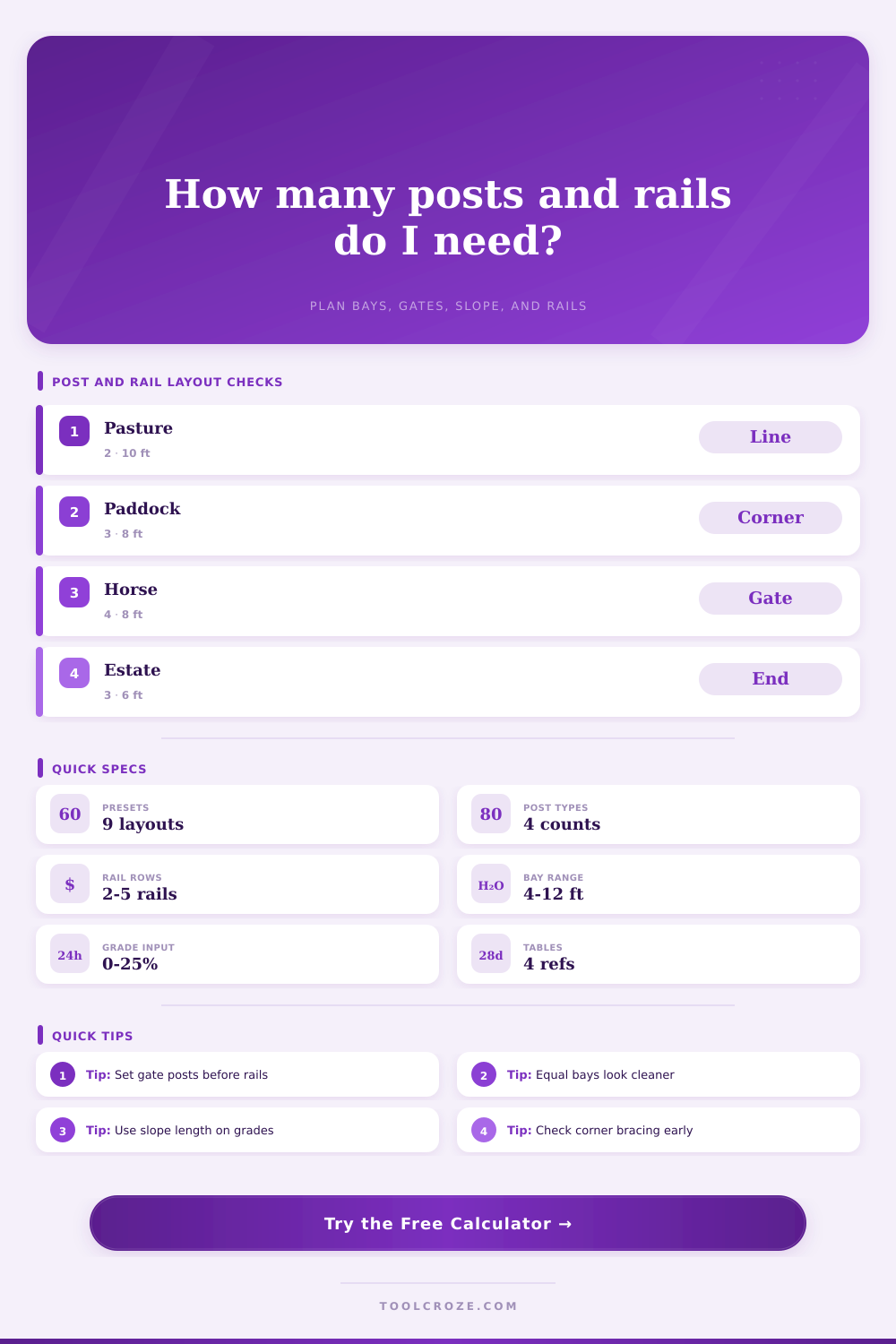
Estimate rails, post counts, equalized bay spacing, gate breaks, slope adjustment, and rail purchase length for a cleaner post-and-rail layout.
| Style | Common Rails | Usual Bay | Typical Use |
|---|---|---|---|
| 2-rail split rail | 2 rails per bay | 8 to 10 ft | Decorative boundary and garden edges |
| 3-rail pasture | 3 rails per bay | 8 to 10 ft | Rural line fence and general pasture |
| 4-rail horse paddock | 4 rails per bay | 6 to 8 ft | Horse areas and tighter containment |
| 3-rail estate | 3 rails per bay | 6 to 8 ft | Drive fronts and visible property lines |
| 5-rail livestock | 5 rails per bay | 5 to 7 ft | Smaller animals and high-pressure corners |
| Post Type | Where It Appears | Count Logic | Layout Note |
|---|---|---|---|
| Line post | Between terminal points | Total bays minus layout runs | Created by equalized bay spacing |
| End post | Open run ends | User-entered end posts | Usually two for a straight fence |
| Corner post | Direction changes | User-entered corner posts | Each corner starts a new rail run |
| Gate post | Both sides of gate | Two posts per gate opening | Gate width is removed from rail length |
| Average Grade | Slope Factor | Rail Effect | Planning Note |
|---|---|---|---|
| 0% | 1.000 | No added run length | Use normal center-to-center spacing |
| 5% | 1.001 | Small added length | Still useful on long lines |
| 10% | 1.005 | About 0.5% more | Round rails up before ordering cuts |
| 15% | 1.011 | About 1.1% more | Check step-down appearance at posts |
| 25% | 1.031 | About 3.1% more | Shorter bays may align better visually |
| Stock Rail | Good Bay Target | Gate Opening | Best Use |
|---|---|---|---|
| 6 ft rail | 5.5 to 6 ft | 3 to 5 ft walk gate | Decorative or tight curves |
| 8 ft rail | 7.5 to 8 ft | 4 to 6 ft walk gate | Most paddock and estate layouts |
| 10 ft rail | 9 to 10 ft | 10 to 12 ft drive gate | Open pasture runs with fewer posts |
| 12 ft rail | 10 to 12 ft | 12 to 16 ft equipment gate | Long rural lines with stout rails |
Tape and stakes is how most folks begin to fence. Measure distance around. Figure out number of sections based off your spacing. Then, we goes to the lumber yard.
By third post, that confidence is gone. The final bay doesn’t add back up to even. Or maybe there’s a seven-foot gap from previous post to the corner post. Or perhaps you have a four-foot stub for a rail at gate opening.
How to Plan Your Fence
Plug in your fence line length and space you want between them. Let the calculator do the math. You won’t have any more headaches forcing straight lines on crooked ground, it evens all the bays so they end neatly.
What kind of fence? What is your containment strategy? Do you want a property-line marker or an anti-deer barrier? That’s a two-rail split rail; contain cattle or horses? That’s something else… Height and distributing pressure. Is it pasture fencing? It is a heavy-duty livestock barrier.
The reference table spells out typical configurations from simple, lightweight three-rail pastures to strong five-rail livestock barriers. The key input are the number of rails per bay. Going from a two-rail to a four-rail configuration doubles your material costs and shifts the load on each post. Don’t expect the same post spacing for a two-rail fence that you would use for a four-rail one. The leverage go up, the demand on the soil with it.
Slope is a budget killer because it changes how much rail you actualy need. The other thing most folks do (homeowners) when they measure out their fence line is they measure horizontally. They don’t consider the rails will have to accommodate the rise and fall of land. If the land has any roll at all, you’ll need more rail than simply measuring post-to-post, horizontaly.
This tool includes a slope factor according to the average grade. On the low end, a five-percent grade will add virtually nothing to your material list. On the high side, a twenty-five-percent grade will bump your rail up about three percent. Doesn’t seem like much. But on a long run along a pasture, that additional percentage could of what sends you home empty handed or with an extra thirty feet of rail. A little thing, but when you’re standing in the mud waiting on a delivery…it’s a big deal.
One common failing point are gate posts. People treat them like line posts, digging them two feet deep and hoping for the best. All the tension in the fence line is concentrated at gates. They must be heavily cross-braced or braced with concrete. This helps them holds up under the swing weight and pressure from animals trying to push into them.
The calculator identifies gate posts as separate from line posts in its output. There are two post per gate opening. Where you set them will determine if your bays remain symmetrical. Set those first and then rest of the line flows naturaly towards them.
Embedment depth affects how deep a post goes. For wood posts, bury one third of the post length (or two and a half feet minimum), as per the standard rule of thumb. If your soil is rocky or sandy, the tool will allow you to change the embedment depth. The smaller your soil, the bigger diameter your post needs to be (or the wider your post hole) to achieve same holding power.
The waste percentage input accounts for possible cut errors, such as splits in rails, and it is better to have a buffer than not enough. In a word, safety. Ten percent is a healthy margin if your line is straight. If you’re working around an irregular surface or curve, up the number. Ordering just a bit more rail then the bare math requires protects you from having to stop at home center at 5 p.m. It happens on a Friday.
This is really the work part. Digging holes and hammering posts isn’t all there is to it; that’s the physical labor, but planning it out on paper is what makes or breaks how well furnitures come together. Plan ahead to account for the slope and the gates, and space your bays equally. This way, you avoid having to make a jillion little adjustments as you go along. It makes for a smooth installation instead of a series of chaotic changes.
The idea is to have an intentional-looking fence. Measure twice, calculate once, and dig with confidence. Taking the time to get the spacing correct before the first post goes in is often the difference between a good fence and a great fence.