Wood Fence Post Spacing Calculator
Lay out straight runs, corners, gate openings, adjusted even post spacing, panel fit, rails, and brace counts before marking the fence line.
Fence spacing result
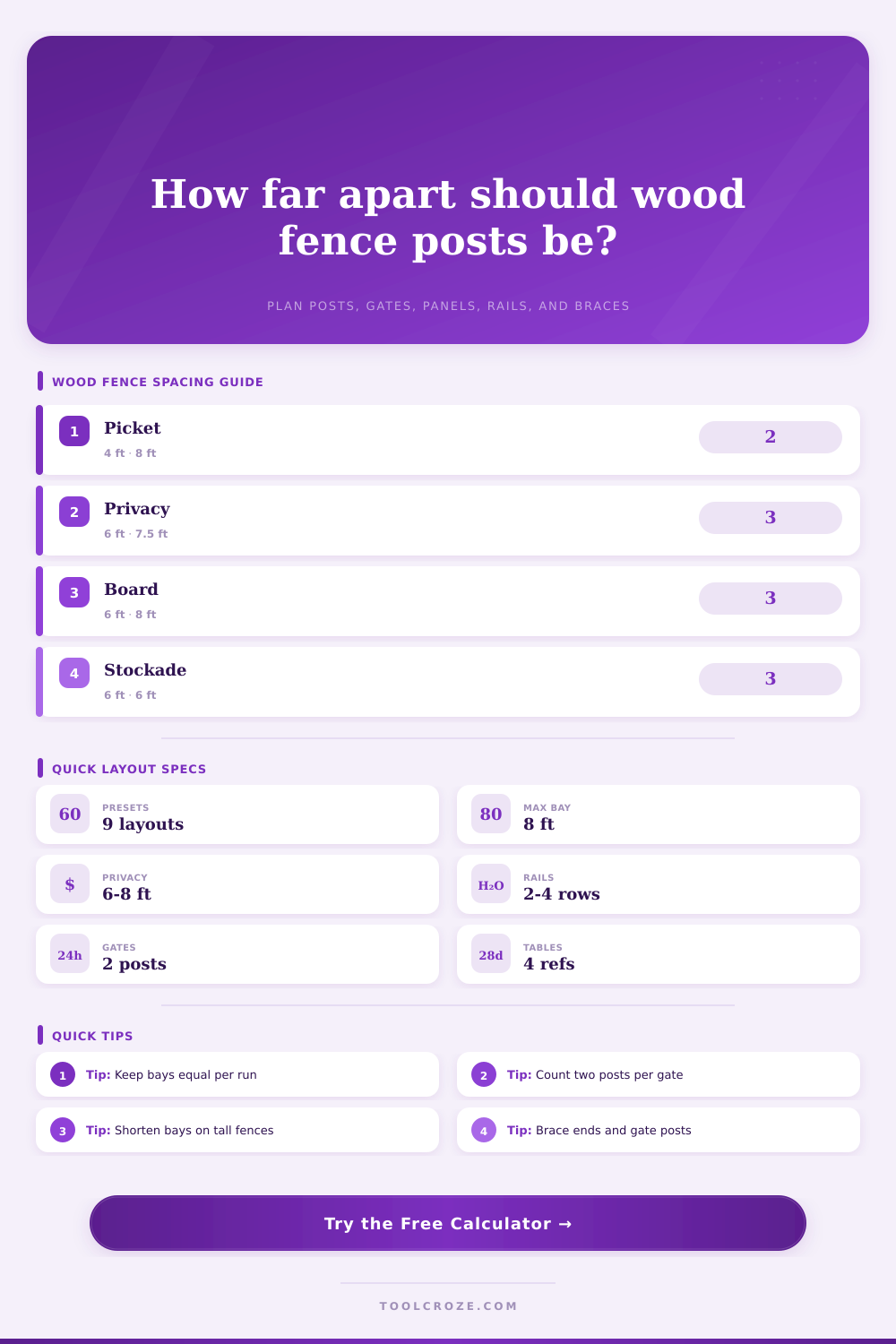
| Fence type | Typical height | Target spacing | Rails per bay | Use note |
|---|---|---|---|---|
| Wood picket | 3 to 4 ft | 6 to 8 ft | 2 | Good for open front yards |
| Privacy board | 6 ft | 7 to 8 ft | 3 | Keep spacing shorter in windy sites |
| Board-on-board | 6 to 8 ft | 6 to 7.5 ft | 3 to 4 | Heavier infill needs tighter bays |
| Shadowbox | 5 to 6 ft | 6 to 8 ft | 3 | Balances both faces of the fence |
| Stockade panel | 6 ft | 6 ft | 3 | Match the manufactured panel width |
| Split rail | 3 to 4 ft | 8 to 10 ft | 2 to 3 | Use wider spacing only for open rail fences |
| Post location | Count rule | Common post | Brace need | Layout check |
|---|---|---|---|---|
| Run end | One at each terminal | 4x4 or 6x6 | Usually yes | Mark before line posts |
| Corner | One shared turning post | 4x4 or 6x6 | Yes | Keep both runs square |
| Gate opening | Two hinge/latch posts | 6x6 preferred | Yes | Deduct clear opening from fence length |
| Interior line | Bay count minus terminals | 4x4 | Usually no | Use adjusted even spacing |
| Heavy wind bay | Add intermediate braces | 4x4 or 6x6 | Every third bay | Shorten spacing before adding height |
| Panel width | Best bay range | Trim behavior | Rail count | Best match |
|---|---|---|---|---|
| 6 ft panel | 5.5 to 6 ft | Low trim when bays equal 6 ft | Bay count x rails | Stockade and pool screens |
| 7 ft section | 6.5 to 7 ft | Moderate trim on long runs | Bay count x rails | Board-on-board and shadowbox |
| 8 ft panel | 7 to 8 ft | Common full-panel planning width | Bay count x rails | Privacy and picket layouts |
| 10 ft rail span | 8 to 10 ft | Use only for open rail fences | Bay count x rails | Split rail boundaries |
| Preset | Length | Runs | Gates | Target spacing |
|---|---|---|---|---|
| Backyard privacy | 120 ft | 3 | 1 | 8 ft |
| Front picket return | 72 ft | 2 | 1 | 7.5 ft |
| Corner lot wrap | 180 ft | 4 | 2 | 7 ft |
| Split rail boundary | 240 ft | 2 | 0 | 10 ft |
| Dog run enclosure | 48 ft | 4 | 1 | 6 ft |
Plan your fence layout before purchasing your posts. That’s right, most of us buys our materials first and then figure it out! This results in a lopsided fence or a gate that doesn’t fit. Or we has leftover materials. The real work begin before you start digging.
If your yard isn’t level you want your fence to have steady rhythm, even though it’s uneven. This page do the math for you. Just plug in number of gates, the number of corners, and the overall length. It calculates how many posts you’ll need so you don’t have to guess how many intermediate post to use. It even lets you know if your bays is too large to use with the rail that you want to purchase.
How to Plan Your Fence Layout
Below is a breakdown of typical post spacing by fence types. Generally speaking, privacy fences require a smaller space; about seven and a half feet. That will prevent sag in wood in high winds. Picket fences can be wider since the infill material are lighter so they don’t need as small a bay. Split rail fences is even wider. The weight doesn’t all hang off the rail, which makes for longer lasting fences.
Consider terminal posts when plugging in your numbers. That’s ends, corners and hinges on gates. They sees the most stress. The calculator presumes they’re braced. If you’re building in a windy location, you may wish to change the brace rule found under settings. Standard bracing covers the bases. In heavy wind conditions, you may need intermediate supports every third bay. This is where most folks fall down; they don’t notice it until the fence begins to lean.
The most common failure point are gates. This tool asks for your gate count and average opening width. It subtracts this from total run length. It then divides out the bays so you don’t get a super skinny piece at one end or another. Why? Because you want equal spacing. It’s professional, and it simplifies installing the panels.
The calculator lets you know how many pre-made panel will fit. How much trimming may be required. It gives you an allowance for a waste factor. Smart, since cuts aren’t perfect, and wood expands and contracts. It will then give you a total post count. That’s all terminals plus line posts. And it will tell you exactly what the even spacing should of be between posts for that particular layout.
If the number seems too short, don’t force the spacing. Instead, try lowering the number of bays if the structure permit. Shorter spans is better for taller fences. The higher they get, more the posts need to carry weight. A four foot picket fence does not require as much support than a six-foot privacy wall. The presets reflect this in the calculator. Load one for a pool screen or a backyard privacy run. Then you can see how numbers change. It’s a fast way to try out different scenarios without doing math yourself.
No, site conditions aren’t on the spreadsheet. No, it doesn’t tell you when you’ve hit a rock. No, it won’t tell you when the frost line is deeper then average. Yes, you still have to call before you dig. And yes, you should get to know your local codes. But the tool provides a good baseline. It brings your chaotic yard to a measurable grid.
Walk the line, then mark the terminals. Divide up what’s left over. The rhythm should feel right as you go. A straight fence is satisfying. It’s an even mark and it lasts longer over time. A fence is a permanent boundary or it’s just a temporary fix. And all that requires is getting spacing correct. The calculator will do that math for you (above). That way, you’re free to worry about what’s fun. You can watch how the line comes together. You can stain the wood. That is the fun stuff. Begin with the posts. Get the beat right. Then the rest follows.