
How many times do you reach for a low-cost plastic ruler? They snaps in half, they bend out of shape and the ink washes off fast.
A wooden rule remains on the bench of serious craftsmen. Why? Because wood is durable and has a warmth that plastic lacks. But even more important: The proper wooden tool will prevent you from making costly errors down the road.
Why You Need the Right Ruler
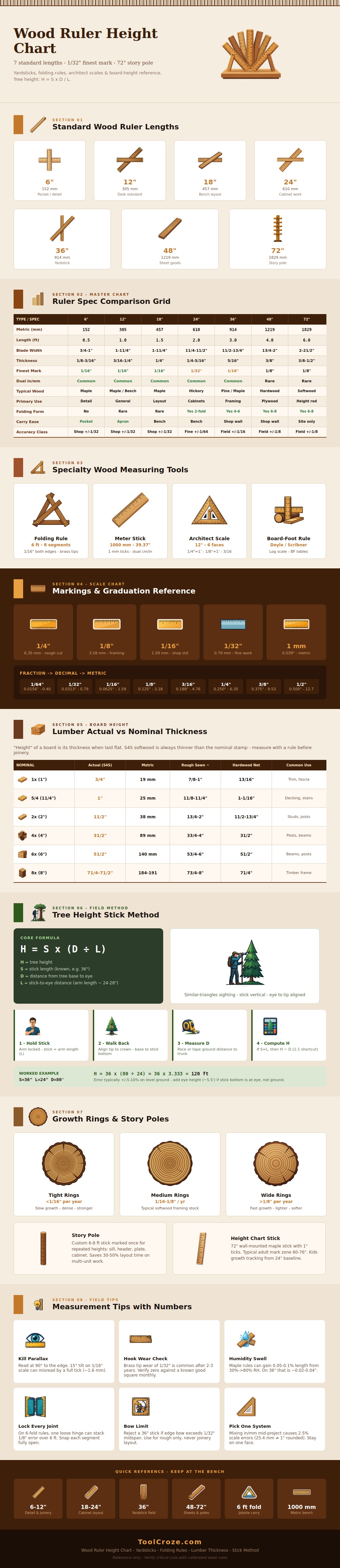
The infographic above show which length to use for each task. That way when purchasing your new tool, you don’t guess.
A ruler is A RULER. Or so most folks believe. Wrong.
There’s a difference between a six-inch pocket rule used for detail work (to fit in tight spots and read less then 1/16-inch fractions) and a thirty-six-inch yardstick meant for rough layout on flooring or framing jobs. The latter will span the distance across a typical step.
The chart points out that as stick length increases, so does blade thickness and width. Thicker blades holds their shape better against bowing. An easy test: does your yardstick bend in half? Then you’re measuring wrong already. You’ll draw marks on wood with inaccurate information. Noticing something? Those best marks is typically on the short ones.
The twenty-four-inch cabinet maker’s rule often has 1/32-inch markings. It is not so important on a seven foot story pole. What is a story pole? It is a long stick (pole) with certain heights marked out for your jobsite. These are the heights where you mark your window header or sill plate. Punch a hole or make a mark at each height. Use that stick to mark those holes over and over throughout the house. It takes half the layout time since you don’t have to measure out from scratch anymore. Just pick up your pole and go. Old school but it works every time.
There’s also lumber thickness, which our instincts fail at. Remember: Nominal sizes is nominal. A two-by-four isn’t actualy two inches by four inches. After being planed and dried out, a two-by-four comes in more like 1.5 inches by 3.5 inches. Here’s how standard hardwoods and softwoods stack up against their nominal counterparts. Knowing what the difference is between actual and nominal size will save you some headaches when your joinery doesn’t quite match up. You’ll purchase a board believing that it’s an inch thick. Then, after cutting out your piece, you discover your cutout is too shallow.
We’re all advised to measure before we cut. This is more than just good advice; if you want your project to hold together, it is the only way to go.
There are some quirks in field measurements. For instance, trees are measured by their height with that stick thing. That’s easy. There’s an element of simple geometry involved. It assumes your arm length stay the same the whole time. And if you grasp the concept of similar triangles, it’s amazingly accurate. Basically you take a stick out at arms’ length and line it up with the tree. Then you step back until the stick measures how tall the tree is. The distance you stepped back should of been about the same as the height of the tree. Seems like magic but really it’s just math in the real world.
Wood also behaves different depending on humidity. As seasons come and go, maple swells and shrinks. Even small variations in relative humidity will cause a rule to expand or contract slightly. This is normaly insignificant for rough work. For fine cabinetry it could be enough to make a drawer stick. Store your precision tools where the environment remains constant. Don’t store them in a damp basement or a hot truck. Take good care of your tools just as you do your materials.
But numbers aren’t all there is to measuring. There’s also trust. Trust that the mark on the rule matches the reality of the material. That’s where a good wood ruler kept straight and dry becomes reliable. It waits patiently back up on the bench for its next duty, reminding you that accuracy isn’t an accident but a habit.
Folks get hung up on the tool. The hand wielding the tool is the skill.
