
Maybe you get all excited and tug a lovely quilt out of machine. It is as if you have pulled a crumpled potato chip off machine instead. The fabric puckers and twists, stitches are wonky. The thread snaps audibly.
Is it the machine? Is it the fabric? Are your hands at fault? No, no, no. Mostly it is the thread on the spool.
Why Thread Weight Matters for Sewing
Home sewists don’t think about thread weight until we remember to ask ourselves: What kind of thread should I use? We get hung up thinking about stitch length and type of needle. We forget that thread IS the main support of the seam. Forget about thread weight and whole garment collapses.
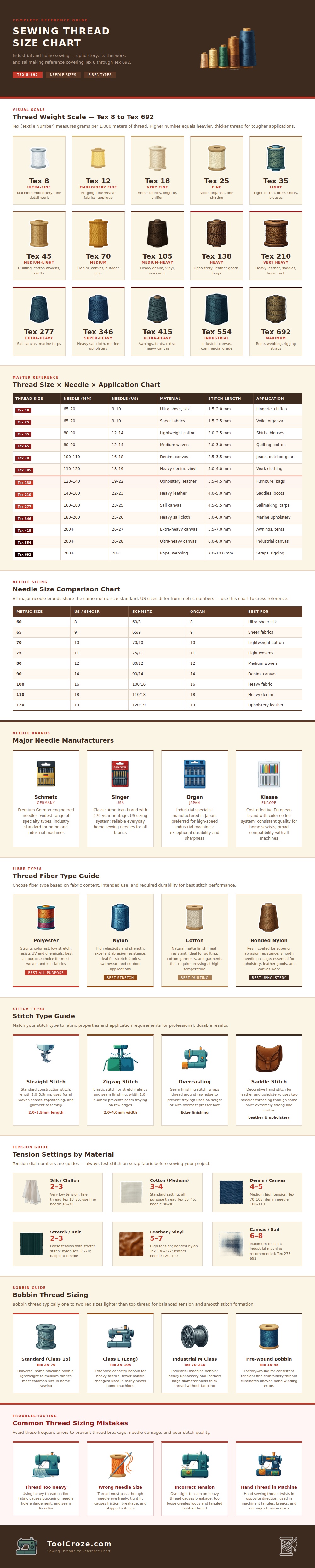
Thread measurement makes sense too. They have a Tex system which measure the weight in grams of one thousand meters of thread. The higher the number, the heavier (thicker) than the thread. Lower numbers indicate finer threads. And it’s a direct scale.
Take a fine Tex 8 thread, barely visible to eye. Ideal for delicate embroidery. On the opposite end of range, a Tex 692 would be more suitable for marine rigging. Rope-like!
Knowing this scale allow you to approach your project correctly. It removes the guessing. You can view a heavyweight denim coat and realize that no lightweight Tex 40 thread will suffice. When tightened, it will snap. Something substantial are required.
So what do these needles go to? What size thread goes on each needle? Here’s the breakdown in a handy chart.
You can see by the chart above that certain needle sizes relates to certain thread weight. Why? Because if your needle eye is too small for the thread you’re using, it will create drag as the thread passes through material and literally burn the thread. That burn weakens the fiber and next thing you know, it breaks right there.
You’ll notice that with heavier upholstery threads, you can’t get away with just any old needle from around house. You need a good heavy duty needle, sometimes an 80, 100, 120 or even larger! You need one to allow those thick thread to slide easy through canvas or leather. No sense wasting time trying to learn this way…just refer to the chart above and understand how the two work together.
So what’s more important? Weight or fiber?
The polyester is the sewing industry work horse. It’s colorfast, strong, and can take a little give.
The cotton is lovely if you’re quilting. It has a matte finish and can stand up to high heat pressing. But would you ever use cotton thread for a leather bag? No way. Not abrasion resistant at all.
For durability you want bonded nylon. Why? Because it is coated with resin that allow it to glide easy when passing through rough material.
A swimsuit needs elasticity. A winter coat needs warmth and weight. If you need something that stands up to the elements like rot and UV damage, choose a sail.
The last part of equation is tension. Your machine’s dial isn’t gospel. Always try out on scrap fabric. Silk requires light tension like 2 or 3 on the dial because it has finer thread. Leather needs heavier tension, perhaps six or eight. If the tension is off, the thread loops or breaks. It is just a balancing act.
Usually the bobbin thread should of been slightly lighter than the top thread so that it creates a balanced seam in between layers of fabric. If both are heavy, the seam becomes bulky and stiff. Both fine doesn’t have any strength.
First, select the correct thread for your material. Match to the needle. Dial in the tension. And then stitch it up. What’s left? A long lasting, flat lying seam. No more break outs. No more puckering. Just a well done job.
That little spool on the shelf makes all the differance.
