
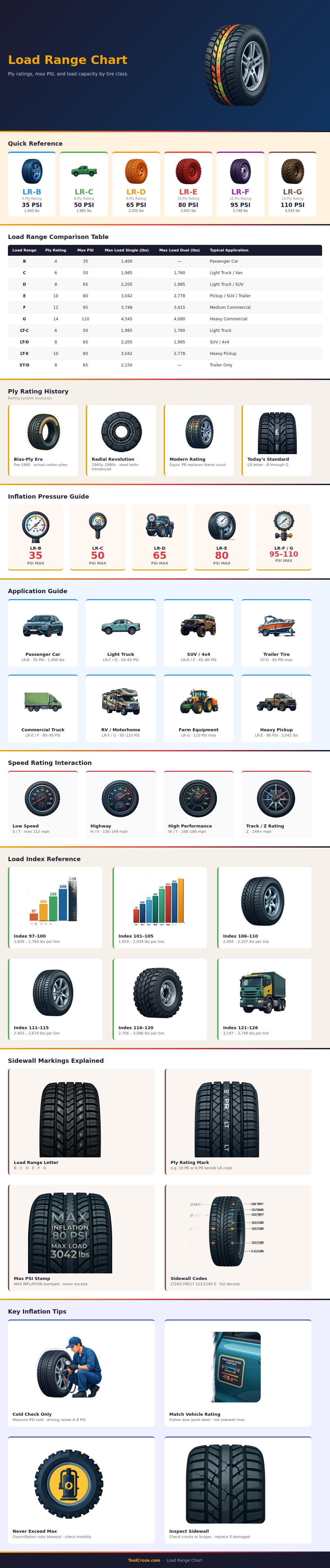
When you load your SUV down with gear, or hook up a trailer, you get anxious. Why? Because you’re not sure if your tires will support the load. It is not because they won’t fit in truck, but because you don’t want to have problems on side of road.
Most folks ignore tire specs. But single most important one for stability is its load range. The good news: you don’t need to be an engineer to figure it out. All you need to do is read the sidewall. You must know what numbers represent. This helps you head out on road safely.
Understanding Tire Load Ranges
How we got here is an accident of history. Originally, ply ratings was literally the number of fabric layers in the tire. If it was a six-ply tire, there were six layers of nylon or cotton. That made some sense when the tire was a bias-ply tire.
Radial tires came along and changed everything. They added steel belts that increases strength while not increasing fabric layers. They retained the old names and used them to tell the customer how strong their new radial tires was. A Load Range E tire today doesn’t have ten fabric layers. It’s just strong enough to replace a 10-ply bias tire.
The letter codes on the chart from B to G adapt old standards to moddern technology using pressure limits and weights. Because you can’t tell how strong a tire is just by examining one. On the shelf, a Load Range C tire appear exactly like a Load Range E tire. But they are built different inside.
A Load Range C will support about two thousand pounds per tire. An E range will exceed three thousand pounds. When towing a small camper or a fully loaded pickup, that makes a big difference.
Look at the infographic, which illustrates each level of capability from passenger car ranges all the way up to heavy commercial duty. Each increment of the letter grade increase both weight capacity and possible inflation pressure. Pick the right capability for your vehicle.
This is where many drivers go wrong when selecting a rating. They think if they can get the tire to fit rim, it’s fine. That’s wrong! You need to use the load range of the tire to match what your vehicle manufacturer have said.
Don’t select by how soft you want the tire to ride. A high-load-range tire will blow out fast on road because you’re under inflating the tire. The sidewall gets hot and the heat make the rubber weaker. Do not put more than the max PSI listed on the sidewall. And don’t go lower then the min needed to carry true load.
Related factors include speed ratings and load indexes. Load index reflect how much weight the tire is rated for at one speed. Some high performance tires with a Z rating might have lesser load capacity. They are built for speed, not to carry weight. So that’s where you balance those two requirements. If you have heavy duty truck then load capacity take precedence. Speed rating takes a back seat. That’s your pre-purchase trade-off.
Keep it simple and disciplined. It’s the best advice: Check your tire pressure with cold tires. Tires warm up when driven, increasing tire pressure readings. That could of mislead you. Cold gives you real deal. Read the placard on the driver’s side door jamb. Don’t go by max number on the tire. The placard indicates the number the vehicle was built to carry. Honor that number and know how to read the letter code on the sidewall.
Only the tires touch the road. Take care of ’em and they’ll do their job.
