
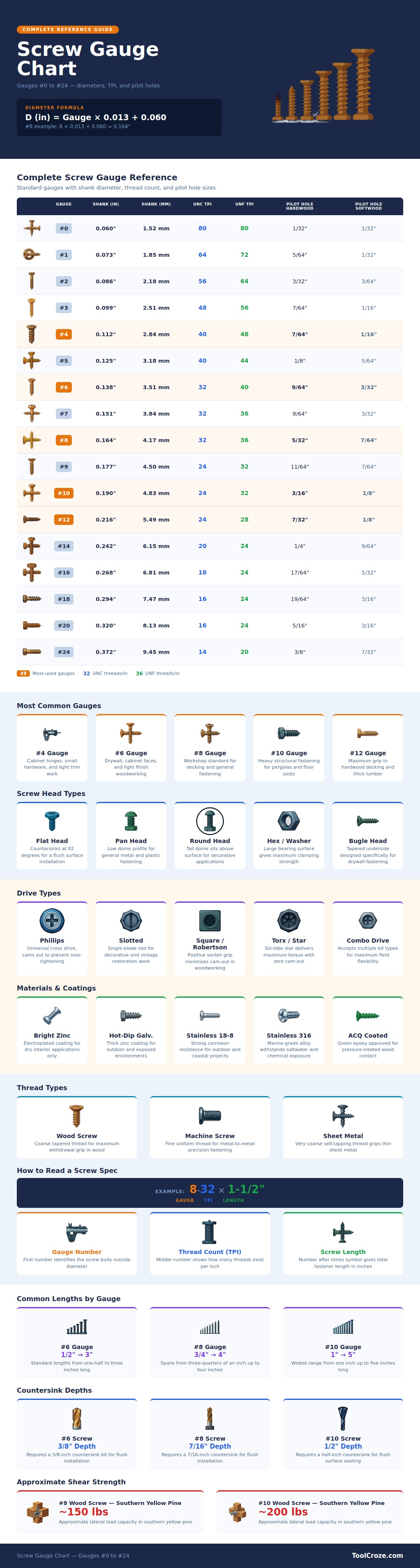
If you’ve ever been confused by all the sizes of screws on display at hardware store, you’re not alone. They don’t use a straight-line method for labeling, and their gauge numbers refers only to the shank diameter. That’s right, a number ten screw isn’t twice as thick as a number five; it’s just a bit larger. Each increase in gauge add a very specific, tiny fraction to the shank diameter which translates into an appropriate holding strength for whatever object you’re attaching.
The reason many builders opt for the number eight gauge is that it’s right in the range of other sizes. On the one hand it’s thick enough to hold a floor joist together, yet thin enough to drive into pine without pre-drilling. According to the data, that means they has a shank diameter of about sixteen hundredths of an inch.
How to Choose the Right Screw
When you step up to the number twelve, however, you’re getting into heavy-duty stuff: a coarser thread with a stronger grip. You’ll fail if your screw is too small for the job but also if it’s too big, splitting wood as it goes in. That’s just material reacting differant than the screw.
Don’t forget about thread count either. You’ll see things labeled on the package as UNF and UNC, which stand for unified fine and unified coarse. The fine has more threads to an inch (less thread depth) and they will bite into wood a little smoother. The coarse has less thread per inch, but they grab onto the wood a little harder because the threads is deeper. The wrong size thread count for your wood will make it perform poorly. Size your pilot hole to match the hardness of the wood and gauge of the screw. Softwoods can generally be screwed right in, whereas hard woods needs bigger pilot holes to avoid splitting.
What about the type of screw? Coatings makes a difference too. For instance, a shiny zinc finish may look nice on your shelves sitting dry in closet, but will rust if placed outside in the rain. For outdoor applications (and along coastal regions that can be hard on less expensive finishes), hot-dip galvanizing and stainless steel is really the only options.
Additionally, when it comes to head type: bugle heads are made for drywall, they sink without needing a countersink bit. It’s an added feature that also increases installation speed. But look at screws like a system. If I go back to the comparison of tools to screws, now you’re making your choice based off which tool does what for the task at hand. And that’s why the packaging has numbers on them. These characteristics include gauge, grip thread, bite coating, and lifespan.
When you understand this, then choosing makes sense. It’s not “what type of fastener should I use?”, but instead, it’s “what type of screw should I use?” and that changes everything. You should of realized earlier. Now you don’t guess, you calculate.
This mindset will help turn your weekend project into a solid, dependable construction. You know the right screw is handling the load. You don’t need to worry about it. Actualy, you’ll recieve better results.
